Destroying Angel
The destroying angel is the name given to several pure white, deadly Amanita species: Amanita virosa in Europe, Amanita bisporigera and Amanita ocreata in North America, and close relatives elsewhere.
🗓️ Last reviewed: August 2026
Overview
The destroying angel is the name given to several pure white, deadly Amanita species: Amanita virosa in Europe, Amanita bisporigera and Amanita ocreata in North America, and close relatives elsewhere. They contain the same amatoxins as the death cap and are just as lethal. What makes them particularly dangerous is their appearance. They are elegant, clean, entirely white mushrooms with no unusual features at all, and they look exactly like the generic idea of a wholesome mushroom that a non-forager carries in their head. This profile exists so readers can recognise and permanently avoid them. There is no safe preparation. Cooking, drying, freezing, and soaking do not remove the toxins.
Identification & Appearance
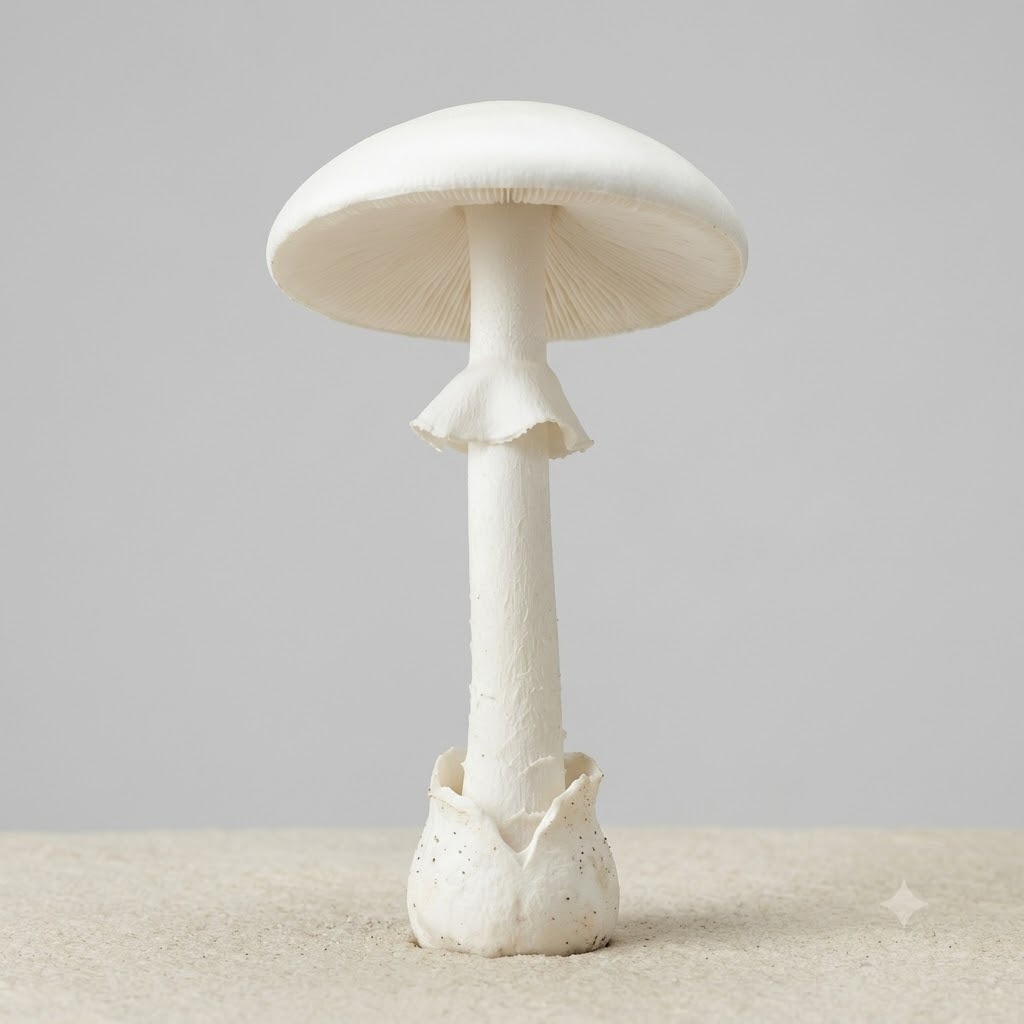
The cap is 5-12 cm across, pure white throughout, smooth, dry to slightly sticky, conical or bell-shaped when young and flattening with age, sometimes with a slightly irregular margin. Gills are white, crowded, and free of the stem, staying white at every stage. The stem is white, often shaggy or fibrous in Amanita virosa, with a fragile white ring high up that can tear away and vanish in older or rain-battered specimens, and at the base a membranous white volva, a sac-like cup enclosing the swollen base, usually buried in soil or litter. Flesh is white and unchanging. Spore print is white. Young specimens emerge as a plain white egg, and cutting one open shows the outline of a developing cap and stem inside.
Where It Grows
Destroying angels are ectomycorrhizal with broadleaved and coniferous trees, the European Amanita virosa favouring birch, beech, and conifers on acidic soils, the North American species associating with oak and other hardwoods. They fruit from summer through autumn in woodland, on heaths with scattered trees, in parks, and in gardens with mature trees. They are widespread across Europe, North America, and Asia. Poisonings often involve pure white mushrooms picked in a garden or park by someone who assumed white meant safe, or who was thinking of an edible white species from a different continent. Because the volva is buried, a specimen cut at ground level loses the single most important identifying feature.
Can It Be Grown
No, and no one should attempt it. It is mycorrhizal and not cultivable, and deliberately propagating a lethal species would be indefensible. If destroying angels appear in a garden used by children or dogs, remove the fruit bodies wearing gloves, seal them in waste, and wash hands afterwards, while understanding that the fungus itself lives on in the tree roots and will fruit again after rain. Do not compost them. The practical protection is knowledge: know which trees are on the ground children play on, check after warm autumn rain, and teach children never to pick or taste any mushroom.
Growing Conditions
Light
Not relevant to the fungus, which lives on tree roots and fruits wherever its host trees stand, including open parkland and garden lawns.
Watering
Fruiting follows summer and autumn rain, generally within one to two weeks. The peak risk period for accidental poisoning is a warm, wet spell in late summer and autumn.
Temperature & Substrate
Fruiting spans roughly 12-24°C from summer into autumn. The substrate is soil around living tree roots, particularly birch, beech, oak, and conifers depending on species and region.
Why It Is Not Food
Destroying angels contain amatoxins, the same class of toxin as the death cap, which shut down cellular protein synthesis and destroy liver tissue. A single fruit body can contain a lethal dose for an adult. There is no preparation that helps: amatoxins survive boiling, frying, drying, freezing, and prolonged soaking. There is no home test, no colour change, no smell, and no folk rule that distinguishes them from edible white mushrooms. The old advice about silver spoons, about animals eating them safely, about peeling caps, and about mushrooms growing in the open being safe are all false, and each has killed people.
Health & Poisoning Pattern
Poisoning follows the amatoxin course: a symptom-free interval of six to twenty-four hours, then severe vomiting, watery diarrhoea and abdominal pain, then a deceptive period of apparent improvement, then liver failure developing over the following days, sometimes with kidney damage. That false recovery is the reason victims are sometimes discharged from hospital and return critically ill. If anyone may have eaten a white gilled mushroom with a ring and a volva, go to an emergency department immediately, before symptoms begin, and bring any remaining mushroom material. Speed of treatment strongly affects outcomes. Do not attempt to induce vomiting or wait to see what happens.
Common Identification Traps
- Cutting the mushroom at ground level - this leaves the volva buried and destroys the key evidence. Excavate white-gilled mushrooms whole.
- A missing ring - the ring is fragile and often torn away by rain or handling in older specimens, so its absence proves nothing.
- Mistaking buttons for puffballs - always slice small white eggs in half; an Amanita button shows a cap and stem outline inside.
- Confusing them with field mushrooms - field mushrooms have pink then chocolate-brown gills and a dark spore print, and no volva. Destroying angel gills stay white forever.
- Assuming white equals safe - the opposite is closer to the truth in this group.
The Rule That Prevents This
Any mushroom with white gills, a ring on the stem, and a sac-like volva at the base belongs to the group responsible for nearly all fatal mushroom poisonings. Do not eat it, whatever else it looks like. Dig up white-gilled mushrooms completely, take a spore print, and never rely on a single feature. Beginners are far safer avoiding all white-gilled mushrooms with rings entirely, permanently, rather than trying to learn which ones are edible.
Best Suited For
- Learning to recognise, so that it can be avoided for life.
- Teaching the discipline of excavating the whole mushroom and checking gill colour.
Not food under any circumstances, for anyone, prepared in any way.
FAQ
How can something so plain be so dangerous? Because there is no warning in its appearance. It is clean, white, and pleasant-looking, and by report not unpleasant to eat. The danger is entirely invisible.
Is one mushroom enough to kill? A single fruit body can contain a lethal dose for an adult. This is not a species where quantity offers much margin.
What if the ring is missing? That means nothing. The ring is fragile and often lost. The volva at the base and the permanently white gills are the features that matter.
Never eat any white-gilled mushroom with a ring and a volva. Learn that combination and refuse it permanently. Have every wild collection checked by an experienced identifier before anything is eaten.
🪴 Foraging kit worth a look
Nothing here identifies a mushroom for you - identification stays with your field guides and local experts. These are simply the basics foragers carry.
Links go to Amazon or a partner store (such as Adagio Teas) and may earn us a commission at no extra cost to you. As an Amazon Associate we earn from qualifying purchases. We link gear types, not sponsors' picks: you choose the exact product.