Plants for the pond.
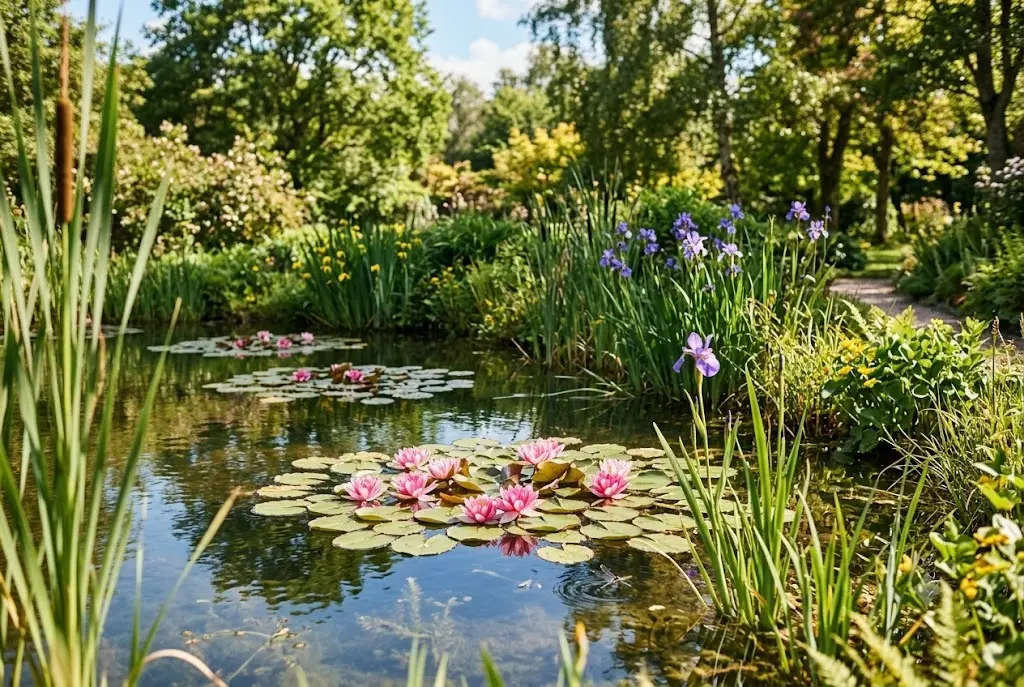
A healthy pond is planted in layers, from the shallow edge down to the deep middle. Get a plant into each zone - something at the margin, something floating to shade the surface, and oxygenators working underneath - and the water largely looks after itself, staying clearer and full of life. Here's what goes where.
Several popular pond plants - water hyacinth, water lettuce, parrot's feather, some waterweeds - are aggressive invasives that choke natural waterways, and are banned or restricted in many regions. Only buy plants legal where you live, never tip pond plants, water or trimmings into a stream, lake or drain, and compost or bin any surplus. When in doubt, choose a native species. Confirm what is legal with your local authority - we do not give legal advice.
Marginal plants (the shallow edge)
0-15 cm of waterGrown in shallow water or wet soil right at the pond's edge, marginals soften the rim, give wildlife cover and hide the liner. They are the plants that make a pond look like it belongs.
- Pickerel weed - blue flower spikes, loved by bees, very easy
- Yellow flag iris - bold; vigorous, so contain it or choose a native iris
- Marsh marigold - one of the first to flower in spring
- Cattail (reedmace) - classic, but spreads hard; use the dwarf kind in small ponds
- Sweet flag & corkscrew rush - grassy, architectural edge texture
- Arrowhead & water forget-me-not - arrow leaves and soft blue flowers
Floating & surface plants
roots in baskets or free-floatingLeaves that sit on the surface shade the water, which starves algae of light and keeps it clearer. Aim to cover roughly half to two-thirds of the surface through summer.
- Hardy water lily - the queen of the pond; wants still water and full sun
- Lotus - spectacular but needs heat and space; a big-container plant
- Frogbit & water soldier - small hardy floaters, great in wildlife ponds
- Water hyacinth - beautiful but a banned invasive in many regions - never release it
- Water lettuce - fast surface cover, also invasive and restricted in many places
Oxygenators (submerged)
fully underwaterThe unsung workhorses. Growing beneath the surface, they add oxygen, mop up the nutrients algae would otherwise feed on, and give fish and insects somewhere to shelter and spawn. Every pond wants a few bunches.
- Hornwort - rootless, fast, superb oxygenator; the easy default
- Elodea / waterweed - vigorous oxygenator (some species are invasive - check the type)
- Vallisneria (eelgrass) - ribbon leaves, good in deeper water
- Water starwort - fine feathery growth, tolerates cooler water
- Parrot's feather & milfoil - avoid; several are aggressive banned invasives
Deep-water plants
30 cm+ of waterRooted in the deepest zone with leaves reaching the surface, these anchor the planting and, like lilies, shade the water. In a small pond a single deep-water plant may be all you need.
- Water lily (deep-zone varieties) - the main deep-water plant for most ponds
- Water hawthorn - scented white flowers, and it works in part shade and cool weather
- Aponogeton - good for dappled ponds where lilies sulk
Bog & moisture-loving plants (the damp ground around it)
The soggy soil at a pond's margin, a rain garden or a boggy border wants plants that revel in permanently damp ground. Several garden plants we cover are perfect for it:
Planting is the last step - first comes the hole, the liner and the pump. Our build-a-pond guide walks through it, and the pond volume calculator sizes your pump and treatments.
Ponds and young children are a serious drowning risk - even a few centimetres of water is enough. Fence or cover a pond where small children have access, never leave them near it unsupervised, and think hard before building one. This is general planting guidance, not safety or legal advice.