Peace Lily (Spathiphyllum)
The peace lily (Spathiphyllum species) is an indoor plant with glossy, dark green leaves and showy white flowers (Clemson HGIC).
Last reviewed: November 2026
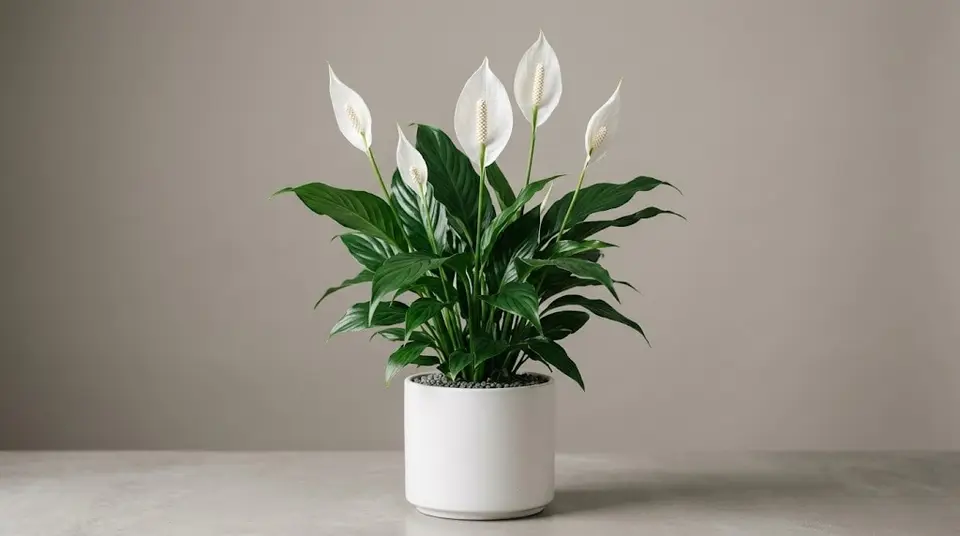 AI illustration
Overview
The peace lily (Spathiphyllum species) is an indoor plant with glossy, dark green leaves and showy white flowers (Clemson HGIC). Although it is known as a peace lily, it is not related to lilies and belongs to the arum family, Araceae (RHS), which also includes caladiums, elephant ears, anthuriums and callas (Clemson HGIC). Clemson HGIC calls peace lilies easy to grow and a popular choice for houseplants (Clemson HGIC), and NC State marks it as poisonous to humans and a problem for cats, dogs, horses and children (NC State Extension).
Origin & Natural Habitat
NC State Extension describes peace lilies as a group of about 60 species of semi-evergreen, perennial herbs, native to Mexico, tropical America, Malesia and islands of the western Pacific (NC State Extension); Clemson HGIC counts over 40 species, found in tropical regions, mainly in Central and South America (Clemson HGIC). The RHS says the plants grown as houseplants come from tropical forests in Central America and Colombia, so they need warmth and indirect or filtered light (RHS). The genus name is Greek for "spathe leaf", after the prominent spathe, which is a modified leaf (NC State Extension).
Appearance
Peace lilies have glossy, dark green oval leaves that narrow to a point and rise directly from the soil (Clemson HGIC); NC State Extension describes leaves 4 to 25 inches (10-64 cm, computed) long and 1 to 10 inches (2.5-25 cm, computed) wide, in basal rosettes, with no visible stem above the ground (NC State Extension). Most peace lilies grow 1 to 4 feet (30-122 cm, computed) tall and wide, and a few cultivars reach 6 feet (183 cm, computed) (Clemson HGIC); NC State Extension says they more typically reach 3 feet (91 cm, computed) high and wide indoors, and dwarf cultivars are available (NC State Extension).
The "flower" is a large, petal-like spathe around a spike, the spadix, which holds the tiny true flowers (RHS). Clemson HGIC describes long-lasting flowers, pure white and turning pale green as they age (Clemson HGIC), and NC State Extension says the white blooms change to pale green after 10 days and then last for at least another month (NC State Extension).
Among the cultivars, Clemson HGIC names 'Sensation', the largest of all commercially produced peace lilies at 6 feet (183 cm, computed) tall and wide, and 'Domino', with dark green leaves speckled with white streaks, at 30 inches (76 cm, computed) tall and wide (Clemson HGIC). The RHS lists 'Mauna Loa', reaching 90 cm (3 ft) with spathes up to 10 cm (4 in) long, and the compact 'Variegata' and 'Gemini', 30 cm (1 ft) tall, with irregular white splashes on the leaves (RHS).
When it flowers
The RHS says the spathes are mainly produced in spring and summer and last for several months before fading to green (RHS), while NC State Extension says the plants have no specific bloom time but flower freely (NC State Extension). Clemson HGIC says a lack of flowering usually occurs when plants are less than a year old or are growing in insufficient light (Clemson HGIC).
Checked: 20 November 2026.
Why People Grow It - Uses & Benefits
- Flowers in modest light: Clemson HGIC says peace lilies are among the few leafy houseplants that will flower in low light (Clemson HGIC), and NC State Extension says they flower freely, with no specific bloom time (NC State Extension).
- Easy care: Clemson HGIC and the RHS both call peace lilies easy to grow (Clemson HGIC, RHS), and NC State Extension describes them as low-maintenance plants (NC State Extension).
- Interior accents: NC State Extension says they are popular as specimens or accents in interior groupings for their deep-green glossy foliage and showy, white blooms (NC State Extension).
- Indoor air: the peace lily is one of the plants named in the early chamber studies on indoor air: a 2025 article in F1000Research cites that work for its potential to absorb volatile organic compounds, tested it in a real storage room and concluded that the effect outside controlled conditions still needs further study (Joshi et al., 2025). A home is not a sealed chamber: in a 2020 review of 196 results from 12 chamber studies, Cummings and Waring calculated that 10 to 1000 plants per square metre of floor would be needed to match the removal that air exchange with the outdoors already gives in typical buildings (Cummings and Waring, 2020).
Care
Light
Bright indirect light suits it best; Clemson HGIC says peace lilies tolerate low light but grow best in bright indirect light, and should not be placed in direct sun, as the heat will scorch the foliage (Clemson HGIC). The RHS keeps them near a window but out of direct summer sun for strong growth and flowering, and says plants survive in deeper shade but rarely flower and grow very slowly (RHS). NC State Extension lists partial to deep shade (NC State Extension), and Clemson HGIC calls the peace lily one of the few foliage plants that will flower in low light (Clemson HGIC). Keep it away from heat or air-conditioning vents that blow directly on it, as hot, cold or drafty spots damage the plant (Clemson HGIC). For choosing a spot, see which window for which plant.
Watering
Keep the soil moist but not soggy; Clemson HGIC says to let it dry out slightly between waterings, to use room-temperature water and never to let the plant sit in a saucer of excess water, which leads to root rot (Clemson HGIC). If the soil dries out too much, the plant wilts and the leaves and edges turn yellow (Clemson HGIC); the RHS says lack of water can make peace lilies droop alarmingly, but if watered promptly they should soon recover with no ill-effects (RHS). The RHS waters from April to October once the top few centimetres of compost have become dry and reduces watering slightly in winter (RHS), and NC State Extension says watering from below works very well for peace lilies (NC State Extension). Fluoride in tap water can damage the foliage, so the RHS uses rainwater or filtered water whenever possible (RHS). If a peace lily has collapsed, see why a peace lily wilts.
Soil & Potting
Peace lilies will flourish in almost any well-drained potting mix (Clemson HGIC); NC State Extension calls for a potting mix high in organic matter and says the plant requires a large pot and should be kept somewhat pot-bound (NC State Extension). For repotting, the RHS uses peat-free multi-purpose compost with perlite mixed in to improve drainage, ideally at a 3:1 ratio (RHS). Two bagged mixes and two plant foods are compared under Feeding below.
Humidity & Temperature
The RHS says peace lilies prefer moderate humidity and their leaves may start to turn brown if the air is too dry (RHS). It stands the pot in a saucer over a tray of damp gravel and mists the leaves or wipes them with a damp cloth regularly (RHS), and NC State Extension lists low humidity among the causes of brown leaf tips (NC State Extension). Clemson HGIC gives warm days of 68-85 °F (20-29 °C, computed) with cooler nights, and says to avoid temperatures below 60 °F (16 °C, computed), as cold damage may occur (Clemson HGIC). NC State Extension says temperatures of 40 to 60 °F (4-16 °C, computed) slow growth considerably and extended periods below 40 °F (4 °C, computed) can damage leaves, stems and roots (NC State Extension), while the RHS calls average room temperatures anywhere between 12 and 24 °C (55-75 °F) fine, away from hot radiators and cold draughts (RHS).
Feeding
Clemson HGIC says peace lilies need very little fertilizer and uses a balanced liquid houseplant fertilizer, such as 20-20-20, every six to eight weeks in spring and summer, mixed at one-quarter of the recommended strength; overfertilizing can burn the leaf tips and roots brown (Clemson HGIC). NC State Extension also fertilizes at one-quarter of the recommended strength and flushes the soil between applications, as over-fertilizing and salt build-up can burn the leaf tips and roots (NC State Extension). The RHS applies a general liquid fertiliser every few weeks from April to October to boost leaf production and flowering (RHS).
| Product | Type | What the maker states | Links |
|---|---|---|---|
| Espoma Organic Houseplant Mix | Potting mix | For foliage, tropical and flowering houseplants; 50-60% processed forest products with sphagnum peat moss, perlite, limestone, earthworm castings, alfalfa, kelp and feather meal, and mycorrhizae; 8 qt bags | See on Amazon · Maker's page |
| Dr. Earth House Plant Potting Soil | Potting mix | For indoor containers and house plants; contains kelp flour and alfalfa meal, with beneficial soil microbes and mycorrhizae; OMRI listed | See on Amazon · Maker's page |
| Espoma Indoor! | Organic liquid plant food | For all houseplants; 2 teaspoons per quart of water, every 2 to 4 weeks by the label | See on Amazon · Maker's page |
| Dr. Earth Pump & Grow House Plant Food | Organic liquid, 1-1-1 | Two pumps on the soil, watered in within 24 hours; the maker says one dose feeds for two weeks | See on Amazon · Maker's page |
| Any balanced 20-20-20 | Water-soluble fertilizer | The kind Clemson names, used at a quarter of the label strength | See on Amazon |
How we put this together. The feeding advice comes from the peace lily pages of Clemson HGIC, NC State Extension and the RHS, linked above. The products are compared on what each maker states on its own product page, checked on 26 October 2026; we have not trialed them. Both liquid foods are labeled for feeding more often than the quarter-strength schedule of Clemson HGIC above; the RHS also feeds every few weeks. There are no prices here: the Amazon links search for the exact product, and we may earn a commission if you buy through them.
Repotting
Peace lilies like to be slightly pot-bound; Clemson HGIC repots when roots start growing through the drainage holes or circle on top of the soil, into a container just one to two inches (2.5-5 cm, computed) larger, as too large a pot may keep the potting mix too wet and lead to root rot (Clemson HGIC). Repotting can be done at any time of year, but the plant recovers quicker in the growing season (Clemson HGIC); NC State Extension repots, when necessary, in February or March (NC State Extension), and the RHS says newly bought plants can usually stay in their original container for at least a year or two, then checks the roots in spring and repots only when they are densely packed (RHS). The RHS adds that compost drying out very quickly after watering may be a sign that the plant is rootbound and needs a larger pot (RHS), and Clemson HGIC's repotting fact sheet says a plant also needs repotting if it requires frequent watering or wilts shortly after watering (Clemson HGIC 1458).
Propagation
NC State Extension gives division as the recommended way to propagate peace lilies (NC State Extension), and the RHS says peace lilies are propagated most easily by dividing a large, established clump in spring (RHS).
Propagation steps
- Pick the time: divide a large, established clump in spring (RHS).
- Lift it out: remove the plant from its pot (RHS); Clemson HGIC turns the pot upside down, holds the soil back with a hand straddling the plant and knocks the lip of the pot against a solid object to free the rootball (Clemson HGIC 1458).
- Split the rootball: cut or pull it apart into several smaller plants, each with plenty of roots and several strong stems, wearing gloves, as the sap can irritate skin (RHS).
- Pot each piece: pot them up individually into free-draining peat-free compost (RHS), keeping the top of each rootball within 1 inch (2.5 cm, computed) of the container top and adding no soil above its original level (Clemson HGIC 1458).
- Water in: water well so excess water drains out of the pot, pressing the soil gently with your fingers rather than packing it (Clemson HGIC 1458).
Checked: 20 November 2026.
Common Problems & Pests
The RHS calls peace lilies generally healthy, tolerant and trouble-free (RHS):
- Root rot: Clemson HGIC says root and stem diseases are the most common problem and are usually associated with overwatering (Clemson HGIC), and the RHS says compost kept too wet for long periods can result in root rot (RHS).
- Brown leaf tips: NC State Extension names excessive direct sunlight, underwatering and low humidity as causes, and says over-fertilizing and salt build-up can burn the tips (NC State Extension); Clemson HGIC says leaf edges can turn brown from overfertilization or excessive drying (Clemson HGIC).
- Yellow leaves: the RHS says overwatering can cause browning or yellowing leaves (RHS); Clemson HGIC adds that leaves and edges turn yellow when the soil dries out excessively, and that a magnesium deficiency can stunt the plant, with the leaf tissue between the veins turning yellow while the veins stay green (Clemson HGIC).
- No flowers: lack of flowering usually occurs when plants are less than a year old or growing in insufficient light (Clemson HGIC); the RHS moves them near a window in bright light, out of direct summer sun (RHS).
- Drooping: lack of water can make peace lilies droop alarmingly, but if watered promptly they should soon recover (RHS).
- Dust: the wide glossy leaves collect dust, so Clemson HGIC wipes them regularly with a damp cloth (Clemson HGIC); NC State Extension says this also removes some pests that gather under the leaves (NC State Extension).
Pests at a glance
Clemson HGIC says peace lilies have few insect pests, but fungus gnats, mealybugs, spider mites and scales can be problematic (Clemson HGIC), and NC State Extension calls mealybugs probably the most common insect indoors (NC State Extension); for control, follow the product label and ask your local extension service, since we do not give pesticide advice.
| Problem | Our guide |
|---|---|
| Fungus gnats | Fungus Gnats |
| Mealybugs | Mealybugs |
| Spider mites | Spider Mites |
| Scale insects | Scale Insects |
| Root rot | Root Rot |
Checked: 20 November 2026.
Toxicity & Safety
NC State marks the peace lily (Spathiphyllum) as poisonous to humans and a problem for cats, dogs, horses and children: the toxic principle is calcium oxalate crystals, the leaves can be poisonous if eaten in large quantities, and the symptoms it lists are severe pain in the mouth, a burning feeling in the lips, tongue and throat, excessive drooling, vomiting (not in horses) and difficulty swallowing (NC State Extension). Clemson HGIC says the calcium oxalate crystals in the plant cells can cause toxicity in pets and children if consumed, most commonly burning of the mouth, throat and tongue (Clemson HGIC); NC State Extension rates the poison severity as medium and names the leaves as the poisonous part (NC State Extension). The RHS wears gloves when handling peace lilies, as the sap can irritate skin, and keeps them out of reach of children and pets (RHS), while NC State Extension lists the plant as not causing contact dermatitis (NC State Extension). This is not veterinary or medical advice: if a pet chews it, call your vet, and for a child, contact a poison control center.
Best Suited For
Good fit if:
- you want flowers in modest light: Clemson HGIC says peace lilies are among the few leafy houseplants that will flower in low light (Clemson HGIC).
- you want an easy plant: Clemson HGIC and the RHS both call peace lilies easy to grow (Clemson HGIC, RHS).
- you can give it bright, indirect light near a window, out of direct summer sun (RHS).
- you like dividing plants: division is the recommended way to propagate it (NC State Extension).
Think twice if:
- you have pets or small children that chew plants: NC State marks it as a problem for cats, dogs, horses and children (NC State Extension), and Clemson HGIC says it can cause toxicity in pets and children if consumed (Clemson HGIC).
- your room gets cold: Clemson HGIC says to avoid temperatures below 60 °F (16 °C, computed), as cold damage may occur (Clemson HGIC).
- your only spot is in deep shade and you want flowers: the RHS says plants in deeper shade rarely flower (RHS).
FAQ
Why does my peace lily droop?
The RHS says lack of water can make peace lilies droop alarmingly, but if you water them promptly they should soon recover with no ill-effects (RHS). Clemson HGIC adds that root and stem diseases, usually associated with overwatering, are the most common problem (Clemson HGIC).
Why are the leaf tips turning brown?
NC State Extension names excessive direct sunlight, underwatering and low humidity, and says over-fertilizing and salt build-up can burn the leaf tips (NC State Extension); the RHS adds that fluoride in tap water can damage the foliage (RHS).
Why won't my peace lily flower?
Clemson HGIC says a lack of flowering usually occurs when plants are less than a year old or are growing in insufficient light (Clemson HGIC); the RHS keeps them near a window in bright light, but out of direct summer sun (RHS).
Is the peace lily toxic to cats and dogs?
Yes: NC State marks it as a problem for cats, dogs, horses and children, with mouth pain, excessive drooling, vomiting and difficulty swallowing among the symptoms (NC State Extension). This is not veterinary advice: if a pet chews it, call your vet. For other plants, see which plants are toxic to cats and dogs.
Should I cut off old flowers?
The RHS snips off fading leaves and spent flowers at the base of the stem and wears gloves, as the sap can be a skin irritant (RHS).
Sources
The facts on this page link to these sources:
- Clemson HGIC (hgic.clemson.edu)
- RHS (rhs.org.uk)
- NC State Extension (plants.ces.ncsu.edu)
- Joshi et al., 2025 (doi.org)
- Cummings and Waring, 2020 (doi.org)
- Clemson HGIC 1458 (hgic.clemson.edu)
General information only. If you suspect poisoning, call a poison control center, a doctor or a vet straight away.
Gear for growing peace lily (spathiphyllum)
Links go to Amazon or a partner store (such as Adagio Teas) and may earn us a commission at no extra cost to you. As an Amazon Associate we earn from qualifying purchases. We link gear types, not sponsors' picks: you choose the exact product.