Pothos (Epipremnum aureum / Devil's Ivy)
Pothos (Epipremnum aureum) is a low-maintenance evergreen houseplant in the arum family, Araceae, grown for its glossy, green or variegated leaves on cascading stems (NC State Extension).
Last reviewed: November 2026
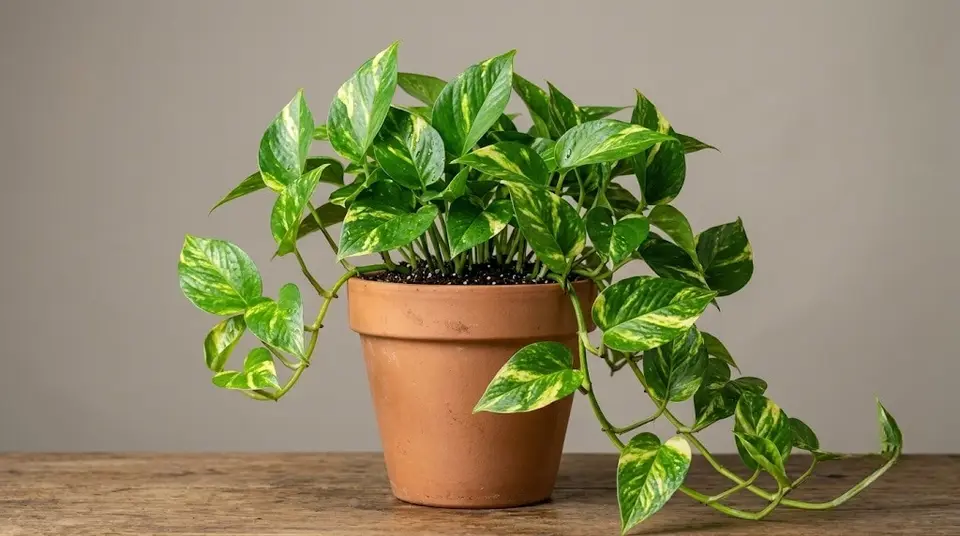 AI illustration
Overview
Pothos (Epipremnum aureum) is a low-maintenance evergreen houseplant in the arum family, Araceae, grown for its glossy, green or variegated leaves on cascading stems (NC State Extension). Clemson HGIC says pothos and related species are among the most popular houseplants, easy to care for and available in many varieties (Clemson HGIC), and the RHS calls epipremnum, or devil's ivy, an easy-to-grow houseplant that thrives in a wide range of conditions and is ideal for beginners (RHS). NC State marks pothos as poisonous to humans and a problem for cats, dogs and horses (NC State Extension).
Origin & Natural Habitat
NC State Extension says pothos is native to the Society Islands (NC State Extension), while Clemson HGIC says it is native to China, India and some parts of Southeast Asia, in a warm, tropical habitat with dappled sunlight and high humidity (Clemson HGIC). The RHS says epipremnums as a group originate in tropical forests across South-East Asia and Australia, where they scramble up trees to reach more light, gripping the bark with fleshy aerial roots (RHS). In its natural habitat, Clemson HGIC says, pothos wraps around tree trunks and its leaves can get up to 3 feet (91 cm, computed) long, with holes along the middle (Clemson HGIC).
Names
NC State Extension says the species name aureum is Latin for "golden" and that the plant was previously known as Scindapsus aureus; it was also once treated as a cultivar of Epipremnum pinnatum, named E. pinnatum 'Aureum', until botanists recognized the two as separate species (NC State Extension). The RHS still lists golden pothos as Epipremnum pinnatum 'Aureum', with an RHS Award of Garden Merit, and says epipremnums may still be sold under their previous name, Scindapsus (RHS). Clemson HGIC says golden pothos is often sold as 'Devil's Ivy' or 'Hunter's Robe' (Clemson HGIC).
Appearance
NC State Extension describes glossy, heart-shaped to elliptic leaves, green or variegated with yellow, cream or white, on slender stems that climb by brown aerial roots (NC State Extension). As a houseplant, Clemson HGIC says, the leaves are usually a few inches long and stay whole, and the vines fill a pot for a bushy look (Clemson HGIC). NC State Extension says a container plant generally keeps its juvenile leaf shape, but given a support to climb and enough light it begins to produce large, mature leaves, and that the trailing and climbing vines can grow as long as 40 feet (12 m, computed) (NC State Extension). It rarely flowers, with a spadix inside a boat-shaped spathe, and houseplants rarely if ever produce fruits (NC State Extension).
Cultivars:
- 'Golden Pothos' - large, wide leaves with yellow variegation; one of the most common varieties, readily available at most nurseries (Clemson HGIC).
- 'Marble Queen' - striking white or cream variegation and pointed leaves; needs more light than other varieties (Clemson HGIC).
- 'Snow Queen' - predominantly white leaves speckled with green; needs lots of bright, indirect light (Clemson HGIC).
- 'Pearls and Jade' - teardrop-shaped leaves, smaller than other cultivars, speckled light and dark green with large white spots (Clemson HGIC).
- 'Neon' - bright lime-green, slender leaves; grows quickly and tolerates lower light (Clemson HGIC).
- 'Jade' - solid dark green leaves, great in low light (NC State Extension).
- 'Manjula' - broad, upright leaves with pointed tips; slower-growing and bushy, and vines less readily than other cultivars (Clemson HGIC).
- 'Cebu Blue' - slender, pointed, silvery-blue leaves; Clemson HGIC places it in a different species, Epipremnum pinnatum (Clemson HGIC).
Checked: 20 November 2026.
Why People Grow It - Uses & Benefits
- Easy care: Clemson HGIC says pothos are easy to care for (Clemson HGIC), NC State Extension calls the plant very easy to grow (NC State Extension), and the RHS calls it ideal for beginners (RHS).
- Trailing or climbing: the RHS grows the long stems cascading from a hanging basket or a pot on a high shelf, or trains them up a moss- or coir-covered pole for a vertical display (RHS); Clemson HGIC says pothos does beautifully in hanging baskets with regular pruning (Clemson HGIC).
- Modest light: NC State Extension says it prefers bright, indirect light and survives for long periods in low light (NC State Extension).
- New plants from cuttings: the RHS says the stems readily produce roots from the leaf joints, so you may not need to buy one if a friend with a healthy plant can give you cuttings (RHS).
- Indoor air: golden pothos is one of the plants named in the early chamber studies on indoor air: in the experiments of B. C. Wolverton and colleagues, pothos grown on an activated carbon filter reduced benzene and trichloroethylene inside a Plexiglas chamber (Environmental Health Perspectives). A home is not a closed chamber: in a 2020 review of 196 results from 12 chamber studies, Cummings and Waring calculated that 10 to 1000 plants per square metre of floor would be needed to match the removal that air exchange with the outdoors already gives in typical buildings (Cummings and Waring, 2020).
Care
Light
Bright, indirect light suits it best; Clemson HGIC says pothos prefer bright, indirect light but will tolerate lower light, which may cause variegated varieties to lose some of their coloring (Clemson HGIC). The RHS places it in a west- or east-facing window, or behind sheer curtains or blinds in a south-facing window, and avoids direct sun, especially in summer, as this can scorch the leaves; too little light may cause the foliage to lose its variegation and growth to be poor (RHS). NC State Extension says the plant survives for long periods in low light (NC State Extension). For choosing a spot, see which window for which plant.
Watering
Let the soil dry between waterings, then water thoroughly; Clemson HGIC says to water the plant so the water reaches all the roots (Clemson HGIC). The RHS waters only once the compost is approaching dryness, testing it with a finger first, and warns that keeping the compost too wet or leaving the plant sitting in water for long periods can make the roots rot (RHS). To maintain the acidity of the compost, the RHS avoids regular tap water, especially in hard water areas, and uses rainwater or filtered water at room temperature whenever possible (RHS). If a pothos has dried out completely, see the pothos left over the holidays.
Soil & Potting
Clemson HGIC pots pothos in an airy, well-draining soil mix (Clemson HGIC). The RHS says epipremnums like an open, moisture-retentive but well-drained and slightly acidic compost; a peat-free houseplant compost will do, but it prefers a blend of three parts ericaceous (acidic) peat-free compost, one part grit and one part medium-sized orchid bark (RHS). Clemson HGIC's repotting fact sheet covers the drainage hole with a small piece of broken clay pot and adds no layer of clay pieces or rocks, because that slows water movement through the pot (Clemson HGIC 1458).
Humidity & Temperature
Clemson HGIC gives a preferred humidity of 50 to 70% and says pothos tolerate the average home range of 30 to 60%, which it calls low humidity levels, with a humidifier as an option (Clemson HGIC); the RHS says that, unlike many tropical houseplants, epipremnums can do without high humidity (RHS), and NC State Extension raises humidity with a humidifier or a tray of wet pebbles (NC State Extension). Clemson HGIC keeps pothos in a warm room, at 60-70 °F (16-21 °C, computed) at night and 70-85 °F (21-29 °C, computed) by day, away from air-conditioning vents in summer and from windowsills and heating vents in winter, as hot and cold air can dry out the leaves (Clemson HGIC). The RHS keeps plants at 18-30 °C (65-86 °F) for best results, away from cold drafts and direct heat sources such as radiators (RHS).
Feeding
The sources feed at different rates: the RHS feeds once a month during the growing season, from April to October, with a general houseplant fertilizer (RHS), while NC State Extension fertilizes every other month except when the plant is dormant in winter (NC State Extension). Clemson HGIC links yellow leaves to overwatering or low fertility and corrects low fertility with a houseplant fertilizer every other month in spring and summer (Clemson HGIC). Follow the product label for the amount.
Repotting & Training
Clemson HGIC repots pothos when roots show through the drainage holes or the plant becomes overcrowded and root-bound, and says most plants can be repotted once every year or two, depending on their growth rate (Clemson HGIC). The RHS says epipremnums can stay in their original pot for several years; once the roots are crowded or appear through the drainage holes, it repots in spring into a slightly larger container, and repots every two or three years into a pot one size larger, avoiding a much larger pot, as the compost would stay wet for too long, risking root rot (RHS). Clemson HGIC's repotting fact sheet picks a pot 1 or 2 inches (2.5-5 cm, computed) larger in diameter than the current one (Clemson HGIC 1458).
To keep it bushy, the RHS cuts long stems back to just above a leaf, as new shoots sprout from the leaf joints (RHS), and NC State Extension says leaves yellow and fall off over time, concentrating most of the leaves at the ends of the stems, so it prunes stems back to keep a bushy habit (NC State Extension). On a moss- or coir-covered pole, the RHS keeps the moss damp so the stems root into it, and ties on wayward stems (RHS); Clemson HGIC says growing pothos up a moss pole or wooden rod lets it show its climbing habit and produce larger leaves (Clemson HGIC). The RHS also wipes the leaves occasionally with a damp cloth to remove dust (RHS).
Propagation
The RHS says epipremnums are very easy to propagate, as the stems readily produce roots from the leaf joints, and names stem cuttings and layering as the best methods (RHS); NC State Extension gives stem cuttings as the recommended method (NC State Extension). For more plants, see how to propagate houseplants.
Propagation steps
- Wear gloves: the RHS wears gloves when handling or taking cuttings, as these plants are toxic and can irritate skin (RHS).
- Cut a stem: remove a section of stem and trim it just below a leaf joint (RHS); Clemson HGIC says each cutting should have at least one node to root properly (Clemson HGIC).
- Root it: stand the cuttings in a glass of water in a bright spot until roots appear (RHS); Clemson HGIC says stem cuttings root easily in soil or water (Clemson HGIC).
- Pot it up: once roots appear, pot the cuttings up (RHS) in an airy, well-draining mix (Clemson HGIC).
- Or layer a stem: pin a trailing stem down into a pot of free-draining compost, and roots should start to sprout from the leaf joint (RHS).
Checked: 20 November 2026.
Look-alikes: pothos or philodendron?
Pothos is often confused with philodendrons, and Clemson HGIC tells it from the common heartleaf philodendron like this:
| Pothos | Heartleaf philodendron | |
|---|---|---|
| Leaf stalk (petiole) | Grooved | Not grooved |
| New leaves | Emerge with no sheath | Each new leaf comes out of a sheath that later dries and falls off |
| Leaves | Glossy, folded along the midrib, with fine dots or streaks of gold, white or yellow | Heart-shaped (the heartleaf type) |
| Light and warmth | Needs brighter light and warmer temperatures | Needs less light and warmth than pothos |
NC State Extension adds that pothos has no conspicuous free stipules on new growth (NC State Extension).
Checked: 20 November 2026.
Common Problems & Pests
- Root rot and blackened leaf edges: Clemson HGIC says root rot is caused by overwatering or poorly draining soil (Clemson HGIC), and NC State Extension says overwatering can cause root rot and blackening of the leaf margins (NC State Extension).
- Yellow leaves: Clemson HGIC names overwatering or low fertility (Clemson HGIC); NC State Extension adds that leaves yellow and fall off over time (NC State Extension).
- Scorched leaves and dying tips: Clemson HGIC says leaf scorch and tip dieback are often caused by low humidity or intense light (Clemson HGIC).
- Loss of variegation: NC State Extension says low light can cause loss of variegation (NC State Extension), and the RHS says too little light may also make growth poor (RHS).
- Bare stems with leaves only at the tips: NC State Extension says leaves yellow and fall off over time, concentrating most of the leaves at the ends of the stems, and prunes the stems back (NC State Extension); the RHS prunes straggly plants back to stimulate new side-shoots (RHS).
Pests at a glance
Clemson HGIC says pothos are generally pest-free indoors but may be affected by spider mites and mealybugs (Clemson HGIC), and NC State Extension says to monitor for mealybugs and scales and names banded greenhouse thrips among its common insect problems (NC State Extension); for control, follow the product label and ask your local extension service, since we do not give pesticide advice.
| Problem | Our guide |
|---|---|
| Mealybugs | Mealybugs |
| Spider mites | Spider Mites |
| Scale insects | Scale Insects |
| Thrips | Thrips |
| Root rot | Root Rot |
Checked: 20 November 2026.
Toxicity & Safety
NC State marks pothos (Epipremnum aureum) as poisonous to humans and a problem for cats, dogs and horses: the toxic principle is calcium oxalate crystals, and the symptoms it lists are oral irritation, pain and swelling of the mouth, tongue and lips, excessive drooling, vomiting (not in horses), difficulty swallowing, skin irritation and diarrhea (NC State Extension). Clemson HGIC says all parts of a pothos are mildly toxic if ingested, as the calcium oxalate crystals can cause mouth and throat irritation, vomiting and difficulty swallowing, and keeps pothos out of the reach of children and pets (Clemson HGIC). NC State Extension rates the poison severity as medium, lists the flowers, fruits, leaves, roots, seeds and stems as poisonous parts, says it causes contact dermatitis and lists skin irritation among the symptoms (NC State Extension), and the RHS wears gloves when handling or pruning, as the plants are toxic and can irritate skin (RHS). This is not veterinary or medical advice: if a pet chews it, call your vet, and for a child, contact a poison control center.
Best Suited For
Good fit if:
- you want an easy plant: the RHS calls it ideal for beginners (RHS), and NC State Extension calls it very easy to grow (NC State Extension).
- you have a high shelf or a hanging basket: the RHS grows the long stems cascading from a hanging basket or a pot on a high shelf (RHS).
- your room is not very bright: NC State Extension says it survives for long periods in low light (NC State Extension), and describes 'Jade' as great in low light (NC State Extension).
- you want new plants from cuttings: the RHS says the stems readily produce roots from the leaf joints (RHS).
Think twice if:
- you have pets or small children that chew plants: NC State marks it as a problem for cats, dogs and horses (NC State Extension), and Clemson HGIC keeps it out of the reach of children and pets (Clemson HGIC).
- you want to keep a white or cream variety in a dim spot: Clemson HGIC says 'Marble Queen' needs more light than other varieties and 'Snow Queen' needs lots of bright, indirect light (Clemson HGIC).
- your skin reacts to plant sap: NC State Extension says it causes contact dermatitis (NC State Extension), and the RHS wears gloves when handling it (RHS).
FAQ
Why is my pothos getting leggy, with bare stems?
NC State Extension says leaves yellow and fall off over time, concentrating most of the leaves at the ends of the stems, and prunes the stems back to keep a bushy habit (NC State Extension); the RHS cuts straggly stems back to just above a leaf, so new side-shoots sprout from the leaf joints (RHS).
Can pothos grow in water?
Stem cuttings root easily in water (Clemson HGIC), and the RHS stands them in a glass of water in a bright spot until roots appear, then pots them up (RHS). The sources we used do not cover keeping a pothos in water for good, so we don't either.
Why is my variegated pothos turning green?
Too little light: Clemson HGIC says lower light may cause variegated varieties to lose some of their coloring (Clemson HGIC), and the RHS gives it bright, indirect light, out of direct summer sun (RHS).
How do I tell pothos from philodendron?
Clemson HGIC says pothos leaf stalks are grooved and new pothos leaves come without a sheath, while heartleaf philodendron stalks are not grooved and each new leaf has a sheath that later falls off (Clemson HGIC).
Is pothos toxic to cats and dogs?
Yes: NC State marks pothos as a problem for cats, dogs and horses, with oral irritation, excessive drooling, vomiting and difficulty swallowing among the symptoms (NC State Extension). This is not veterinary advice: if a pet chews it, call your vet. For other plants, see which plants are toxic to cats and dogs.
Sources
The facts on this page link to these sources:
- NC State Extension (plants.ces.ncsu.edu)
- Clemson HGIC (hgic.clemson.edu)
- RHS (rhs.org.uk)
- Environmental Health Perspectives (doi.org)
- Cummings and Waring, 2020 (doi.org)
- Clemson HGIC 1458 (hgic.clemson.edu)
- Clemson HGIC (hgic.clemson.edu)
General information only. If you suspect poisoning, call a poison control center, a doctor or a vet straight away.
Gear for growing pothos (epipremnum aureum / devil's ivy)
Links go to Amazon or a partner store (such as Adagio Teas) and may earn us a commission at no extra cost to you. As an Amazon Associate we earn from qualifying purchases. We link gear types, not sponsors' picks: you choose the exact product.