Propeller Plant (Crassula falcata)
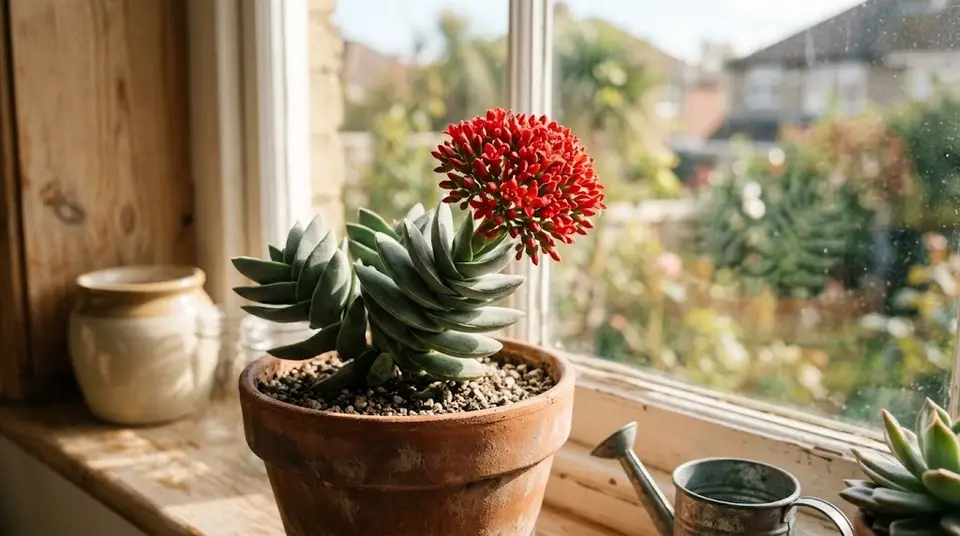
The propeller plant is a sculptural crassula whose thick, sickle-shaped grey-green leaves stack in flat, overlapping pairs like the blades of a propeller - and in summer it tops the sculpture with a dense head of brilliant scarlet flowers.
Last reviewed: July 2026
 AI illustration
 Overview
The propeller plant is a sculptural crassula whose thick, sickle-shaped grey-green leaves stack in flat, overlapping pairs like the blades of a propeller - and in summer it tops the sculpture with a dense head of brilliant scarlet flowers. Architectural, easy and unusual, it earns its place in any succulent collection.
Origin & Natural Habitat
Crassula falcata (botanically Crassula perfoliata var. minor) comes from the Eastern Cape of South Africa, growing on rocky slopes. It has long been cultivated for its dramatic foliage and vivid blooms.
Appearance
Broad, flattened, sickle-shaped leaves in soft grey-green with a fine powdery finish, stacked in alternating pairs that twist like propeller blades up a short stem. In summer, mature plants carry a rounded cluster of tiny, intensely scarlet flowers with a light cinnamon scent.
Why People Love It - Qualities & Benefits
People love the bold propeller geometry, the powdery grey foliage, and the shock of scarlet in summer - few succulents combine sculpture and flowers this well. It is also robust and unfussy.
Care
Light
Bright light with several hours of direct sun keeps the blades thick, compact and well-coloured and sets the flower head - a sunny windowsill is ideal.
Watering
Soak when the soil is fully dry, then wait; keep drier in winter. The thick leaves store generously and rot in constantly damp soil.
Soil & Potting
A gritty, free-draining succulent mix in a pot with drainage.
Humidity & Temperature
Warm, dry air suits it; ordinary room air is fine. Keep above about 5-7°C with a cooler, drier winter rest.
Feeding
A dilute succulent feed once or twice in the growing season supports the summer flowering.
Repotting
Repot every couple of years in spring. After flowering the bloomed stem slowly declines - cut it back and side shoots or offsets carry on.
Propagation
From leaf or stem cuttings: remove a whole leaf or a side shoot, callus for several days, and set on gritty mix. Leaves root slowly but reliably.
Common Problems & Pests
Overwatering rot is the main risk; mealybugs can lodge between the tight leaf pairs. Stretched, spaced blades mean too little light. Post-flowering stem decline is natural - propagate the offsets.
Toxicity & Safety
As a crassula, the propeller plant is considered mildly toxic to cats and dogs if eaten - keep it out of pets' reach.
Pros & Cons
Pros: striking propeller geometry, brilliant scarlet summer flowers, robust and compact. Cons: mildly toxic to pets, flowered stems decline, needs good sun to stay tight.
Best Suited For
For collectors and anyone who wants architecture plus genuine flower power from one easy grey succulent.
FAQ
Will it flower indoors? Yes - given a few hours of direct sun, mature plants reliably produce the scarlet summer head.
The stem that flowered looks tired - is it dying? It naturally declines after blooming; cut it back and grow on the offsets.
Gear for growing propeller plant (crassula falcata)
Links go to Amazon or a partner store (such as Adagio Teas) and may earn us a commission at no extra cost to you. As an Amazon Associate we earn from qualifying purchases. We link gear types, not sponsors' picks: you choose the exact product.