Monstera Deliciosa (Swiss Cheese Plant)
Monstera deliciosa, the Swiss cheese plant, is a woody, evergreen climbing vine in the arum family, Araceae, native from Mexico to Panama; despite its other common name, split-leaf philodendron, it is not a philodendron (NC State Extension).
Last reviewed: November 2026
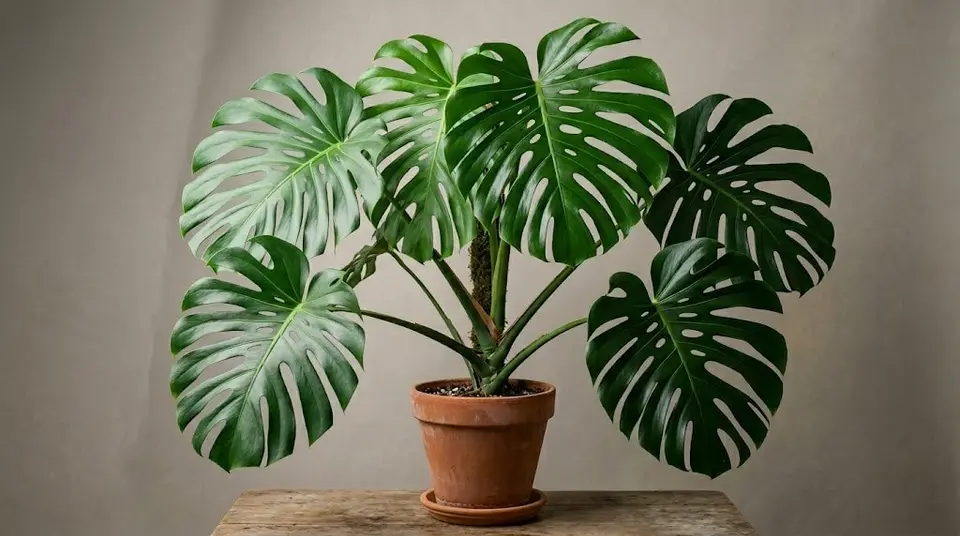 AI illustration
Overview
Monstera deliciosa, the Swiss cheese plant, is a woody, evergreen climbing vine in the arum family, Araceae, native from Mexico to Panama; despite its other common name, split-leaf philodendron, it is not a philodendron (NC State Extension). The RHS says only a couple of Monstera species are grown as houseplants, by far the most popular being Monstera deliciosa, the original Swiss cheese plant, so called because of the holes in its leaves (RHS). It can grow to 70 feet (21 m, computed) tall, though it stays between 6 and 8 feet (1.8-2.4 m, computed) in most homes (NC State Extension), and NC State marks it as poisonous to humans and a problem for cats, dogs and horses (NC State Extension).
Origin & Natural Habitat
NC State Extension gives its native range as Mexico to Panama and says that in its native habitat it starts life as a terrestrial plant, turning epiphytic once it comes into contact with a sturdy tree it can climb (NC State Extension). The RHS says monsteras come from the tropical forests of southern Mexico and South America, where they grow like vines, scrambling up trees to reach more light, and produce roots from their stems that attach onto the trees and support their climbing growth (RHS). It is thought, the RHS adds, that the holes evolved to allow light through to the lower leaves as the plants climb (RHS).
Names
The RHS says these plants can potentially grow to monster proportions, living up to their botanical name of Monstera, and that the name deliciosa comes from the sweet, aromatic fruits the plant occasionally produces in the wild (RHS). NC State Extension lists ceriman, cutleaf philodendron, hurricane plant, Mexican breadfruit, split-leaf philodendron and Swiss cheese plant as common names (NC State Extension); the RHS plant profile adds custard plant, fruit salad plant and Indian ivy, with Philodendron pertusum as a synonym (RHS plant profile).
Appearance
NC State Extension describes gigantic leaves, up to 1 foot (30 cm, computed) or more, dark green, glossy, long-stalked and heart-shaped, perforated with several holes, some of which reach the edge and split it so the leaf looks deeply lobed; only mature leaves have these holes, which develop as the leaf grows (NC State Extension). The RHS plant profile describes an evergreen shrub to 5 m or more, climbing by aerial roots, with leaves to 90 cm, white flower spathes of 30 cm and cone-like cream fruit (RHS plant profile), and gives a maximum height of 4-8 metres, a maximum spread of 1.5-2.5 metres and 10-20 years as the time to maturity (RHS plant profile). Clemson HGIC says the leaves are small and round when they first emerge and later develop holes and deep cuts (Clemson HGIC), and the RHS says plants usually start to produce holey leaves once they are a few years old (RHS).
Cultivars:
- 'Albo Variegata' - a striking plant with variegated leaves, rare and expensive (NC State Extension).
- 'Thai Constellation' - a pattern of marbled and speckled creamy white and green variegation, resembling a constellation; rare (NC State Extension).
- 'Variegata' - the RHS names it, with an Award of Garden Merit, and 'Albo-Variegata' as particularly sought-after variegated forms, much less widely sold and consequently more expensive (RHS).
NC State Extension says variegated cultivars need more sunlight than darker green cultivars (NC State Extension).
Checked: 21 November 2026.
Why People Grow It - Uses & Benefits
- A statement plant: the RHS says it grows into a spectacular, architectural focal point, eventually reaching several metres tall, and that it can soon grow to reach the ceiling, so is ideal if you want a real statement houseplant (RHS).
- Easy to find: the RHS says Monstera deliciosa is very popular and widely sold all year round by garden centres, houseplant retailers and online suppliers (RHS).
- Relatively easy care: the RHS calls Swiss cheese plants relatively easy to look after if kept at 18-25 °C (65-77 °F) with moderate humidity, and usually vigorous, robust and healthy plants given indirect light, moderate humidity and free-draining compost (RHS); for other plants, see houseplants by difficulty.
- Fast growth: NC State Extension rates its growth rate as rapid (NC State Extension).
- New plants from cuttings: the RHS says Swiss cheese plants are easily propagated by taking stem cuttings, from spring to late summer (RHS).
- Indoor air: for houseplants in general, a 2020 review of 196 results from 12 chamber studies by Cummings and Waring calculated that 10 to 1000 plants per square metre of floor would be needed to match the removal that air exchange with the outdoors already gives in typical buildings (Cummings and Waring, 2020).
Care
Light
Give it bright, indirect light; the RHS places Swiss cheese plants by a west- or east-facing window, or in a brighter room away from the window, and says direct sun can scorch the leaves, while in very low light the leaves tend to have fewer holes (RHS). NC State Extension gives moderate brightness but not direct sunlight, and says variegated cultivars need more sunlight than darker green ones (NC State Extension); Clemson HGIC says monsteras will not develop their perforations if the light level is too low (Clemson HGIC). For choosing a spot, see which window for which plant.
Watering
Water thoroughly once at least the top part of the compost has dried: NC State Extension waters thoroughly and then lets the top quarter to one-third of the soil dry between waterings (NC State Extension), and the RHS lets the compost become almost dry before watering thoroughly, never leaves the pot sitting in a saucer of water for any length of time, as this can make the roots rot, and waters slightly less often over winter (RHS). The RHS plant profile waters when the plant is in growth and keeps it just moist in winter (RHS plant profile). To maintain the acidity of the compost, the RHS uses rainwater or filtered water whenever possible, preferably at room temperature, especially in hard water areas (RHS).
Soil & Potting
For the best soil, the RHS recommends an open, well-drained, slightly acidic compost (pH 5-6), with one part ericaceous peat-free compost to two parts orchid compost as an ideal mix, and warns that the roots can easily rot in compost that drains poorly (RHS). Its plant profile names a peat-free, loam-based potting compost (RHS plant profile), while NC State Extension's plant record gives soil high in organic matter with good drainage and a neutral pH of 6.0-8.0, so the two sources differ on pH (NC State Extension). Clemson HGIC's repotting fact sheet covers the drainage hole with a small piece of broken clay pot and adds no layer of clay pieces or rocks, because that slows water movement through the pot (Clemson HGIC 1458). For more on mixes, see the best soil and potting mix for houseplants.
| Product | Type | What the maker states | Links |
|---|---|---|---|
| Espoma Organic Potting Mix | Potting mix | For indoor and outdoor containers; processed forest products, sphagnum peat moss, perlite, humus and limestone, with organic nutrients and mycorrhizae | See on Amazon · Maker's page |
| Espoma Organic Orchid Mix | Bark mix | Aged pine bark, horticultural charcoal, perlite and limestone; 4 qt bags; the bark to loosen a potting mix | See on Amazon · Maker's page |
| Espoma Organic Perlite | Perlite | Lightweight volcanic granules that create pore space and prevent compaction in potting mixes | See on Amazon · Maker's page |
| Mosser Lee Totem Pole Extendible Plant Supports | Moss pole | Extendible plant supports from a sphagnum moss maker, for climbing plants | See on Amazon · Maker's page |
How we put this together. The soil advice above is from the RHS, NC State Extension and Clemson HGIC; the products are described from the makers' own pages, checked on 26 October 2026, and we have not trialed them. The RHS recommends peat-free compost, while the Espoma potting mix lists sphagnum peat moss among its ingredients. There are no prices here: the Amazon links search for the exact product, and we may earn a commission if you buy through them.
Humidity & Temperature
The RHS keeps Swiss cheese plants warm all year round, at 18-25 °C (65-77 °F), away from cold draughts and direct heat such as radiators (RHS), and NC State Extension gives an average warm temperature of 60 to 85 °F (16-29 °C, computed) (NC State Extension). Both sources give it humid air: the RHS mists the leaves regularly or stands the pot in a saucer over a larger tray of moist gravel, groups several tropical plants together, and warns that if the air is too dry, especially in centrally heated homes, the leaves may start to brown at the edges (RHS); NC State Extension uses a humidifier or a tray of wet pebbles (NC State Extension).
Can it go outside?
The RHS rates Monstera deliciosa H1B, a plant that can be grown outside in the summer, with a minimum temperature range of 10-15 °C, and says all its ratings refer to UK growing conditions (RHS plant profile); its cultivation note says it may be kept outdoors in warmer regions, but at temperatures no less than 18 °C, in partial shade (RHS plant profile). NC State Extension lists USDA Plant Hardiness Zones 10a to 12b (NC State Extension).
Checked: 21 November 2026.
Feeding
The RHS feeds with a balanced liquid fertiliser during the growing season, from April to September (RHS), monthly while the plant is in growth (RHS plant profile). Follow the product label for the amount.
Repotting, Support & Pruning
The RHS says Swiss cheese plants can usually stay in their original pot for a year or two and should then be repotted every few years; as they become top-heavy, it chooses a pot weighty enough not to topple, only a few centimetres larger than the previous one, and avoids a much larger pot, because overpotting keeps the compost wet for too long, risking root rot (RHS). Clemson HGIC's repotting fact sheet picks a pot 1 or 2 inches (2.5-5 cm, computed) larger in diameter than the current one (Clemson HGIC 1458), and NC State Extension prunes or repots, if needed, in spring (NC State Extension). For the steps, see how to repot a houseplant.
NC State Extension says sturdy support is necessary to prevent the stems from breaking (NC State Extension). The RHS trains or ties the stems onto a moss pole, into which they will eventually root if the moss is kept moist, which also keeps these top-heavy plants upright, and says that once a plant feels it is climbing, it will often produce larger, more mature leaves with more holes, botanically known as fenestrations (RHS). Clemson HGIC says monsteras can be grown like a tree philodendron (Clemson HGIC).
If the plant gets too large for its space, the RHS prunes it back in spring, noting that the new stems will generally have smaller, less mature leaves with fewer holes until it settles down again (RHS). It also wipes the leaves regularly to remove insects and dust, so they can absorb daylight more efficiently (RHS), and NC State Extension wipes dust off the leaves regularly too (NC State Extension).
Propagation
The RHS says Swiss cheese plants are easily propagated by taking stem cuttings, from spring to late summer (RHS), and its plant profile lists seed, root tip or stem cuttings (RHS plant profile); NC State Extension recommends layering or stem cuttings (NC State Extension). For more plants, see how to propagate houseplants.
Propagation steps
- Wear gloves: the RHS wears gloves when handling these poisonous plants (RHS).
- Pick the season: the RHS takes stem cuttings from spring to late summer (RHS).
- Root them in water: stand the cuttings in a glass of water in a bright location until they produce a good set of roots (RHS).
- Pot them up: then pot them up in an open, well-drained compost, such as one part ericaceous peat-free compost to two parts orchid compost (RHS).
- Or layer a stem: NC State Extension lists layering as the other recommended method (NC State Extension).
Checked: 21 November 2026.
Look-alikes: monstera, mini monstera or philodendron?
NC State Extension says Monstera deliciosa is often confused with Monstera adansonii and Rhaphidophora tetrasperma (NC State Extension), and Clemson HGIC says monsteras are often called split-leaf philodendrons, though they are not true philodendrons (Clemson HGIC):
| Monstera deliciosa | Monstera adansonii | Rhaphidophora tetrasperma ('Mini Monstera') | Tree philodendron (Philodendron bipinnatifidum) | |
|---|---|---|---|---|
| Leaves | Up to 1 foot (30 cm, computed) or more, with holes through the blade, some splitting the edge; only mature leaves have holes (NC State Extension) | Large, heart-shaped, with oval holes (NC State Extension) | Smaller than those of Monstera deliciosa, and the holes appear at an earlier age (NC State Extension) | Large, with deep irregular slits and no holes, up to 3 feet (91 cm, computed) long (Clemson HGIC) |
| Habit | Climbing vine (NC State Extension) | Climber that attaches itself by aerial roots (NC State Extension) | Climbing vine (NC State Extension) | Self-heading, on a robust, erect stem (Clemson HGIC) |
| Genus | Monstera, not a philodendron (NC State Extension) | Monstera (NC State Extension) | Rhaphidophora: neither a monstera nor a philodendron, though in the same family (NC State Extension) | Philodendron (Clemson HGIC) |
Checked: 21 November 2026.
Common Problems & Pests
- Roots rotting, plant collapsing: the RHS says overwatering, or waterlogging due to poorly draining compost, can cause the roots to rot and the plant to collapse (RHS).
- Brown leaf edges: the RHS says that if the air is too dry, especially in centrally heated homes, the leaves may start to brown at the edges (RHS).
- Few or no holes: in very low light the leaves tend to have fewer holes, and plants usually start producing holey leaves once they are a few years old (RHS); Clemson HGIC says monsteras will not develop their perforations if the light level is too low (Clemson HGIC).
- Scorched leaves: the RHS says direct sun can scorch the leaves (RHS).
- Broken or toppling stems: NC State Extension says sturdy support is necessary to prevent the stems from breaking (NC State Extension), and the RHS chooses a pot weighty enough not to topple, as the plants become top-heavy (RHS).
Pests at a glance
The RHS plant profile says Monstera deliciosa may be susceptible to scale insects and glasshouse red spider mite and is generally disease-free (RHS plant profile), and the RHS growing guide warns that mealybugs, sap-sucking insects, can sometimes colonise a plant, leaving a sticky residue and reducing its vigour (RHS). NC State Extension reports no significant problems but names fern scale among its common insect problems (NC State Extension); for control, follow the product label and ask your local extension service, since we do not give pesticide advice.
| Problem | Our guide |
|---|---|
| Mealybugs | Mealybugs |
| Scale insects | Scale Insects |
| Spider mites | Spider Mites |
| Root rot | Root Rot |
Checked: 21 November 2026.
Monstera Fruit: Can You Eat It, and When Is It Ripe?
The name deliciosa comes from the sweet, aromatic fruits the plant occasionally produces in the wild, but the RHS says a monstera grown as a houseplant is extremely unlikely to fruit, and that the fruits can be toxic if eaten before they are ripe (RHS).
- What it looks like: NC State Extension describes an aggregate of creamy-white berries covered by green hexagonal "scales", more than 3 inches (8 cm, computed) long and 1-3 inches (2.5-7.6 cm, computed) wide (NC State Extension); the RHS plant profile calls it cone-like cream fruit that follows the white flower spathes (RHS plant profile).
- Flowers first: NC State Extension says the inflorescence is a creamy-white spathe up to 1 foot (30 cm, computed) and a spadix 10 inches (25 cm, computed) long and an inch (2.5 cm, computed) thick, and that the plant rarely flowers as a houseplant (NC State Extension).
- When it is ripe: NC State Extension says the fruit is ripe once the scales covering it fall off naturally, and that the plant rarely produces fruit as a houseplant (NC State Extension).
- Who should not eat it: NC State Extension says only ripe fruits are edible, that some people are allergic, and lists the fruits among the poisonous parts of the plant (NC State Extension); it says the ripe berries taste like a mixture of banana and pineapple and are used to flavor drinks and ice cream or eaten fresh (NC State Extension).
This is not food-safety advice: we do not advise eating any part of a monstera. If someone has eaten unripe fruit or another part of the plant, contact a poison control center.
Toxicity & Safety
NC State marks Monstera deliciosa as poisonous to humans and a problem for cats, dogs and horses: the toxic principle is needle-like calcium oxalate crystals, possibly with other unidentified toxins, and it lists intense burning of the mouth, tongue and throat, nausea, vomiting, difficulty swallowing, drooling and diarrhea if large amounts are eaten, and skin irritation from the sap (NC State Extension). NC State Extension describes it as a plant with low-severity poison characteristics, lists the bark, flowers, fruits, leaves, roots, seeds and stems as poisonous parts, and gives intense burning of the mouth, tongue and throat, nausea, vomiting, difficulty swallowing, drooling and diarrhea as symptoms, only if eaten in large quantities, with skin irritation from contact with the sap (NC State Extension). Clemson HGIC says all parts of monsteras contain calcium oxalate crystals and are toxic to pets and children (Clemson HGIC), and the RHS rates it harmful if eaten and a skin and eye irritant, and wears gloves and other protective equipment when handling it (RHS plant profile). This is not veterinary or medical advice: if a pet chews it, call your vet, and for a child, contact a poison control center.
Best Suited For
Good fit if:
- you want a statement plant and have the room: the RHS says it can soon grow to reach the ceiling and is ideal if you want a real statement houseplant (RHS), and NC State Extension says it stays between 6 and 8 feet (1.8-2.4 m, computed) in most homes (NC State Extension).
- you have a spot in indirect light, such as by a west- or east-facing window, out of direct sun (RHS).
- you are happy to train it on a moss pole: the RHS says a plant that feels it is climbing often produces larger leaves with more holes (RHS).
- you want new plants from cuttings: the RHS says it is easily propagated by stem cuttings (RHS).
Think twice if:
- you have pets or small children that chew plants: NC State marks it as a problem for cats, dogs and horses (NC State Extension), and Clemson HGIC says monsteras are toxic to pets and children (Clemson HGIC).
- space is limited: the RHS calls the smaller Monstera adansonii a good choice when space is limited (RHS).
- your home has dry, centrally heated air and you cannot raise the humidity: the RHS says the leaves may then start to brown at the edges (RHS).
- your skin reacts to plant sap: NC State Extension says it causes contact dermatitis (NC State Extension), and the RHS wears gloves when handling it (RHS).
FAQ
Why doesn't my Monstera have holes?
It may be too young or too dark: the RHS says plants usually start to produce holey leaves once they are a few years old, that in very low light the leaves tend to have fewer holes, and that a plant that feels it is climbing often makes larger leaves with more holes (RHS); Clemson HGIC says monsteras will not develop their perforations if the light level is too low (Clemson HGIC).
Is Monstera the same as a "split-leaf philodendron"?
No: NC State Extension says split-leaf philodendron is not a philodendron (NC State Extension), and Clemson HGIC says monsteras are often called split-leaf philodendrons but are not true philodendrons, though closely related, and that philodendrons have deeply cut leaves with no holes (Clemson HGIC).
How often should I water it?
The sources give no fixed schedule: NC State Extension lets the top quarter to one-third of the soil dry between thorough waterings (NC State Extension), and the RHS lets the compost become almost dry before watering thoroughly, and waters slightly less often over winter (RHS).
What should I do with the aerial roots?
The RHS gives the stems a moss-covered pole to root into, as in the wild these roots attach onto trees, and keeps the moss moist (RHS). The sources we used do not cover cutting the roots off, so we don't either.
Why are the new leaves smaller than the old ones?
After pruning, the RHS says, new stems generally have smaller, less mature leaves with fewer holes until the plant settles down again; in very low light the leaves also have fewer holes, and a plant trained to climb makes larger leaves (RHS).
Can you eat monstera fruit?
A houseplant is extremely unlikely to fruit, and the fruits can be toxic if eaten before they are ripe (RHS); NC State Extension says only ripe fruits are edible and some people are allergic (NC State Extension). We do not advise eating it; see the fruit section above.
Is Monstera toxic to cats and dogs?
Yes: NC State marks it as a problem for cats, dogs and horses, with burning of the mouth, vomiting, difficulty swallowing and drooling among the symptoms (NC State Extension). This is not veterinary advice: if a pet chews it, call your vet. For other plants, see which plants are toxic to cats and dogs.
Sources
The facts on this page link to these sources:
- NC State Extension (plants.ces.ncsu.edu)
- RHS (rhs.org.uk)
- RHS plant profile (rhs.org.uk)
- Clemson HGIC (hgic.clemson.edu)
- Cummings and Waring, 2020 (doi.org)
- Clemson HGIC 1458 (hgic.clemson.edu)
- NC State Extension (plants.ces.ncsu.edu)
- NC State Extension (plants.ces.ncsu.edu)
General information only. If you suspect poisoning, call a poison control center, a doctor or a vet straight away.
Gear for growing monstera deliciosa (swiss cheese plant)
Links go to Amazon or a partner store (such as Adagio Teas) and may earn us a commission at no extra cost to you. As an Amazon Associate we earn from qualifying purchases. We link gear types, not sponsors' picks: you choose the exact product.