Mother of Thousands
Mother of thousands is a succulent that grows a fringe of tiny, ready-rooted plantlets along the edge of every leaf - each one dropping off to grow wherever it lands.
Last reviewed: October 2026
 AI illustration
 Overview
Mother of thousands is a succulent that grows a fringe of tiny, ready-rooted plantlets along the edge of every leaf - each one dropping off to grow wherever it lands. Tall, upright and fascinating, it is an easy, almost self-propagating novelty, but it is genuinely toxic to pets and can become weedy, so it needs a careful home.
Origin & Natural Habitat
Kalanchoe daigremontiana comes from Madagascar, growing in dry, rocky ground. Its plantlet strategy makes it a prolific coloniser - in warm climates it can escape and become an invasive weed, so it must never be planted out or discarded outdoors.
Appearance
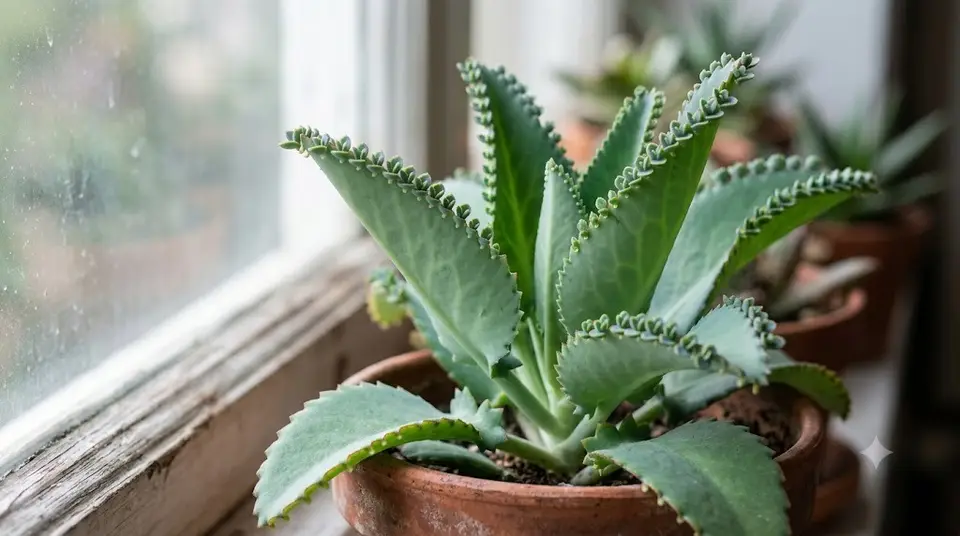
An upright, single-stemmed succulent with large, arrow-shaped, blue-green leaves, often marked with purple blotches beneath. The unmistakable feature is the row of dozens of tiny perfect plantlets (each with its own leaves and roots) lining every leaf margin, ready to drop and grow.
Why People Love It - Qualities & Benefits
People love the sheer novelty of a plant that makes hundreds of babies along its leaves, the ease of growing it (it practically grows itself), and its bold upright form. It is a favourite curiosity and a fun one to share - responsibly.
Care
Light
Bright light with some direct sun keeps it compact and coloured - a sunny windowsill is ideal. In low light it stretches and pales.
Watering
Water when the soil is fully dry, then soak and drain; keep drier in winter. It is very drought-tolerant and rots if kept wet.
Soil & Potting
A gritty, free-draining succulent mix in a pot with drainage. Expect plantlets to root in the pot and in neighbouring pots.
Humidity & Temperature
Warm, dry air suits it; ordinary room air is fine. Keep it above about 10°C - it is frost-tender.
Feeding
A dilute succulent feed once or twice in the growing season is plenty; it hardly needs encouragement.
Repotting
Repot every couple of years in spring - and expect to weed out the countless self-sown plantlets, which sprout everywhere. Collect fallen plantlets rather than letting them scatter, especially near other pots.
Propagation
Effortless - too effortless: the leaf-edge plantlets drop and root on their own. To propagate deliberately, just press a few onto gritty soil. The challenge is stopping it, not starting it.
Common Problems & Pests
Overwatering rot is the main danger to the plant; the main danger to your windowsill is its weediness - plantlets colonise every nearby pot. Aphids and mealybugs can appear. Legginess means too little light.
Toxicity & Safety
Mother of thousands is a kalanchoe and is toxic to cats, dogs and other animals (and people) if eaten - it contains compounds that can affect the heart, and even the dropped plantlets are toxic. Keep it well out of reach of pets and children, sweep up fallen plantlets, and if a pet chews it, contact a vet. This is a plant to enjoy carefully and at a safe height.
Pros & Cons
Pros: extraordinary self-propagating plantlets, bold upright form, extremely easy, fun to share. Cons: toxic to pets and people, weedy and hard to contain, can be invasive outdoors - never plant out.
Best Suited For
For curious growers who want a living novelty on a bright sill - best in a pet-free home, kept out of reach, with fallen plantlets tidied up promptly.
FAQ
Do the babies really grow on the leaves? Yes - each leaf edge grows dozens of tiny rooted plantlets that drop off and grow wherever they land.
Is it safe around pets? No - as a kalanchoe it is toxic to cats and dogs, and so are the plantlets; keep it out of reach and clean up fallen babies.
Gear for growing mother of thousands
Links go to Amazon or a partner store (such as Adagio Teas) and may earn us a commission at no extra cost to you. As an Amazon Associate we earn from qualifying purchases. We link gear types, not sponsors' picks: you choose the exact product.