Plant Light Spectrum Explained
What the plant light spectrum means - full spectrum versus red/blue, PPFD and DLI versus lumens, how long to run a light and how far away to hang it, with the figures university extension services give.
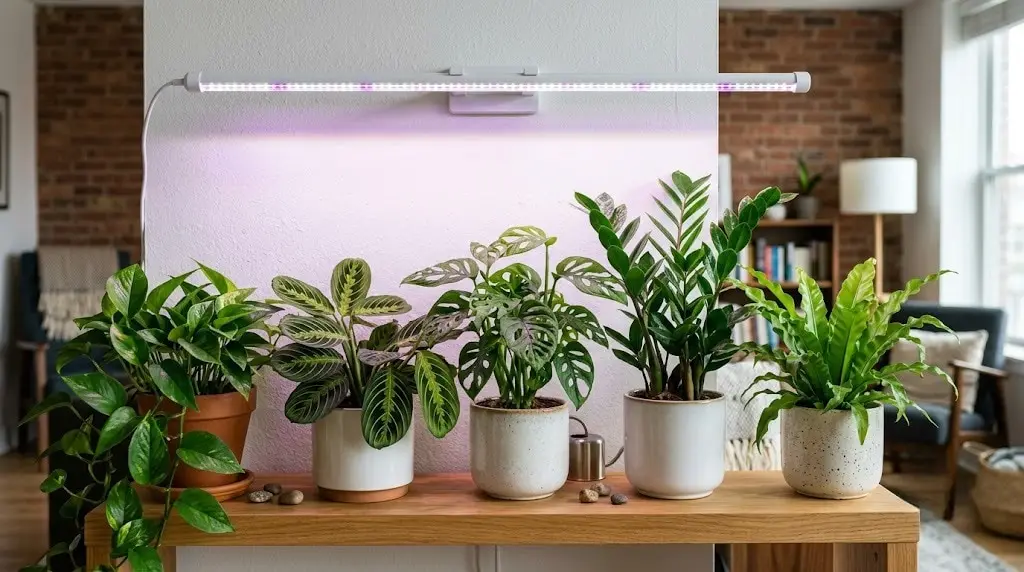
Plants use mainly the red and blue parts of the spectrum, and how well they grow under a lamp depends on how much of that light reaches the leaves and for how long (Iowa State University Extension). The University of New Hampshire’s extension service puts it plainly: when plants fail under lamps, the cause is more often too little light, in intensity or in hours, than the wrong spectrum (UNH Extension).
Grow-light boxes mix terms such as full spectrum, red and blue, daylight and lumens. This page explains each one with the figures from those two extension services. We have not measured any lamp ourselves, and where the two services give different figures, we show both.
What “Spectrum” Means
Light is a mix of wavelengths, and plants do not use them all equally. Iowa State says plants absorb and use the red and blue ends of the spectrum most, and calls the range they use for photosynthesis PAR, photosynthetically active radiation (Iowa State):
- Blue light helps control how much chlorophyll the plant makes, keeps stems from stretching too far and regulates the stomata, the pores through which a leaf exchanges gases (Iowa State).
- Red light drives much of photosynthesis, makes stems stretch and lengthen, and encourages flowers and fruit (Iowa State).
The specifications that matter below, PPF, PPFD and DLI, all count PAR (Iowa State).
Full Spectrum or Red/Blue?
Red/blue (“purple”) lights concentrate their output where photosynthesis uses it. New Hampshire’s specialist says photosynthesis makes best use of a red and blue mix with less yellow and green, rather than daylight full spectrum (UNH Extension).
Full-spectrum white lights look like daylight. Iowa State’s ideal home fixture is “full spectrum” (sometimes called “daylight”), with a Kelvin value in the middle of the range so that it carries some of both red and blue; its alternative is to mix “warm white” and “cool white” bulbs (Iowa State).
Which matters more? New Hampshire’s specialist answers that LED shop lamps will work fine for seedlings, and that the right spectrum is nice but intensity and duration count for more (UNH Extension). What a lamp sold as a grow light adds, by the same answer, is a spectrum with a larger share of photons that plants can use for photosynthesis (UNH Extension).
Not sure whether you need a light at all? Our light-level checker helps you gauge how bright a spot really is.
The Specifications That Matter
PPF and PPFD
Iowa State describes photosynthetic photon flux (PPF) as the light a source gives off that plants can use, measured in micromoles per second, and notes that makers of grow lights typically state it while standard fixtures rarely do (Iowa State). Photosynthetic photon flux density (PPFD) is that useful light per area, in effect the useful light that reaches the leaves, measured in micromoles per square metre per second (µmol/m²/s); from a maker’s PPF, Iowa State gets it by dividing by the lit area in square metres (Iowa State). PPFD drops sharply as the lamp moves further away (Iowa State).
DLI
Iowa State ranks the daily light integral (DLI) among the key measurements for plants under lights: the PAR that lands on an area over 24 hours, in moles per square metre per day, which tells you roughly how much photosynthesis can happen (Iowa State). Its formula is:
DLI = PPFD × hours of light × 0.0036
As an example computed from that formula, a lamp giving 120 µmol/m²/s at the leaves for 14 hours a day delivers 120 × 14 × 0.0036, about 6 moles per square metre per day.
How Much Light Plants Want: Two Tables
The two extension services group plants differently, so here are both. New Hampshire’s specialist gives these daily targets in moles per square metre (UNH Extension):
| Plants | DLI target (UNH) |
|---|---|
| Houseplants, largely | 4-6 |
| Shade plants | 6-8 |
| Part-shade plants | 10-12 |
| Full-sun plants | 14-20 |
| Seedlings before transplanting | 8-14, even for full-sun plants |
Source: UNH Extension
Iowa State’s table, also in moles per square metre per day (Iowa State):
| Light group | DLI (Iowa State) | Plants it lists |
|---|---|---|
| Low | 3-6 | Foliage houseplants |
| Medium | 6-10 | Foliage and flowering houseplants, vegetative cuttings, seedlings (high end of the range) |
| High | 12-16 | Flowering houseplants, succulents, seedlings (low end of the range), herbs and leafy vegetables such as lettuce and basil |
| Very high | 18-30 | Herbs, fruits, vegetables grown for leaves or fruit |
Source: Iowa State
Where they differ: for houseplants, New Hampshire starts at 4 and Iowa State’s low group at 3. For seedlings, New Hampshire gives one range, 8-14, while Iowa State splits them between the top of its medium group and the bottom of its high group.
The Specifications That Tell You Less
- Watts. Iowa State: watts measure the energy a fixture uses, which does not reliably match the light it gives off (Iowa State).
- Lumens and lux. Lumens measure light as the human eye perceives it, and lux is lumens per square metre; Iowa State notes that yellow and green look brighter to the eye, so they raise a fixture’s lumens without adding PAR (Iowa State). New Hampshire’s specialist adds that online calculators can give a fair estimate of PAR from lumens for a given type of LED (UNH Extension).
- Kelvin. A Kelvin rating shows a light’s approximate colour, lower numbers redder and higher numbers bluer, but not the exact wavelengths the plants will get (Iowa State).
How Long to Run the Light
Iowa State’s guidance for home growers is 12 to 14 hours of light a day, with 10 hours as the least and 16 as the most (Iowa State). Its set-up page suggests plugging the lamps into a timer that switches them on and off (Iowa State).
The sources differ on darkness. Iowa State says plants need some darkness each day to grow well, and that some species flower and fruit only if they get it (Iowa State). New Hampshire’s specialist says tomatoes need 6 hours of dark to fruit and peppers do not, and, where only a weaker fluorescent tube is available for seedlings, suggests keeping it close and on for up to 23 hours a day (UNH Extension). Iowa State also warns that room lamps or street lights falling on plants during their dark period can prevent flowering (Iowa State).
How Far Away
Distance changes the light a plant gets: Iowa State says the distance from fixture to foliage can influence the DLI significantly (Iowa State). Its rule of thumb is 6 to 12 inches from the foliage for fluorescent fixtures and 12 to 24 inches for LEDs in most cases (Iowa State). For seedlings, New Hampshire’s specialist usually hangs a household, fluorescent or LED lamp 4-6 inches above the tops, moving it further if they burn and closer, or running it longer, if they stretch (UNH Extension). For a fixture made as a grow light, Iowa State’s advice is to install it as the package directions say (Iowa State).
Then watch the plant. Iowa State’s set-up page lists what to look for (Iowa State):
- Too little light: spindly growth, excessive stretching, yellowing foliage, leaf drop, no flowers where there should be some.
- Too much light: bleached leaves, leaf scorch, leaf drop, excessive reddening, extremely compact growth.
Choosing a Light
- A few houseplants or a tray of seedlings. Iowa State’s general recommendation is nothing more special than a standard 4-foot plug-in LED shop fixture with full-spectrum (“daylight”) light, giving at least 3,000 lumens, 18 inches from the foliage and on for 14 hours a day (Iowa State).
- Herbs and salad leaves. Iowa State’s table puts herbs and leafy vegetables such as lettuce and basil in its high group, 12-16 moles per square metre per day, and lists herbs and vegetables again in its very high group, 18-30 (Iowa State). Our gardening section has guides to growing them.
- Fruiting crops. Fruits and fruiting vegetables such as tomato sit in Iowa State’s very high group, 18-30 (Iowa State), and New Hampshire gives 14-20 for full-sun plants (UNH Extension). For grow lights whose maker states the PPF, Iowa State’s “calculate and set up” approach lets you work out which fixtures you need before you buy (Iowa State).
We name no brands, because we have tested none.
Mistakes to Watch For
- Hanging the light too high. Iowa State notes that most fixtures need to be fairly close to give plants enough light (Iowa State).
- Judging by brightness. Lumens follow what the eye sees, not what the plant can use (Iowa State).
- Leaving it on round the clock. Iowa State gives 16 hours a day as the most for home growers (Iowa State); New Hampshire’s specialist goes beyond that only for seedlings under a weak tube, up to 23 hours (UNH Extension).
- One light for very different plants. New Hampshire’s targets run from 4-6 for houseplants to 14-20 for full-sun plants, so plants with different needs are easier to light in separate groups (UNH Extension).
Frequently Asked Questions
Is full-spectrum white better than red/blue purple grow lights?
For photosynthesis itself, New Hampshire’s specialist says a red and blue mix is used best, and for seedlings the same source says the amount of light, its intensity and duration, matters more than its spectrum (UNH Extension). Iowa State’s ideal home fixture is full-spectrum white (Iowa State).
What colour temperature should a grow light be?
Iowa State suggests a full-spectrum or “daylight” fixture with a Kelvin value in the middle of the range, so that it has both red and blue; lower Kelvin numbers are redder, higher numbers bluer (Iowa State).
Can I use a regular LED bulb to grow plants?
New Hampshire’s specialist says LED shop lamps will work fine for starting seedlings, as long as they hang low enough, are bright enough and stay on for long enough each day (UNH Extension). Iowa State’s general set-up also uses an ordinary shop fixture rather than a grow light (Iowa State).
How close should a grow light be to plants?
Iowa State’s rule of thumb is 12 to 24 inches for LEDs and 6 to 12 inches for fluorescent fixtures (Iowa State); New Hampshire’s specialist hangs a lamp 4-6 inches above seedlings (UNH Extension). Bleached leaves mean too much light and stretching too little, by Iowa State’s list above.
Do plants need UV light?
The four extension pages this article uses do not mention ultraviolet. Iowa State describes the light plants use to photosynthesize, PAR, as mainly red and blue in the visible spectrum (Iowa State).
Sources
- Iowa State University Extension and Outreach, Yard and Garden: Important Considerations for Providing Supplemental Light to Indoor Plants, How to Determine How Much Supplemental Light to Provide for Indoor Plants and How to Set Up Supplemental Lights for Indoor Plants. Read 15 November 2026.
- University of New Hampshire Extension, Optimizing Plant Growth with Indoor Lighting Q&A (2 February 2021; answers by field specialist Jonathan Ebba). Read 15 November 2026.
Recommended Gear on Amazon
- Full-spectrum LED grow light - browse current options and reviews on Amazon.
- Plant light meter - browse current options and reviews on Amazon.
- E26 grow light bulbs - browse current options and reviews on Amazon.
On meters: Iowa State notes that dedicated PPF or PPFD meters can be expensive, that smartphone apps measuring lumens, PPF or PPFD are accurate enough for the typical home gardener, and that readings belong at leaf level (Iowa State).
As an Amazon Associate, we earn from qualifying purchases - at no extra cost to you. This helps us keep producing free, in-depth guides.