Best Air-Purifying Plants
Do houseplants clean the air? What the 1989 NASA report tested, what a 2020 review and the EPA concluded, and ten plants from that report with their light needs and the ASPCA's verdict for pets.
Houseplants will not clean the air of an ordinary home in any amount you would notice. The US Environmental Protection Agency says there is currently no evidence that a reasonable number of houseplants remove significant quantities of pollutants in homes and offices, and it points to source control, ventilation and air cleaners instead.
We picked the ten plants below because each one appears in the tables of the 1989 NASA report on houseplants and indoor air. For each, we give the light it needs according to NC State Extension’s Plant Toolbox and its entry with the ASPCA Animal Poison Control Center for cats and dogs. The order is not a ranking.
How We Put This Together
We compared ten plants on three points: the name each one carries in the tables of the 1989 NASA report (NASA Technical Reports Server), the light NC State Extension’s Plant Toolbox describes for it, and its entry in the ASPCA lists of plants toxic and non-toxic to cats and dogs. Every record was read on 15 November 2026. We have not grown these plants for this article, measured any indoor air or tested anything by hand. The areca palm, the Boston fern and the rubber plant are not in the report’s tables (NASA report), so they are not on this list.
What the NASA Report Tested
In 1989 NASA published a report by B. C. Wolverton, Anne Johnson and Keith Bounds, Interior Landscape Plants for Indoor Air Pollution Abatement. Its abstract says the leaves, roots, soil and microorganisms of plants were evaluated as a possible way to reduce indoor air pollutants, and it proposes an air filter that pairs plants with an activated carbon filter (NASA report). Its tables report how much benzene, formaldehyde and trichloroethylene the plants removed in sealed experimental chambers during 24-hour exposures (NASA report).
A home is not a sealed chamber. In a 2020 review, Cummings and Waring took 196 results from 12 published chamber studies and converted them into clean air delivery rates, the measure used to rate air cleaners (Cummings and Waring, 2020). The median single plant came to 0.023 cubic metres per hour, and by their calculation a building would need 10 to 1,000 plants per square metre of floor to match the removal that air exchange with the outdoors already gives in typical buildings (Cummings and Waring, 2020).
So:
- True: in small sealed chambers, potted plants removed airborne chemicals over many hours or days, which is how the review sums up the chamber studies (Cummings and Waring, 2020).
- Not shown: that a few plants, or a few dozen, change the air in a ventilated home (EPA).
Ten Plants From the Report
| Plant | Name in the 1989 report | Light (NC State) | Cats and dogs (ASPCA) |
|---|---|---|---|
| Snake plant | Mother-in-law’s tongue (Sansevieria laurentii) | Direct sun for part of the day; tolerates very low light | Toxic |
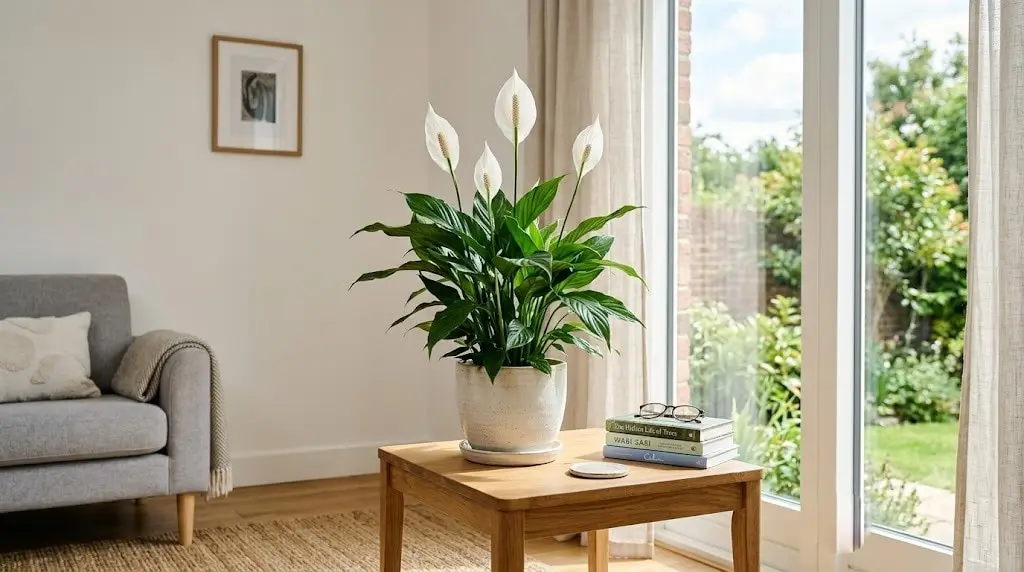
| Peace lily | Peace lily (Spathiphyllum ‘Mauna Loa’) | Partial to deep shade; no direct sun | Toxic |
| Spider plant | Green spider plant (Chlorophytum elatum) | Medium; tolerates deep shade, not direct sun | Non-toxic |
| Gerbera daisy | Gerbera daisy (Gerbera jamesonii) | Full sun to partial shade | Non-toxic |
| Golden pothos | Golden pothos (Scindapsus aureus) | Bright, indirect; survives long periods in low light | Toxic |
| Corn plant and other dracaenas | Janet Craig, Warneckei, Marginata, Mass cane (Dracaena) | Bright to moderate, filtered | Toxic |
| English ivy | English ivy (Hedera helix) | Full sun to deep shade (outdoor record) | Toxic |
| Aloe vera | Aloe vera | Full sun to partial shade | Toxic |
| Chinese evergreen | Chinese evergreen (Aglaonema modestum) | Diffuse sun or good indirect light | Toxic |
| Heartleaf philodendron | Heart leaf philodendron (Philodendron oxycardium) | Medium; tolerates low light | Toxic |
Sources: the tables of the NASA report; NC State Extension’s Plant Toolbox record for each plant, linked in its section below; the ASPCA lists of plants toxic and non-toxic to cats and dogs, with each entry linked in its section. All read on 15 November 2026.
Snake Plant (Dracaena trifasciata)
→ Shop live Snake Plant plants on Amazon
NC State’s snake plant record suggests a spot with direct sun for only part of the day, two to six hours, and says the snake plant will tolerate very low light. Overwatering rots the roots, so the record asks for well-drained soil that dries between waterings from spring to autumn, and watering only every one to two months in winter (NC State). The ASPCA lists the snake plant as toxic to cats and dogs.
Peace Lily (Spathiphyllum)
→ Shop live Peace Lily plants on Amazon
Peace lilies prefer partial to deep shade and should be kept out of direct sun, according to NC State’s peace lily record. The record asks for soil that stays moist without being soggy and is allowed to dry between waterings, and it warns that cold, drafty spots slow growth considerably (NC State). The ASPCA lists the peace lily as toxic to cats and dogs.
Spider Plant (Chlorophytum comosum)
→ Shop live Spider Plant plants on Amazon
The spider plant prefers medium light, can tolerate deep shade and does not tolerate direct sunlight, says NC State’s spider plant record. The same record advises against tap water for it, because chlorine and fluorides can burn the leaf tips (NC State). The ASPCA lists the spider plant as non-toxic to cats and dogs.
Gerbera Daisy (Gerbera jamesonii)
→ Shop live Gerbera Daisy plants on Amazon
NC State’s gerbera daisy record describes a perennial with showy flowers that likes moist, well-drained soil rich in organic matter and full sun, and notes that it is usually treated as an annual. Most of its red, pink, yellow or white flowers come in spring and fall, and the record says to remove spent ones (NC State). The ASPCA lists the gerbera daisy as non-toxic to cats and dogs.
Golden Pothos (Epipremnum aureum)
→ Shop live Pothos plants on Amazon
NC State calls pothos very easy to grow: its pothos record says it prefers bright, indirect light, survives for long periods in low light and wants its well-drained potting medium to dry out between waterings. The record also suggests wiping the leaves now and then with a soft rag to remove dust (NC State). The ASPCA lists golden pothos as toxic to cats and dogs.
Corn Plant and Other Dracaenas (Dracaena)
→ Shop live Dracaena plants on Amazon
The 1989 report tested four plants it filed under Dracaena: Janet Craig, Warneckei, Marginata and mass cane (NASA report). NC State’s corn plant record names ‘Janet Craig’ as one of its cultivars and asks for bright to moderate, filtered light, since direct sun can burn the leaves and too little light makes them narrow. The record links brown leaf tips to low indoor humidity and says a humidifier may help in winter (NC State). The ASPCA lists dracaena as toxic to cats and dogs.
English Ivy (Hedera helix)
→ Shop live English Ivy plants on Amazon
NC State’s English ivy record calls it an invasive species in North Carolina and says it is safer there to grow it as a houseplant or in a patio container. The record warns that touching its sap can badly irritate the skin, with redness, itching and blisters (NC State). The ASPCA lists English ivy as toxic to cats and dogs.
Aloe Vera
→ Shop live Aloe Vera plants on Amazon
NC State’s aloe record asks for full sun to partial shade, very well-drained soil of the kind used for succulents, soil left to dry out completely between waterings and a pot with several drainage holes, clay being best. The ASPCA lists aloe as toxic to cats and dogs.
A ready-made cactus and succulent mix is one way to get that soil:
| Product | Type | What the maker states | Links |
|---|---|---|---|
| Espoma Organic Cactus Mix | Potting mix | For cactus, succulent, palm and citrus container plants; processed forest products, sphagnum peat moss, perlite, humus, limestone and yucca extract | See on Amazon · Maker’s page |
The product is described from the maker’s own page, checked on 15 November 2026; we have not trialed it. There are no prices here: the Amazon link searches for the exact product, and we may earn a commission if you buy through it.
Chinese Evergreen (Aglaonema)
→ Shop live Chinese Evergreen plants on Amazon
NC State’s Chinese evergreen record calls Chinese evergreen one of the easiest plants to grow in a home or office and an excellent choice for low-light indoor spots. It does well in good indirect light or diffuse sun, prefers high humidity but tolerates drier air, and wants its potting mix kept moist from spring to fall, with less water in winter (NC State). The ASPCA lists Chinese evergreen as toxic to cats and dogs.
Heartleaf Philodendron (Philodendron hederaceum)
→ Shop live Heartleaf Philodendron plants on Amazon
Heartleaf philodendron prefers medium light but will tolerate low light, according to NC State’s heartleaf philodendron record, and it can cope with dry air, though it prefers medium humidity and moist soil. The record advises keeping the soil slightly moist and watering less in winter (NC State). The ASPCA lists heartleaf philodendron as toxic to cats and dogs.
What Does Improve Indoor Air
The EPA names three basic strategies for better indoor air: source control, improved ventilation, and air cleaners or filtration (EPA). For most indoor air problems in a home it calls source control the most effective solution, for example sealing or enclosing a source, or adjusting a gas stove so that it gives off less (EPA).
- Control the source. Remove what pollutes the air or cut what it gives off, as above (EPA).
- Ventilate. The EPA lists opening windows and doors, running window or attic fans when the weather allows, and kitchen or bathroom fans that exhaust outdoors (EPA).
- Clean the air. The EPA’s guide says to choose a portable air cleaner whose clean air delivery rate (CADR) is large enough for the room; its chart gives a minimum of 130 cubic feet per minute for a room of 200 square feet with an 8-foot ceiling (EPA guide).
The CADR on an air cleaner’s label covers particles only. For gases, the same guide points to portable units fitted with an activated carbon filter and notes that there is no widely used rating for removing gases (EPA guide). It also says to avoid air cleaners that intentionally produce ozone, a lung irritant, and that the California Air Resources Board and the Association of Home Appliance Manufacturers keep lists of models tested to emit little or no ozone (EPA guide).
Plants can stay for their own sake: the 2020 review suggests that future research look at how plants affect well-being, instead of their ability to clean indoor air (Cummings and Waring, 2020).
Frequently Asked Questions
What are the best plants for air purification?
None stands out, because the EPA says there is no evidence that a reasonable number of houseplants removes significant amounts of pollutants in homes and offices (EPA). The ten on this page are here because they appear in the tables of the 1989 NASA report.
Do air-purifying plants work?
In small sealed chambers they removed chemicals over many hours or days; in a building, the 2020 review calculated that it would take 10 to 1,000 plants per square metre of floor to match ordinary air exchange with the outdoors (Cummings and Waring, 2020).
What about the NASA study?
It was a 1989 report on sealed-chamber tests, and it proposed pairing plants with an activated carbon filter (NASA report). Its results came from chambers, not from homes (Cummings and Waring, 2020).
Which of these plants are safe for pets?
Of the ten here, the ASPCA lists the spider plant and the gerbera daisy as non-toxic to cats and dogs, and the other eight as toxic. If a pet has chewed a plant, call your vet or the ASPCA Animal Poison Control Center; we do not give veterinary advice. More plants are covered in our houseplant guide for homes with pets.
Can houseplants make indoor air worse?
The EPA asks plant owners not to overwater, because overly damp soil may encourage microorganisms that can affect people with allergies (EPA).
Sources
- NASA Technical Reports Server: B. C. Wolverton, Anne Johnson and Keith Bounds, Interior Landscape Plants for Indoor Air Pollution Abatement (final report, 15 September 1989). Read 15 November 2026.
- Cummings and Waring, Potted plants do not improve indoor air quality: a review and analysis of reported VOC removal efficiencies, Journal of Exposure Science and Environmental Epidemiology (2020); abstract read 15 November 2026.
- US Environmental Protection Agency: Improving Indoor Air Quality (last updated 3 August 2026) and Guide to Air Cleaners in the Home (last updated 1 October 2026). Read 15 November 2026.
- NC State Extension Gardener Plant Toolbox: Dracaena trifasciata, Spathiphyllum, Chlorophytum comosum, Gerbera jamesonii, Epipremnum aureum, Dracaena fragrans, Hedera helix, Aloe vera, Aglaonema, Philodendron hederaceum. Read 15 November 2026.
- ASPCA Animal Poison Control Center: plants toxic and non-toxic to cats and to dogs; entries for snake plant, peace lily, spider plant, gerber daisy, golden pothos, dracaena, English ivy, aloe, Chinese evergreen, heartleaf philodendron. Read 15 November 2026.
Recommended Gear on Amazon
- Snake plant (live) - browse current options and reviews on Amazon.
- Golden pothos (live) - browse current options and reviews on Amazon.
- Peace lily (live) - browse current options and reviews on Amazon.
As an Amazon Associate, we earn from qualifying purchases - at no extra cost to you. This helps us keep producing free, in-depth guides.