Getting a Christmas Cactus to Bloom
Holiday cacti set buds when nights get long and cool, so October is when you decide whether yours flowers. How to give it darkness, what makes buds drop, and how to tell a Thanksgiving cactus from a Christmas cactus.
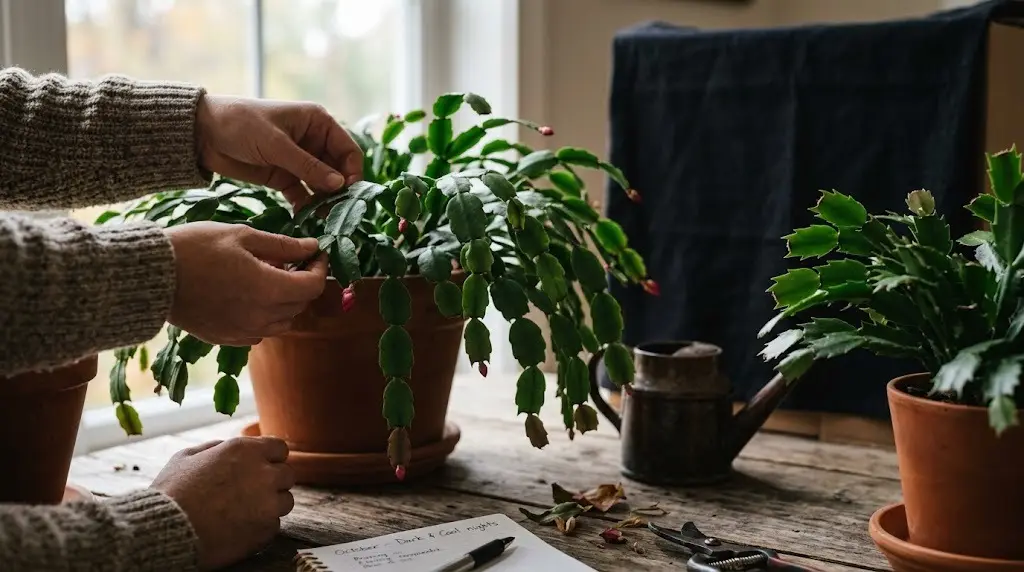
If your holiday cactus grew all summer and never flowered, the fix is darkness. These plants set flower buds in response to long, uninterrupted nights, and a living room with lamps on until midnight never gives them one. Move the plant somewhere that goes properly dark every evening, keep it on the cool side, water a little less, and buds usually show at the stem tips within a few weeks. October is the month to start, because the buds you want for late autumn and winter are decided now.
Which holiday cactus do you have?
Three plants get sold under holiday names, and knowing yours tells you when to expect flowers. NC State Extension describes the Thanksgiving cactus (Schlumbergera truncata) as having pointed, claw-like projections on the stem segments, with flowering in late November. The Christmas cactus (Schlumbergera x buckleyi) has rounded stem margins, flowers that hang down and a bloom season from December to February, according to the same extension service. It adds that most plants sold in stores today are hybrids between the two, so a shop label saying “Christmas cactus” is often a guess.
Look at the edge of a stem segment. Sharp teeth mean Thanksgiving type, smooth scallops mean Christmas type. The Easter cactus is a separate plant with a spring bloom and is outside this guide. Our Christmas cactus profile covers year-round light, soil and watering for the group.
Darkness: the part most people miss
The trigger for buds is night length. NC State lists inadequate dark hours, which it puts at “at least 13 uninterrupted hours”, among the reasons for poor flowering and dropped buds. The key word is uninterrupted. Switching a light on in the middle of the evening breaks the dark period the plant is responding to, so a spare bedroom you walk through with the light on is a worse spot than it looks.
Ways to get it:
- A room nobody uses after sunset. A guest room, an unheated porch that stays above freezing, a cool hallway with no lamp.
- A cover in the evening. A cardboard box or an opaque cloth bag over the plant each evening, taken off in the morning. It works if you are consistent, and it is easy to forget for a night.
- Natural autumn nights. A north or east window in a room you do not light in the evening may be enough on its own as days shorten.
Give the plant bright, indirect light during the day. Darkness at night does not mean a dim life; the plant still needs daytime light to build the energy for flowers. Our piece on why houseplants slow down in autumn explains how much window light drops at this time of year.
Cool nights help
Temperature is the second lever. NC State notes that you can also force flowering with night temperatures of 40 degrees (Fahrenheit) for several successive nights. You do not need to chill the plant that hard. A room that cools down noticeably at night, away from radiators and heat vents, pushes it in the same direction. Do not leave it outside on a frosty night; “cool” and “freezing” are very different things for a houseplant.
Combining long nights with cooler temperatures is the most reliable setup. If you can only manage one, darkness matters more.
Watering and feeding while buds form
During bud set, water a little less than in summer. Let the top of the mix dry before watering again, then water thoroughly and let the pot drain. NC State describes holiday cacti as epiphytic, meaning they grow on other plants in the wild, and they dislike both a bone-dry pot and soggy roots. NC State warns that root rot can be a problem for overwatered plants. Our watering guide has the finger test and other ways to check.
On feeding, the same extension page advises fertilizing monthly once new growth starts in spring and reducing fertilizer in fall and early winter. There is no need to add a “bloom booster” in October; a plant pushed into new leafy growth now is busy with the wrong thing.
Why buds drop before they open
Few things are more annoying than a plant covered in pink buds that fall off one by one. NC State lists the causes together: too few dark hours, sudden temperature changes, lack of moisture, or light changes. In practice, that list describes three common situations:
- Moving the plant once buds appear. Carrying it from a cool, dark back room to a warm, bright coffee table is a change in light and temperature at once. Pick its display spot before buds form, or move it gradually.
- A heater or a draught. A pot next to a radiator, a heat vent, or an outside door that opens to cold air gets swings in temperature all day.
- Letting the pot dry out hard. Developing buds use water. A pot left bone-dry for days during bud set is a common reason for losing them.
Turning the pot to “show the good side” is also a light change. Leave it facing the same way until flowers open.
After flowering
When the last flowers fade, let the plant rest in a bright spot with slightly drier soil for a while. NC State notes that a Thanksgiving cactus may bloom a second time as days lengthen in February, so do not rush to cut it back. Repotting, if needed, is a spring job; the extension page suggests repotting every three years or so, since the plant does well slightly pot-bound. For the rest of the cold season, our winter houseplant care guide covers light, humidity and heating.
If you keep it in the same pot, same window and same routine every autumn, a holiday cactus becomes one of the more predictable flowering houseplants you can own.
Recommended Gear on Amazon
- Cactus and succulent potting mix - browse current options and reviews on Amazon.
- Indoor-outdoor thermometer - browse current options and reviews on Amazon.
- Soil moisture meter - browse current options and reviews on Amazon.
As an Amazon Associate, we earn from qualifying purchases - at no extra cost to you. This helps us keep producing free, in-depth guides.