Why Houseplants Slow Down In Autumn
Autumn growth stalls because indoor light collapses far faster than the temperature does - often 70 to 90 percent between August and November. Here is what to change, what to leave alone, and how to tell a slowdown from a problem.
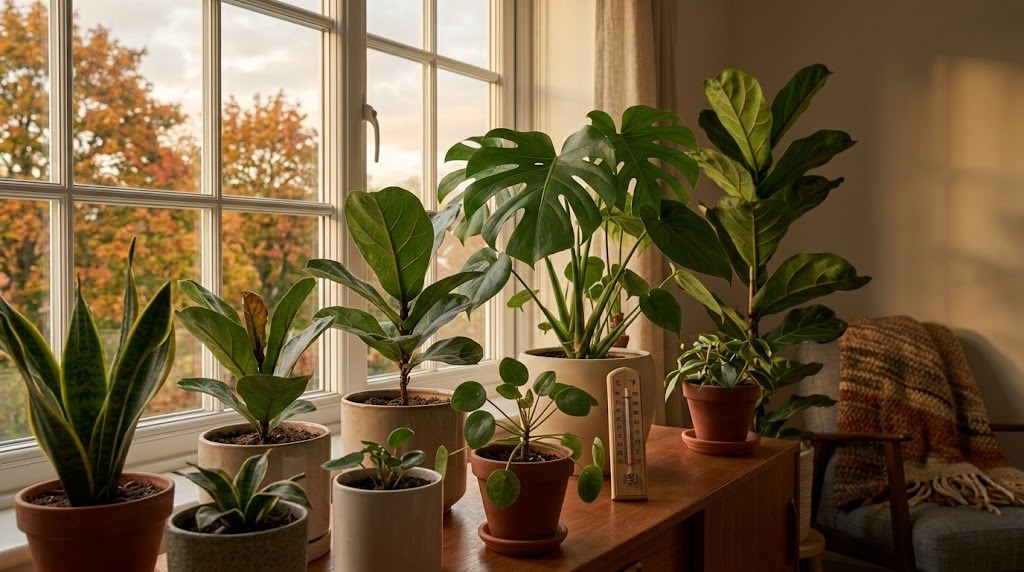
The short version: houseplants slow down in autumn because the light collapses, not because the room got colder. Between late August and late November, the usable light at a typical indoor windowsill drops by something like 70 to 90 percent - shorter days, a lower sun angle, more cloud, and dirtier glass all stacking together. Your thermostat hides the season from the plant’s leaves but not from its light meter.
That single fact drives every autumn care change worth making. A plant taking in a fraction of the energy cannot use the same amount of water, cannot use the same amount of fertiliser, and cannot recover from disturbance at the same rate. Almost every autumn houseplant failure is somebody keeping summer habits into a winter light budget.
The light maths, roughly
The useful measure is daily light integral - the total photons a leaf receives over a day. Outdoors in June, an open site might see 30 to 60 mol per square metre per day. A bright south-facing windowsill in midsummer might manage 5 to 15. The same windowsill in November often sits at 1 to 3, and a north-facing room can fall under 1.
Three things compound at once. Daylength shrinks by several hours. The sun sits lower, so light passes through more atmosphere and strikes the window glass at a shallower angle, which reflects more of it away. And autumn cloud cover in most temperate regions is simply heavier than summer cloud. None of these are visible to your eyes, because human vision adapts logarithmically - a room that reads as “still quite bright” in October can be delivering a tenth of its July light. If you want a number rather than an impression, our light checker tool is a more honest judge than memory.
What a normal slowdown looks like
Healthy autumn slowdown is boring, which is the point:
- New leaves arrive at longer intervals, and the newest ones are slightly smaller than the summer flush
- Soil stays wet noticeably longer between waterings
- The plant looks static for weeks at a time without deteriorating
- Older lower leaves may yellow and drop occasionally, one at a time, while the crown stays firm
What is not a slowdown: several leaves yellowing at once, soft or mushy stem bases, a sour smell from the compost, leaves going limp while the soil is wet, or fresh growth emerging pale, stretched and floppy. The first group is seasonal. The second group is usually root damage from watering on a summer schedule, and the last is a light problem the plant is trying to solve by reaching.
Watering is the main thing to change
Change the interval, not the amount. When you do water, water properly - until it runs freely from the drainage hole - but wait considerably longer between times. In practice that often means intervals stretching by 50 to 100 percent, so a plant on a weekly summer rhythm may want water every ten to fourteen days by November.
Do not switch to a calendar. Check instead:
- Lift the pot. Weight is the most reliable signal most people have. Learn what dry and freshly watered feel like for each plant, and the guesswork mostly disappears.
- Push a finger in to the second knuckle, or use a wooden skewer, which comes out damp and darkened if there is still moisture at depth.
- Ignore the surface. Heated indoor air dries the top centimetre fast while the root ball below stays saturated for days.
- Empty saucers within half an hour. Standing water in low light is the single most common autumn killer.
Our watering guide covers the technique itself, and the watering calculator gives a starting interval you can then adjust by pot weight.
Fertiliser: stop, or nearly
A plant that is not making new tissue has no use for a nitrogen supply, and unused salts accumulate in the compost where they draw water away from roots and burn root tips. For most foliage houseplants, the sensible autumn move is to taper feeding through September and stop by mid-October, resuming when you see genuine new growth in late winter or spring.
The exception is a plant under strong artificial light on a long photoperiod, which is not really experiencing autumn at all and can keep growing at a reduced feed. Our fertilising guide has the dilution details.
What not to do in autumn
Do not repot. Root disturbance costs the plant energy it cannot currently earn, and fresh compost around an under-used root ball stays wet. Unless a plant is genuinely failing in its pot, wait for spring.
Do not chase the light with constant moves. Moving a plant to a brighter spot once, deliberately, is good. Shuffling it weekly is not - leaves acclimate over two to three weeks, and repeated moves keep them permanently mid-adjustment.
Do not prune hard. Cutting back is a growth-season job. Removing genuinely dead material is fine at any point.
Do not park anything against cold glass or above a radiator. The two worst microclimates in the house sit within a metre of each other in most rooms, and the combination of chilled leaves and bone-dry rising air is why windowsill plants look worse than the ones a metre back. The rest of the winter picture is in our winter houseplant care guide.
Slowdown versus true dormancy
Most tropical foliage plants do not have real dormancy. They just idle, and they will resume whenever the light does. Monstera, pothos, philodendron, ficus and the aroids generally sit in this group.
A smaller set genuinely rests, and treating a resting plant like an idling one causes problems. Many desert cacti want a cool, near-dry winter rest to flower properly the following year. Caudex and tuberous species may drop all their leaves on purpose and should then be kept barely moist. Cyclamen and a few others invert the calendar entirely, growing through winter and resting in summer - a cyclamen going limp in July is on schedule, not dying.
Knowing which category a plant sits in decides whether you are looking at a rest to be respected or a decline to be investigated. When in doubt, the safe autumn default is more light, less water, no fertiliser, and patience until February.