How to Quarantine New Houseplants
Two to four weeks of isolation catches the pests that shop lighting hides - spider mites, thrips, mealybugs and scale - before they reach the rest of your collection. Here is a realistic setup, the inspection schedule that actually finds things, and why the fourth week matters most.
The short version: keep every new plant physically separated from your existing ones for at least two weeks, and four if you can manage it, check it every three to four days with a hand lens, and treat the fourth week as the important one rather than the first. Most pest problems in home collections arrive on a purchased plant, not on the air. The infestation you eventually notice on six plants started on one, and almost always during the two weeks when nobody was looking.
This matters more in autumn than in summer. Plants bought now go into rooms that are heating up and drying out, and warm dry air is close to ideal for spider mites. A pest that would have stayed marginal outdoors can double its population in days indoors.
Why the shop plant looks clean and is not
Retail display conditions actively hide infestations. Plants are usually lit from above and viewed from the front, at about a metre, in a shop that has had them for a week or two. The three things that give pests away - the underside of leaves, the point where each leaf meets the stem, and the top centimetre of soil - are all in shadow or out of sight.
The four pests worth planning around behave differently, which is exactly why a single glance fails:
- Spider mites. Under 0.5 mm, usually on leaf undersides. What you see first is stippling - a fine pale speckling on the upper leaf surface - not the animal. Visible webbing means the population has already been building for weeks.
- Thrips. Slim, fast, and they hide in new growth and flower buds. The signature is silvery scarring with tiny black specks of frass. Adults drop or fly when disturbed, so a plant can read clean while you are holding it.
- Mealybugs. White cottony clusters in leaf axils, under the pot rim, and down at the soil line. The crawler stage is nearly invisible and is how they spread.
- Scale. Immobile brown or tan bumps on stems and midribs that look like part of the plant. People routinely miss these for months because they do not move.
Add fungus gnats, which are harmless to a healthy plant but multiply fast in the peat-heavy mixes nurseries use, and you have the standard cast. Our houseplant pest identification guide has the detail on telling them apart, and fungus gnats get their own write-up because the fix is different - it is a soil and watering problem rather than a foliage one.
A quarantine setup that people actually maintain
The perfect version is a separate room. The version that works in a flat is more modest, and modest is fine as long as you get the separation right.
Distance beats barriers. A different room is best. A different corner of the same room, two metres from the nearest plant, is meaningfully better than nothing. What you are preventing is contact - touching leaves, shared drip trays, and your own hands moving between plants. Spider mites travel by walking and by hitching a ride on you; two metres of still air is a real obstacle to them.
Do not share tools or water trays. One set of scissors for quarantine, or wipe the blades with alcohol between plants. Never let a quarantined plant sit in a tray with anything else.
Work in order. Handle your established plants first and the quarantined ones last, every time. Wash your hands afterwards. This one habit prevents more spread than any spray.
Give it enough light to grow. A quarantine plant that is sulking in a dark hallway will not show you new growth, and new growth is where thrips and mites declare themselves. Put it somewhere it can actually grow - if you are not sure what a spot delivers, the light checker tool will give you a realistic reading rather than a guess.
Leave the repotting for later. Resist the urge to repot on day one. You want the plant stable and observable, not recovering from root disturbance, and a fresh pot makes the soil surface harder to read. Wait until quarantine ends.
The inspection schedule
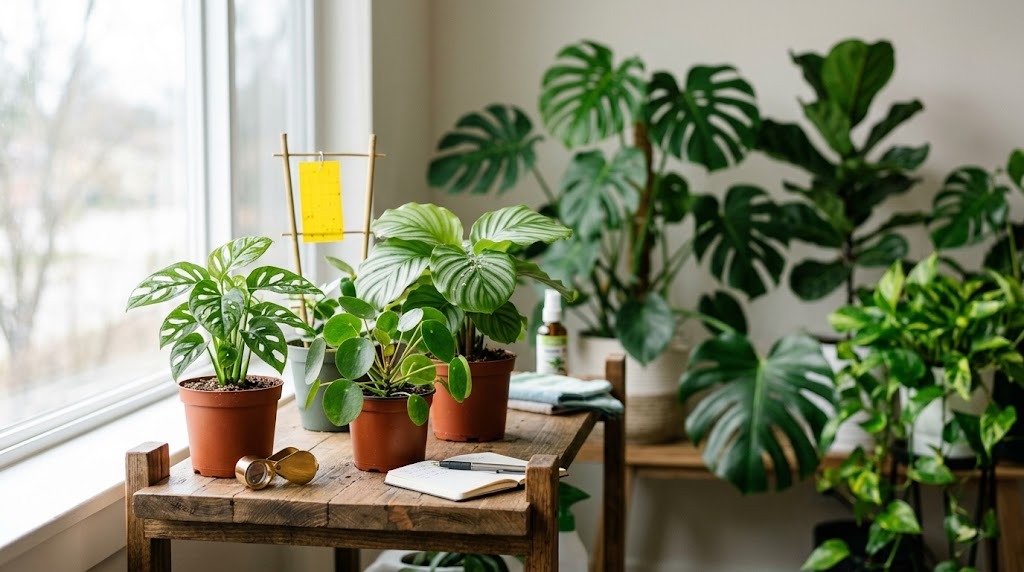
Check on day 1, then every three to four days. Five minutes, with a 10x hand lens or your phone camera at maximum zoom.
Each check, look at:
- Leaf undersides, especially along the midrib. Turn the leaves over. This is not optional; it is where two of the four pests live.
- Leaf axils and the growing tip. New growth is the richest feeding site and the first place thrips damage appears.
- Stems and the underside of the pot rim. Scale and mealybugs favour both.
- The soil surface. Tap the pot and watch for fungus gnats lifting off.
The white paper trick is worth the ten seconds it takes: hold a sheet of white paper under a branch and tap it sharply. Mites and thrips that will not show themselves on a leaf show up immediately as moving specks against white.
Keep a note of what you saw and when. On a plant you check every few days, the thing you are trying to detect is not a pest - it is a change, and memory is unreliable across three weeks.
Why the fourth week is the one that counts
Egg timing is the whole argument for a longer quarantine. Spider mite eggs hatch in roughly three to seven days depending on temperature; thrips usually pupate in the soil rather than on the plant, and the whole egg-to-adult cycle runs two to three weeks at room temperature and longer in a cool room. A plant that was treated at the nursery before sale can be genuinely clean of adults on the day you buy it and still be carrying a generation that has not emerged yet.
Two weeks catches most of it. Four weeks catches the second generation, which is the one that would otherwise emerge a few days after you decided the plant was fine and moved it next to everything else. If you have a large collection, or you have just spent a season clearing an infestation, the extra fortnight is cheap insurance.
Release the plant only after two consecutive clean inspections at the end of the period. If you find something, the clock restarts from the day the last live pest is found - not from the day you started treating.
Adjusting for where the plant came from
Not every plant needs the full four weeks.
- Big-box retail and supermarket plants: full quarantine, no exceptions. High turnover, mixed stock, plants from several growers sharing a bench.
- Specialist nurseries and reputable online sellers: still quarantine, but two to three weeks is usually proportionate. Their pest management is generally better, and a good seller would rather hear about a problem than not.
- Cuttings and swaps from other hobbyists: quarantine at full length. Enthusiast collections are where the interesting pests circulate, and an unrooted cutting can carry mite eggs perfectly well.
- Plants that spent the summer outside: treat them as new arrivals coming back in. That is a slightly different job, covered in moving houseplants back indoors.
Four weeks of a plant sitting in the spare room feels like an overreaction right up until the first time you skip it. The cost of quarantine is patience. The cost of skipping it is usually several months of treating a whole collection, and sometimes losing the plants that were hardest to replace.
🛒 Recommended Gear on Amazon
- Neem oil spray - browse current options and reviews on Amazon.
- Yellow sticky traps - browse current options and reviews on Amazon.
- Jeweller’s loupe - browse current options and reviews on Amazon.
As an Amazon Associate, we earn from qualifying purchases - at no extra cost to you. This helps us keep producing free, in-depth guides.