Moving Houseplants Back Indoors
Bring summer holiday plants in before nights hit 10-12C, and do it over 10-14 days rather than in one afternoon. Here is the pest check, the light step-down, and why leaves drop anyway.

The short version: start moving houseplants back inside when night temperatures are heading for 10-12C, not when they actually arrive, and spread the move over 10 to 14 days. Almost every problem people blame on “the shock of coming indoors” is really one of two things - pests that hitched a ride, or a light drop of 90 percent or more in a single afternoon. Both are avoidable, and neither is fixed after the fact.
Late August is the window in most temperate climates. If you are further north, you may already be behind. If you are somewhere Mediterranean or in the southern US, you have until late September or October. Check your local first-frost date against the hardiness zones tool rather than going by the calendar, because the useful number is nights, not dates.
Why 10-12C and not first frost
Most common tropical houseplants stop growing somewhere in the 10-15C range and start suffering chilling damage below about 10C, well before anything freezes. Chilling injury does not look like frost damage. There is no blackening overnight. Instead you get soft, water-soaked patches on leaves, then yellowing, then leaf drop over the following two or three weeks, by which point the cold snap is long forgotten and the plant appears to be dying indoors for no reason.
Tender favourites are the least forgiving. Anything in the Begonia, Alocasia, Calathea or Codiaeum groups will register a single 8C night. Succulents and pelargoniums shrug off far more, and many will happily sit out to 4-5C. Move the sensitive ones first and let the tough ones stay out and colour up.
The practical rule: watch the 10-day forecast, and act when the lowest predicted night is within about 3C of your threshold. Forecasts miss, and a sheltered patio is often 2C colder than the airport figure the app is quoting you.
The pest quarantine, which is the part people skip
A plant that spent 12 weeks outdoors is not the same plant that went out in May. It has been colonised. Spider mites, mealybugs, scale, aphids, and fungus gnat larvae in the top few centimetres of compost are all normal passengers, and outdoors they were held in check by predators, rain, and wind. Indoors, in warm dry air with no predators, a population that was invisible in September becomes a full infestation by November.
Do this before anything crosses the threshold:
- Hose the whole plant, undersides of leaves included, at moderate pressure. This alone removes a large share of mites and aphids mechanically.
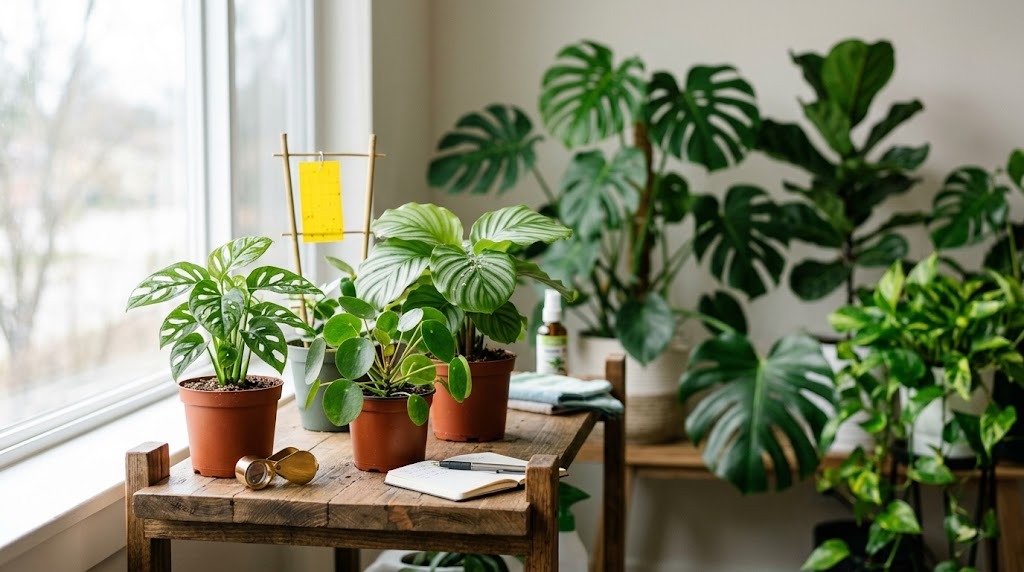
- Inspect the leaf undersides and the leaf axils in good light. Mealybugs look like small scraps of cotton wool in the joints. Scale looks like brown limpets on stems and midribs, and does not brush off easily.
- Check the drainage holes for slugs, woodlice and ants that have moved into the root ball.
- Consider a top-up of fresh compost on the surface, or scrape off the top 2cm, which removes most fungus gnat eggs.
- Quarantine for two weeks in a separate room from your permanent indoor collection, and look again at day 7 and day 14. Two weeks covers a full spider mite generation and most fungus gnat hatches; mealybugs and scale cycle more slowly, so keep checking the leaf joints and stems for another month after the quarantine ends.
If something does turn up, our houseplant pests guide covers identification in more detail, and the specific misery of gnats has its own fungus gnat guide.
Repotting at this point is tempting and usually a mistake. You are about to ask the plant to cope with a large light reduction, and root disturbance on top of that is two stresses at once. Unless the plant is genuinely root-bound and you have no choice, wait for spring.
The light problem nobody expects
This is the bigger of the two issues, and it is invisible.
Bright shade outdoors is somewhere around 10,000 to 25,000 lux. A spot one metre back from a bright north window is often 500 to 1,500 lux. Moving a plant from one to the other is a 90 to 95 percent cut, and the plant’s summer leaves are physically built for the brighter setting - thicker, with more chlorophyll packed per area. They cannot be rebuilt, so the plant sheds them and grows thinner shade leaves instead.
That is why a healthy plant drops a third of its foliage two weeks after coming in, and why panicking and watering more makes it worse.
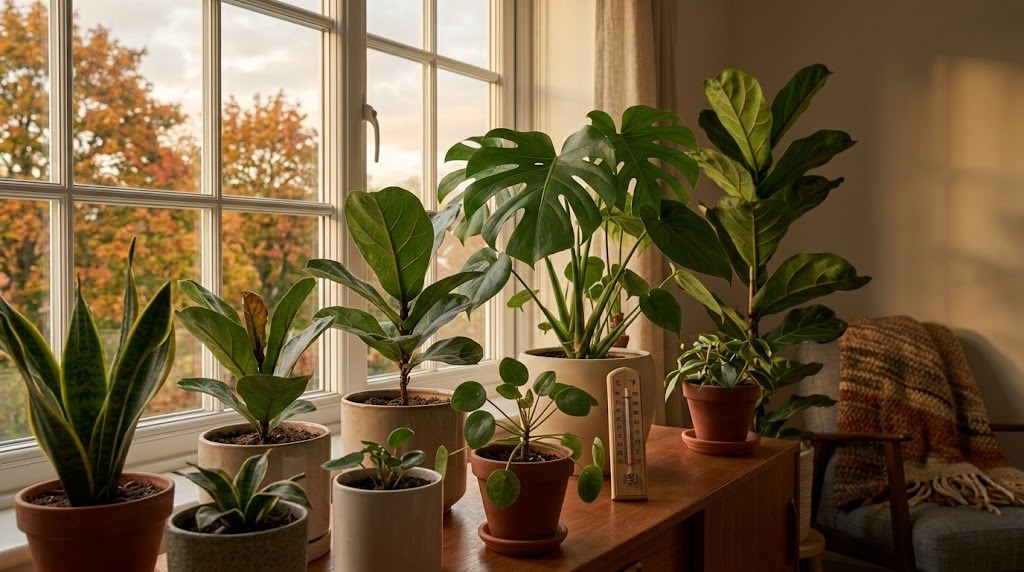
You can soften this. Step the plant down over 10 to 14 days: full position, then a shadier outdoor spot, then a porch or unheated conservatory, then its indoor place. Give it the brightest window you have for the first month, even if that is not where you want it long term. Clean the glass, which is worth a surprising amount in autumn. And measure rather than guess with the light checker, because human eyes adjust automatically and are terrible at estimating this.
Some leaf loss is still normal and healthy. Judge the plant by whether new growth appears, not by whether old leaves stay.
Water and feeding change too
Cooler air, lower light, and a shorter day all mean less water use. A plant on a five-day cycle outdoors in August may want 10 to 14 days by October. Keep watering to the same schedule and you will rot the roots of a plant that looks thirsty because it is dropping leaves. Check the top few centimetres with a finger before every watering and skip when in doubt. The watering calculator is a starting point, not a schedule to follow blindly through a season change.
Stop or heavily reduce fertiliser from about now until late February. Feeding a plant that is not growing pushes salts into the compost that the roots never take up, and the visible result is brown, crisp leaf tips in midwinter.
Humidity is the reverse problem. Once heating comes on, indoor air often falls to 25-35 percent relative humidity, which is drier than most tropical houseplants have experienced all summer. Grouping plants together helps a little, trays of pebbles help a little, and a small humidifier helps a lot. We go into the numbers in humidity for houseplants.
A realistic timeline
Two weeks out, inspect and hose everything, and start the shade step-down for the tender plants. One week out, bring the sensitive group into quarantine and check the forecast again. Move the tough ones as the nights close in, and give the whole collection its winter positions once the two-week quarantine clears.
Then leave them alone. The plants that struggle in November are almost always the ones that got repotted, fed, and watered on a summer schedule by an owner trying to help. Once they are in, less is genuinely more, and the rest of the season is covered in our winter houseplant care guide.
🛒 Recommended Gear on Amazon
- Insecticidal soap - browse current options and reviews on Amazon.
- Plant saucers - browse current options and reviews on Amazon.
- LED grow light - browse current options and reviews on Amazon.
As an Amazon Associate, we earn from qualifying purchases - at no extra cost to you. This helps us keep producing free, in-depth guides.