How to build a pond.
A pond is the single best thing you can add to a garden for wildlife, and a simple one is well within a weekend's work. You don't need pumps and gadgets - the most alive ponds are just a well-shaped hole, a liner, and the right plants doing the filtering. Here's the order of work for a beginner.
A pond is a real drowning risk to young children, who can drown in just a few centimetres of water in moments and without a sound. If small children can reach the garden, fence the pond securely, cover it with a rigid mesh grid at water level, or wait until they're older. Never rely on supervision alone. This is a serious decision, not a detail - please treat it as one.
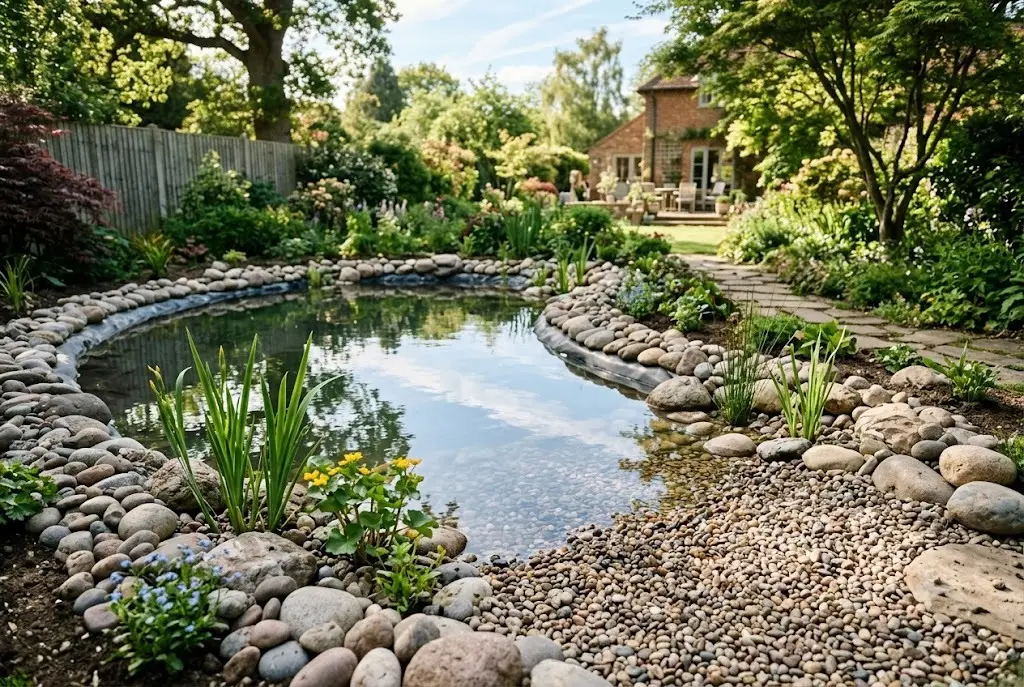
A wildlife pond (gently sloping, planted, no pump) is the easiest and best for nature. A formal pond (crisp edges, often a pump and fish) is more work. Pick a level spot with some sun for lilies but not baking all day, away from overhanging trees that drop leaves.
Bigger is more stable and easier to keep clear - go as large as you sensibly can. Include a shallow shelf (about 20-30 cm) for marginal plants and a deep zone (at least 60 cm, more if you want fish or to stop it freezing solid) in the middle. A shallow beach edge lets wildlife get in and out.
Mark the outline with a hose or rope, dig to your zones, and remove sharp stones and roots. Check the rim is dead level all the way round with a plank and spirit level - a pond that's out of level shows an ugly liner edge on the high side and overflows the low one.
A flexible liner (butyl or EPDM) over a protective underlay fits any shape and lasts decades - the usual choice. A rigid preformed shell is quicker for a small pond but limits the shape and shelves. Whichever you use, cushion the hole with underlay or soft sand first so nothing punctures it.
A wildlife pond thrives with no pump at all - plants do the work. Add a pump and filter mainly if you keep fish or want a fountain or waterfall. Size the pump to your pond's volume (a filter usually wants the whole volume turned over every hour or two) - the calculator below helps.
Fill it (ideally with rainwater; tap water is fine but let it stand a day or two). Let it settle, then plant in stages by zone - oxygenators and marginals first, a lily last. Go easy: it always looks sparse at first and fills in fast. See the pond-plant guide for what goes where.
New ponds almost always go pea-green for a few weeks as they find their balance; it clears on its own as plants establish and shade the water. Resist the urge to empty and refill. Top up in summer, net leaves out in autumn, and thin overgrown plants once a year.
Ready to plant it up? Head to the pond plants guide for marginal, floating, oxygenating and deep-water picks by zone, size your pump with the pond volume calculator, and remember the golden rule: plants, not gadgets, keep a pond clear.
General guidance for a small garden pond, not engineering or legal advice. Large ponds, dams, or ponds near boundaries and services may need permissions or professional design - check locally. Above all, take the child-safety warning above seriously.