Fiddle Leaf Fig (Ficus lyrata)
Ficus lyrata, the fiddle-leaf fig or banjo fig, is a small tropical tree and broadleaf evergreen from western and central Africa, popular as a houseplant, with large, broad, lyre-shaped leaves up to 18 inches (46 cm, computed) long (NC State Extension).
Last reviewed: November 2026
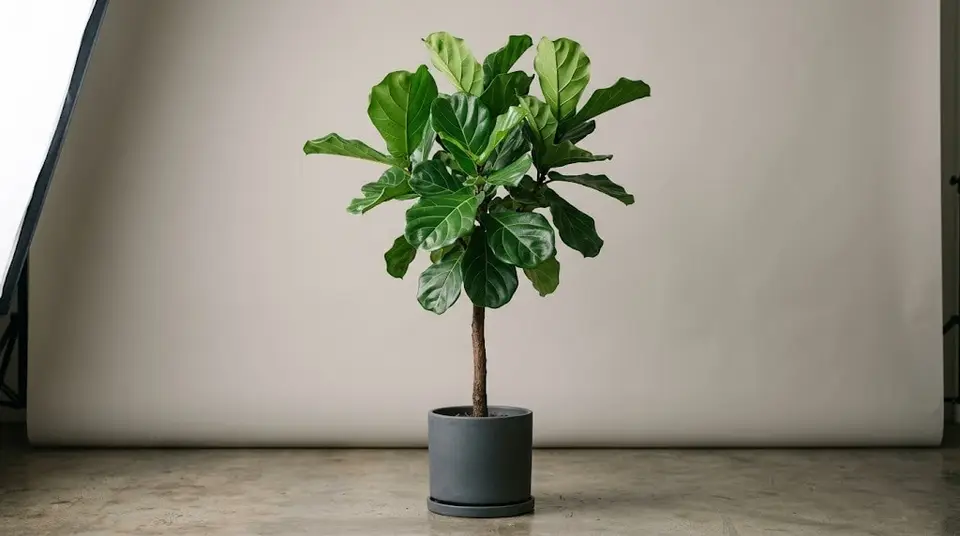 AI illustration
Overview
Ficus lyrata, the fiddle-leaf fig or banjo fig, is a small tropical tree and broadleaf evergreen from western and central Africa, popular as a houseplant, with large, broad, lyre-shaped leaves up to 18 inches (46 cm, computed) long (NC State Extension). As a houseplant it grows 2 to 10 feet (0.6-3 m, computed) tall, rarely flowers or fruits, and counts as relatively low-maintenance, though it is sensitive to overwatering (NC State Extension). The RHS says ornamental figs are generally easy to grow and long-lasting when they get bright indirect light, a warm, even temperature and medium to high humidity (RHS). This page sets out what that means in a real room, and says so where the sources do not agree.
Origin & Natural Habitat
NC State Extension says the plant is native to tropical regions of western and central Africa, where it grows 60 to 100 feet (18-30 m, computed) tall, erect and vase-shaped, and bears figs singly or in pairs; in tropical climates it is often used as an ornamental shade tree (NC State Extension). The RHS plant profile gives its range as tropical West and Central Africa and describes a robust evergreen tree to 5 m (16 ft, computed) or more (RHS plant profile). A Penn State Extension Master Gardener column says it has been growing in popularity as a houseplant since the 1970s (Penn State Extension).
Names
The genus name Ficus comes from the Latin name for an edible fig, and lyrata means "in the shape of a lyre", after the leaves (NC State Extension). NC State Extension also lists the earlier name Ficus pandurata and the common names banjo fig and fiddle-leaf fig (NC State Extension).
Appearance
NC State Extension describes large, leathery, coarse, fiddle-shaped leaves up to 18 inches (46 cm, computed) long and 12 inches (30 cm, computed) wide, and its leaf notes in the same record give a smaller 12 by 5 inches (30 by 13 cm, computed) (NC State Extension). The RHS plant profile describes glossy dark green, obovate or fiddle-shaped leaves to 45 cm (18 in, computed) long, with the veins impressed above (RHS plant profile). The two differ on the shine: NC State Extension says the leaves are bullate and not glossy (NC State Extension), while the RHS calls them glossy in its profile and shiny in its growing guide (RHS).
Young plants are scarcely branched, stiff and sturdy, without aerial roots, and the bark is brown and flaky at first and turns gray and smooth as the tree matures (NC State Extension). The RHS says flowers and fruits are not seen on container-grown plants (RHS plant profile).
Cultivars:
- 'Bambino' - a dwarf variety that grows a few feet tall (NC State Extension); the RHS lists a compact, upright shrub of 1-1.5 m (3.3-4.9 ft, computed), with a spread of 0.5-1 m (1.6-3.3 ft, computed) (RHS 'Bambino' profile).
- 'Compacta' - grows up to 5 feet (1.5 m, computed) tall, with smaller leaves (NC State Extension).
- 'Little Sunshine' - a small plant with bright, violin-shaped green leaves (NC State Extension).
- 'Variegata' - green and cream leaves, an uncommon variety (NC State Extension).
Checked: 21 November 2026.
Why People Grow It - Uses & Benefits
- A focal point: NC State Extension says it can make a great focal point in a living room or office space and, being texturally heavy, is best suited for large spaces (NC State Extension).
- Height on a small footprint: the RHS says its upright growth means it does not take up too much floor space, even when quite tall (RHS).
- Leaves all year: it is a broadleaf evergreen, and NC State Extension lists its foliage as year-round (NC State Extension).
- A long-lived plant: the RHS says ornamental figs can live for many years, and that some form quite large specimens over time (RHS).
- Summer on the patio: in a container it can go out to a sheltered deck or patio for the summer (NC State Extension).
Care
Fiddle leaf fig care at a glance.
| What | What the sources say | Source |
|---|---|---|
| Light | Bright indirect light or partial shade, protected from afternoon sun | NC State Extension |
| Water | Regularly in spring and summer, compost drying slightly in between; only just moist in winter | RHS |
| Soil | Moist, well-drained, loamy and acidic | NC State Extension |
| Temperature | Above 55 °F (13 °C, computed); the RHS says most figs above 10-13 °C (50-55 °F) | NC State Extension, RHS |
| Humidity | Medium, or medium to high | NC State Extension, RHS |
| Feeding | High-nitrogen fertiliser, spring to late summer | RHS |
| Repotting | Every couple of years, in spring | RHS |
Light
Give it bright indirect light or partial shade, out of the afternoon sun (NC State Extension). The RHS growing guide for ornamental figs also asks for bright indirect light, and says some can tolerate a few hours of morning or evening sun, especially in winter (RHS). The RHS plant profile for this species lists full sun in a west- or south-facing, sheltered spot (RHS plant profile), so the sources do not agree on direct sun. For a plant in a room we follow the two care guides: a bright spot out of hot afternoon sun, because NC State Extension says leaf scorch can occur if the plant gets too much direct sunlight (NC State Extension). To judge your own window, see our window light guide.
Watering
Water regularly in spring and summer, when the plant is growing; the RHS says to use room-temperature water and let the compost dry out slightly between waterings, then keep it only just moist in winter (RHS). NC State Extension says the fiddle-leaf fig is sensitive to overwatering and that leaf drop may come from too much or too little water (NC State Extension). A Penn State Extension Master Gardener column checks the soil with a moisture meter or a finger about 2 inches (5 cm, computed) deep, and warns against letting it dry until it pulls away from the pot, because water then runs down the inside of the pot instead of reaching the root ball (Penn State Extension). None of these sources gives a fixed number of days, so check the soil each time rather than watering by the calendar.
Soil & Potting
NC State Extension says it prefers moist, well-drained, loamy, acidic soils (NC State Extension), and its record lists acid soil, below pH 6.0 (NC State Extension). The RHS suggests a loam-based potting compost, such as peat-free John Innes No 3, with added fine bark chippings, and says a peat-free multi-purpose compost would also suit (RHS); its plant profile accepts acid, alkaline or neutral pH (RHS plant profile), so the two differ on pH. For more on mixes, see the best soil and potting mix for houseplants.
| Product | Type | What the maker states | Links |
|---|---|---|---|
| Espoma Organic Potting Mix | Potting mix | For indoor and outdoor containers; processed forest products, sphagnum peat moss, perlite, humus and limestone, with organic nutrients and mycorrhizae | See on Amazon · Maker's page |
| Dr. Earth House Plant Potting Soil | Potting mix | For indoor containers and house plants; kelp flour and alfalfa meal, beneficial microbes and mycorrhizae; OMRI listed | See on Amazon · Maker's page |
| Espoma Organic Perlite | Perlite | Lightweight volcanic granules that create pore space and prevent compaction in potting mixes | See on Amazon · Maker's page |
| Espoma Indoor! | Organic liquid plant food | For all houseplants; dose and interval are on the maker's page | See on Amazon · Maker's page |
How we put this together. The soil advice above is from NC State Extension and the RHS; the products are described from the makers' own pages, checked on 26 October 2026, and we have not trialed them. The RHS recommends peat-free compost, while the Espoma potting mix lists sphagnum peat moss among its ingredients. There are no prices here: the Amazon links search for the exact product, and we may earn a commission if you buy through them.
Humidity & Temperature
NC State Extension says the plant performs best in medium relative humidity with a temperature greater than 55 °F (13 °C, computed) (NC State Extension). The RHS asks for a warm, even temperature, without large fluctuations and away from draughts, and says most ornamental figs must be kept above 10-13 °C (50-55 °F) (RHS). For humidity, the RHS suggests medium to high levels, misting the leaves regularly, particularly in hot weather, and standing the container in a tray of damp gravel with the water level just below the surface (RHS). NC State Extension adds that brown spots may appear when room temperature fluctuates at heating or cooling vents (NC State Extension), so keep the plant away from them.
Can it go outside?
NC State Extension says the fiddle-leaf fig can be planted outdoors in hardiness zones 10 through 12, and that in a container it can go out to a sheltered deck or patio for the summer and come back indoors as outdoor temperatures start to drop in the fall (NC State Extension). The RHS rates it H1B, a plant that can be grown outside in the summer, with a minimum temperature range of 10-15 °C (50-59 °F, computed), and says its ratings refer to UK growing conditions (RHS plant profile). A Penn State Extension Master Gardener column warns that the leaves can sunburn: it starts plants in a shady spot, watches them for a few days, then moves them into filtered light, keeps them out of direct sun, and checks closely for bugs before bringing them back in (Penn State Extension).
Checked: 21 November 2026.
Feeding
The RHS says you can feed with a high-nitrogen fertiliser from spring to late summer to encourage leafy growth (RHS), and it lists too much fertiliser among the causes of sudden leaf drop (RHS). Follow the product label for the amount.
Repotting
The RHS says to move the plant into a slightly larger container every couple of years in spring (RHS). In the years between, or once the plant is too large to repot, it says to scrape off the top 2.5 cm (1 in) of compost and replace it with fresh compost (RHS). For the method, see how to repot a houseplant.
Pruning & Cleaning
The RHS says ornamental figs need little or no pruning, but that a vigorous plant can be cut back to reduce its size and that most figs cope well, even with hard pruning: in late winter or early spring, shorten any overly long shoots, cutting just above a leaf (RHS). Always wear gloves, since the sticky white sap may irritate skin or aggravate allergies (RHS). A Penn State Extension Master Gardener column wipes the leaves top and bottom with a damp cloth about every few months, and uses the moment to check for brown spots and pests (Penn State Extension). For more, see how to clean houseplant leaves.
Propagation
The RHS plant profile lists propagation by seed, leaf-bud or semi-hardwood cuttings (RHS plant profile). Its growing guide for ornamental figs covers cuttings and air layering (RHS). For more on methods, see our propagation guide.
Propagation steps
- Wear gloves: NC State Extension recommends them particularly when pruning or propagating, because the sap can irritate the skin (NC State Extension).
- Pick the season: the RHS takes semi-ripe cuttings of ornamental figs in spring or summer (RHS).
- Keep them warm: the RHS says a heated propagator will aid rooting (RHS).
- Or air layer a stem: the RHS says some figs, including the rubber plant, can be air layered in spring or late summer, with rooting taking about a year, and that you need a sharp knife, a couple of handfuls of sustainably sourced sphagnum moss, a piece of polythene, and string or strong sticky tape (RHS). It does not name the fiddle-leaf fig there.
Checked: 21 November 2026.
Common Problems & Pests
| What you see | What the sources point to | Source |
|---|---|---|
| Sudden leaf drop | Usually overwatering; also low winter temperatures, low light, too much fertiliser or cold draughts | RHS |
| Leaf drop | Too much or too little water | NC State Extension |
| Yellowing or dark spotting | Overwatering; the lower leaves may also naturally turn yellow and drop with age | RHS |
| Brown spots | Room temperature swings at heating or cooling vents; a Master Gardener column names root rot | NC State Extension, Penn State Extension |
| Scorched leaves | Too much direct sunlight | NC State Extension |
| Dry, shrivelled leaves | Too little humidity, dry compost or too much direct sun | RHS |
| Poor new growth, small pale leaves | Inadequate light; stunted growth may mean it needs a larger pot | RHS |
The RHS names overwatering first for both leaf drop and dark spotting, so check the compost before you change anything else.
Pests at a glance
NC State Extension says the fiddle-leaf fig has no serious insect pests or diseases, but asks you to monitor a houseplant for scale, aphids, mealy bugs, thrips and spider mites, and says bacterial or fungal diseases are possible (NC State Extension). The RHS names red spider mites, mealybugs and scale insects on ornamental figs, and says the earlier you spot an outbreak, the easier it is to treat (RHS); for control, follow the product label and ask your local extension service, since we do not give pesticide advice.
| Problem | Our guide |
|---|---|
| Mealybugs | Mealybugs |
| Scale insects | Scale Insects |
| Spider mites | Spider Mites |
| Aphids | Aphids |
| Thrips | Thrips |
| Root rot | Root Rot |
Checked: 21 November 2026.
Toxicity & Safety
NC State Extension says this plant is toxic to humans, cats and dogs if ingested, and that oral irritation, excessive drooling and vomiting may occur (NC State Extension). Its record gives a low poison severity, names insoluble calcium oxalates as the toxic principle, lists the bark, flowers, fruits, leaves, roots, sap and stems as poisonous parts, and adds burning of the mouth, tongue and lips and difficulty swallowing to the symptoms (NC State Extension). The sap can irritate the skin, and NC State Extension recommends gloves, particularly when pruning or propagating (NC State Extension); the RHS lists the plant as a skin allergen and says to wear gloves and other protective equipment when handling it (RHS plant profile). This is not veterinary or medical advice: if a pet chews it, call your vet, and for a child, contact a poison control center. See our list of plants toxic to cats and dogs.
Best Suited For
Good fit if:
- you have a bright room with space for a big plant: NC State Extension says it is texturally heavy and best suited for large spaces (NC State Extension).
- you want height without losing much floor: the RHS says its upright growth does not take up too much floor space, even when quite tall (RHS).
- you can give it one steady spot away from vents and draughts: the RHS asks for an even temperature without large fluctuations (RHS).
- you are happy to check the soil before watering, since NC State Extension says it is sensitive to overwatering (NC State Extension).
Think twice if:
- you have pets or small children that chew plants: NC State Extension says it is toxic to humans, cats and dogs if ingested (NC State Extension).
- your skin reacts to plant sap: the RHS lists it as a skin allergen (RHS plant profile).
- your room is dim: the RHS links poor new growth and small pale leaves to inadequate light (RHS).
- you need a small plant: NC State Extension lists the dwarf 'Bambino' at a few feet (NC State Extension), and our houseplant difficulty index can point you to other plants.
FAQ
Why is my fiddle leaf fig dropping leaves?
The RHS says sudden leaf drop in ornamental figs is usually due to overwatering, but may also come from low winter temperatures, low light, too much fertiliser or cold draughts (RHS). NC State Extension says leaf drop may occur from too much or too little water (NC State Extension). Check the compost first, then the spot.
What do the brown spots mean?
NC State Extension links brown spots to room temperature swings at heating or cooling vents (NC State Extension). The RHS says yellowing or dark spotting of leaves is a sign of overwatering (RHS), and a Penn State Extension Master Gardener column treats brown spots as a sign of root rot (Penn State Extension). So check whether the soil stays wet before you move the plant.
How much light does it really need?
Bright indirect light or partial shade, with protection from the afternoon sun, according to NC State Extension (NC State Extension). The RHS says some ornamental figs can take a few hours of morning or evening sun, especially in winter, and that small pale leaves or poor new growth may mean the light is too low (RHS).
Is the fiddle leaf fig hard to keep alive?
NC State Extension calls it a relatively low-maintenance houseplant (NC State Extension), and the RHS calls ornamental figs generally easy to grow and long-lasting when given the right conditions (RHS). Those conditions are the catch: bright indirect light, an even temperature away from draughts, and compost that is not kept wet.
Is it toxic to cats and dogs?
Yes: NC State Extension says it is toxic to humans, cats and dogs if ingested, with oral irritation, excessive drooling and vomiting among the effects (NC State Extension). This is not veterinary advice: if a pet has chewed it, call your vet.
How big does it get indoors?
NC State Extension says 2 to 10 feet (0.6-3 m, computed) as a houseplant (NC State Extension). If that is too much, the RHS says most figs cope well with being cut back, even hard (RHS), and NC State Extension lists the dwarf 'Bambino' at a few feet and 'Compacta' at up to 5 feet (1.5 m, computed) (NC State Extension).
Checked: 21 November 2026.
Sources
The facts on this page link to these sources:
- NC State Extension (plants.ces.ncsu.edu)
- RHS (rhs.org.uk)
- RHS plant profile (rhs.org.uk)
- Penn State Extension (extension.psu.edu)
- RHS 'Bambino' profile (rhs.org.uk)
General information only. If you suspect poisoning, call a poison control center, a doctor or a vet straight away.
Gear for growing fiddle leaf fig (ficus lyrata)
Links go to Amazon or a partner store (such as Adagio Teas) and may earn us a commission at no extra cost to you. As an Amazon Associate we earn from qualifying purchases. We link gear types, not sponsors' picks: you choose the exact product.