Moon Cactus
The moon cactus is the eye-catching, brightly coloured little cactus you see topped with a ball of neon red, orange, pink or yellow.
Last reviewed: October 2026
Overview
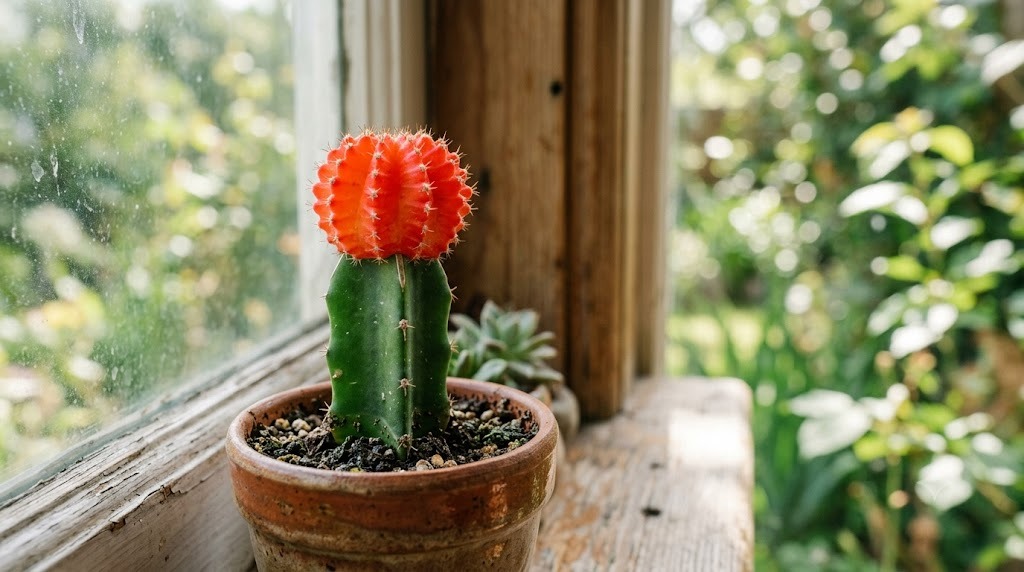
The moon cactus is the eye-catching, brightly coloured little cactus you see topped with a ball of neon red, orange, pink or yellow. That colourful top is a mutant cactus with no green of its own, grafted onto a green rootstock that feeds it - a clever, cheerful, but relatively short-lived novelty.
Origin & Natural Habitat
The colourful top is a mutant form of Gymnocalycium from South America, bred without chlorophyll so its red, orange or yellow pigments show. Because it can't photosynthesise, it is grafted onto a green cactus (often a Hylocereus stem) that does the feeding.
Appearance
A small round, ribbed, brightly coloured ball (red, pink, orange or yellow) sitting on top of a green columnar rootstock, joined at a graft. The colourful scion has spines along its ribs but no green pigment of its own.
Why People Love It - Qualities & Benefits
People love the instant, cheerful colour and the fun, quirky look - it is a bright, low-cost, low-care novelty that brings a pop of colour to a windowsill or desk.
Care
Light
Give bright but indirect light. Direct midday sun can scorch the coloured top, while too little light weakens the green rootstock that keeps the whole plant alive - a bright spot out of harsh sun is the balance.
Watering
Water when the soil is fully dry, like any cactus - soak and let it dry out. Keep it drier in winter. The graft is prone to rot, so err dry and never let it sit wet.
Soil & Potting
A gritty, free-draining cactus mix in a pot with drainage. Sharp drainage protects the vulnerable graft union from rot.
Humidity & Temperature
Warm, dry air suits it; ordinary room air is fine. Keep it warm (above about 10°C); it is less cold-tolerant than many cacti because of the tropical rootstock.
Feeding
A dilute cactus feed once or twice in the growing season is enough. Do not overfeed the small plant.
Repotting
Repot occasionally in spring if it outgrows its pot, handling gently around the graft. Be aware the coloured top will not live indefinitely (a few years is common), as the graft eventually fails.
Propagation
Moon cacti can't be grown on their own from the coloured top (it has no chlorophyll). Propagation means grafting a fresh coloured offset onto a green rootstock - an advanced technique, so most people simply buy new plants.
Common Problems & Pests
Rot at the graft union from overwatering is the main killer. The green rootstock may sprout its own pups, which can overtake the plant. Fading or corking of the top is often just age - these are naturally short-lived.
Toxicity & Safety
Moon cacti are not toxic to people or pets, but the spines can prick, so keep them out of reach of children and animals.
Pros & Cons
Pros: instant bright colour, small, cheap, easy short-term care. Cons: relatively short-lived (the graft fails in time), can't be grown from the top, graft rots if overwatered.
Best Suited For
A fun, colourful pick for a bright windowsill or desk, for beginners and children's rooms - just enjoy it as a cheerful, temporary splash of colour rather than a lifelong plant.
FAQ
Why is my moon cactus dying after a couple of years? The graft is naturally short-lived; that is normal for these plants.
Can I grow the colourful top on its own? No - it has no chlorophyll and needs the green rootstock to survive.
Gear for growing moon cactus
Links go to Amazon or a partner store (such as Adagio Teas) and may earn us a commission at no extra cost to you. As an Amazon Associate we earn from qualifying purchases. We link gear types, not sponsors' picks: you choose the exact product.