Fairy Ring Champignon
The fairy ring champignon (Marasmius oreades) is the small tan mushroom that makes the dark green rings and arcs in lawns, meadows, and grazed pasture, and it is one of the best-flavoured wild mushrooms in Europe.
🗓️ Last reviewed: August 2026
Overview
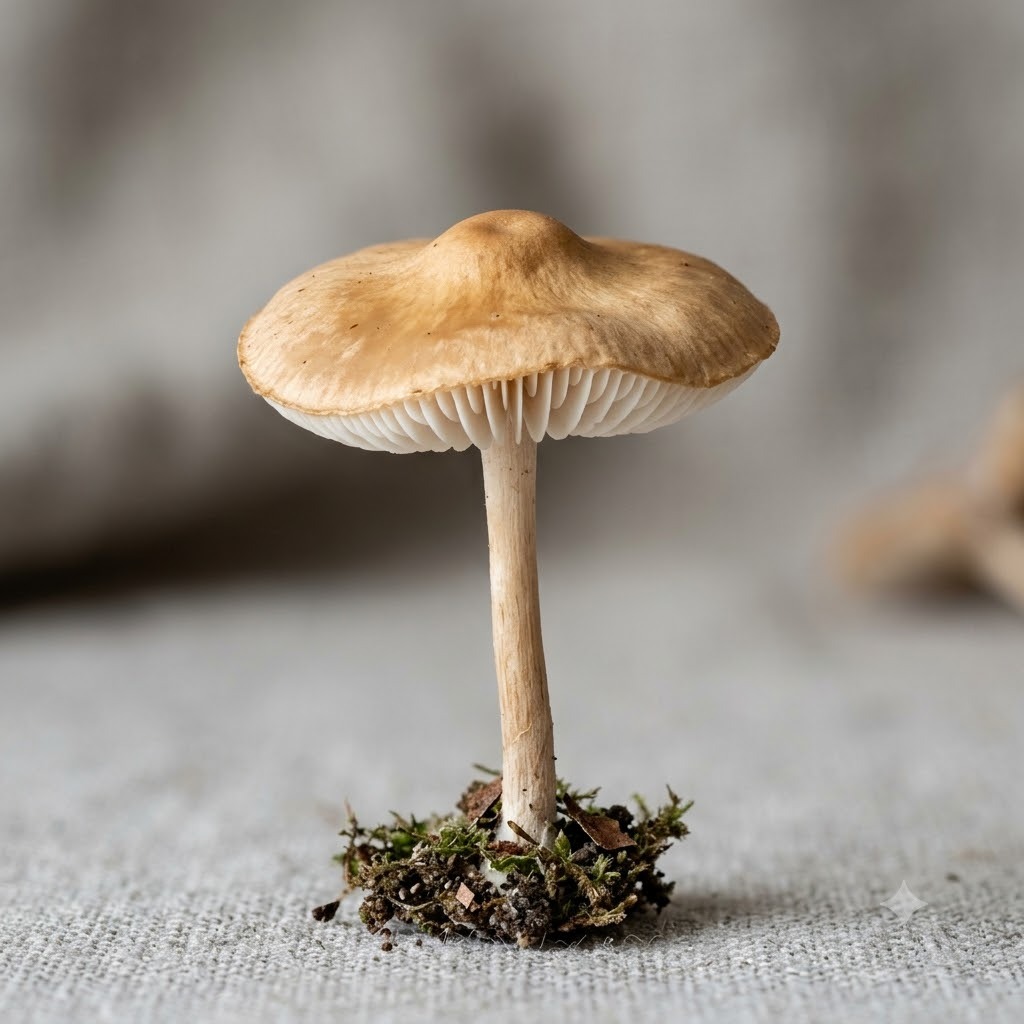
The fairy ring champignon (Marasmius oreades) is the small tan mushroom that makes the dark green rings and arcs in lawns, meadows, and grazed pasture, and it is one of the best-flavoured wild mushrooms in Europe. Dried, it has a concentrated sweet, nutty aroma that outclasses most woodland species, and it is the traditional flavouring mushroom of French and eastern European cooking, where it is called mousseron. It also has an unusual survival trick: it dries out completely in a hot spell, looks dead, and revives to full form when rain returns. The catch is serious and needs stating up front: it grows in exactly the same grassland as several small white toxic funnel caps, including one that is deadly, so this is a species that demands proper learning rather than casual picking.
Identification & Appearance
The cap is 2-5 cm across, tan to pale buff, drying paler, convex with a distinct low central bump, and the margin is often faintly grooved. Gills are the key: white to pale cream, thick, and widely spaced, and free or only narrowly attached to the stem, never crowded and never running down it. The stem is slender, tough, and fibrous, and here is the practical test: it is so pliable that it can be twisted around a finger without snapping, unlike the brittle stems of most small grassland mushrooms. Flesh is thin and white, with a sweet almond-like smell. Spore print is white. The killer look-alike, the fool's funnel (Clitocybe rivulosa), has crowded gills that run down the stem, a whitish cap, and a brittle stem, and it grows in the same rings. Any small pale grassland mushroom with crowded decurrent gills should be treated as dangerous.
Where It Grows
Fairy ring champignons are saprotrophs of grassland, growing in lawns, playing fields, pasture, meadows, dunes, roadside verges, and churchyards, from late spring through autumn. They are the classic ring-forming species: the mycelium spreads outwards from a central point, exhausting nutrients behind it and stimulating grass growth at the advancing edge, which produces the darker green ring visible even when no mushrooms are present. Rings can be decades or centuries old and metres across. The species is common across Europe, North America, and much of Asia. Because it lives in mown, grazed, and managed grass, the ground it grows in is often treated with fertiliser, herbicide, or fungicide, which matters more than usual for a species people pick from lawns.
How to Grow at Home
There is no commercial cultivation and no reliable spawn. As a grassland saprotroph it should in principle be culturable, and it has been grown experimentally, but nothing has reached the market. The realistic route is management rather than cultivation: if a ring already exists in a lawn, it will keep producing for years, and it responds to being left alone. Do not apply fungicide or high-nitrogen feed, do not scarify the ring, and mow rather than strip. Many gardeners want the opposite, since fairy rings are considered a lawn defect and the dry hydrophobic soil under an established ring can kill grass; there is a genuine tension between a tidy lawn and a productive ring, and it is worth deciding which one you want before treating it.
Growing Conditions
Light
Full sun to light shade, since this is a grassland species rather than a woodland one. The fungus itself lives in the turf and thatch; what matters is that the grassland is not treated with fungicide.
Watering
Fruiting follows rain from late spring to autumn, often within days. This species revives remarkably after drought: dried, shrivelled fruit bodies rehydrate and continue to release spores when rain returns, which is why a ring can appear to produce mushrooms overnight.
Temperature & Substrate
Fruiting spans roughly 8-24°C across a long season. The substrate is grassland turf, thatch, and the organic layer beneath it. It is not a wood-rotter and will not grow on logs or sawdust.
Culinary Use
This is one of the great flavouring mushrooms. The caps are small but intensely aromatic, sweet and nutty with a hint of almond, and the flavour concentrates beautifully on drying, which is the traditional treatment. Discard the stems, which are tough and fibrous however long you cook them. Fresh caps are good fried, in omelettes, and in sauces; dried and powdered they lift soups, stews, and risottos out of proportion to their quantity. In France they are the classic mousseron used in cream sauces. Cook them thoroughly. They keep dried for a year or more without losing much aroma. Because each cap is small, expect to pick a lot for a meal, which is another reason drying is the sensible approach, building a store over a season rather than needing a single big harvest.
Health & Nutrition
Nutritionally it is a small, low-calorie mushroom with some fibre, protein, B vitamins, and trace minerals. The health considerations are two, and both are about where it grows rather than what it contains. First, lawns, sports fields, and verges are routinely treated with herbicides, fertilisers, and pesticides, and roadside grass carries traffic residues; pick from ground whose treatment history you know. Second, and far more important, the toxic look-alikes in the same habitat. Fool's funnel and its relatives contain muscarine, which causes profuse sweating, salivation, tears, blurred vision, abdominal cramps, and in serious cases dangerous slowing of the heart. Onset is fast, typically within 15 minutes to two hours, and it requires urgent medical attention. Never mix small grassland mushrooms in one bag.
Common Problems
- Confusion with fool's funnel - the dangerous one. Fool's funnel has crowded gills running down the stem; the champignon has widely spaced gills that are free of it.
- Confusion with small brown lawn mushrooms generally - grassland holds many species. If the stem is brittle rather than twistable, reconsider.
- Tough stems - normal, discard them.
- Picking from treated lawns - herbicide, fungicide, and fertiliser residues are common in exactly this habitat.
- Rings damaging the lawn - the mycelium makes the soil hydrophobic, and grass inside old rings often dies back. A gardening problem rather than a foraging one.
Pros & Cons
Pros
- Outstanding flavour, especially dried, better than most woodland species.
- Long season from late spring to autumn.
- Grows in accessible open grassland, no woodland needed.
- Rings recur in the same place for many years.
Cons
- Shares habitat with deadly muscarine-containing funnel caps.
- Small caps and tough stems mean a lot of picking for a little food.
- Grassland is often chemically treated.
- Considered a lawn defect by many gardeners, so rings get sprayed.
Best Suited For
- Experienced foragers who have learned the grassland look-alikes properly.
- Cooks who dry mushrooms for flavouring rather than bulk.
- Anyone with access to untreated meadow, pasture, or an old lawn.
Not ideal for beginners picking small pale mushrooms from lawns, or anyone unwilling to check gill spacing and attachment on every single specimen.
FAQ
How do I tell it from the fool's funnel? Gills. Fairy ring champignon has thick, widely spaced gills that are free of the stem. Fool's funnel has crowded gills that run down the stem. Also test the stem: the champignon's is pliable and twistable, the fool's funnel's is brittle.
Why do the mushrooms grow in a circle? The mycelium spreads outward evenly from a starting point, fruiting at the advancing edge and dying back behind it. Some rings are centuries old.
Are the dried ones really better? For flavour, yes. Drying concentrates the sweet nutty aroma, and dried caps stored airtight keep their character for a year or more.
Never eat a fairy ring champignon without 100% expert identification. Small pale grassland mushrooms include species containing muscarine, which can be dangerous. Confirm the widely spaced free gills, twistable stem, white spore print, and sweet smell with an experienced identifier, and never pick mixed handfuls.
🪴 Foraging kit worth a look
Nothing here identifies a mushroom for you - identification stays with your field guides and local experts. These are simply the basics foragers carry.
Links go to Amazon or a partner store (such as Adagio Teas) and may earn us a commission at no extra cost to you. As an Amazon Associate we earn from qualifying purchases. We link gear types, not sponsors' picks: you choose the exact product.