Fly Agaric
The fly agaric (Amanita muscaria) is the most recognisable mushroom on Earth: scarlet cap, white flecks, the storybook toadstool of every illustration from Alice in Wonderland to garden ornaments.
🗓️ Last reviewed: October 2026
Overview
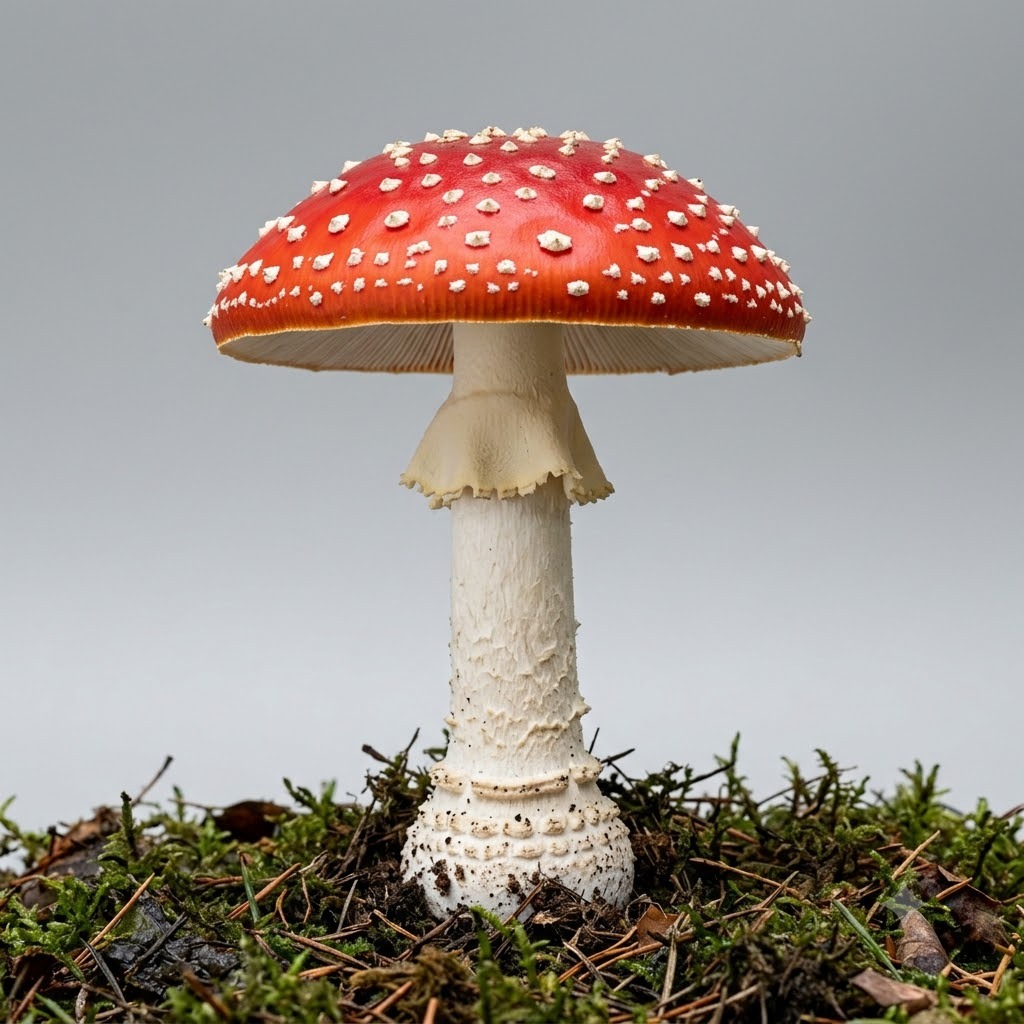
The fly agaric (Amanita muscaria) is the most recognisable mushroom on Earth: scarlet cap, white flecks, the storybook toadstool of every illustration from Alice in Wonderland to garden ornaments. It is also poisonous, and the poisoning it causes is unlike the liver-destroying amatoxin group. Fly agaric contains ibotenic acid and muscimol, which act on the central nervous system and produce confusion, delirium, drowsiness, nausea, muscle twitching, and sometimes hallucinations and seizures. It is rarely fatal in healthy adults, which has fuelled a good deal of romanticised writing, but severe cases do occur, children and older people are at greater risk, and the experience by most accounts is unpleasant rather than mystical.
Identification & Appearance
The cap is 8-20 cm across, brilliant scarlet to orange-red, fading with rain and age to orange or yellowish, covered in white to pale cream warts, remnants of the universal veil, which can wash off entirely in heavy rain and leave a plain red cap. Gills are white, crowded, and free of the stem. The stem is white, with a soft drooping ring and a distinctly bulbous base ringed with concentric rows of scaly warts rather than the sac-like volva of the death cap group. Flesh is white, yellowish just under the cap skin. Spore print is white. Young specimens emerge as white eggs studded with warts, and can be confused with edible puffballs by the careless, though cutting them open reveals the developing mushroom inside.
Where It Grows
Fly agaric is ectomycorrhizal, associating strongly with birch, pine, spruce, and other trees, and it is one of the most widespread mushrooms in the world, native across the northern hemisphere and introduced with planted trees into Australia, New Zealand, South America, and southern Africa. It fruits from late summer through autumn in woodland, on heaths, in parks, and in gardens with birch or conifers. It often appears in troops and rings, and it is a common sight in ordinary suburban settings, which is precisely why children encounter it. It is genuinely important ecologically, forming partnerships that help its host trees take up nutrients, and it should be left in place rather than kicked over.
Can It Be Grown
No, and it should not be attempted. Like all Amanita species it is mycorrhizal and cannot be cultivated on a substrate. Where it appears in gardens with birch or pine, it is doing useful work for the trees. If small children or dogs use the ground, remove the fruit bodies with gloves and dispose of them in sealed waste, but do not attempt to eradicate the fungus, which lives in the root system. Teaching children that no mushroom in the garden is ever to be picked or tasted is far more effective than trying to keep a lawn free of a fungus that fruits from tree roots.
Growing Conditions
Light
Not relevant to the fungus, which lives on tree roots and fruits in woodland, heath, parkland, and gardens according to where its hosts grow.
Watering
Fruiting follows late summer and autumn rain. Heavy rain also washes the white warts off the cap, which is a common cause of confusion, since a plain red or orange cap looks like a different mushroom entirely.
Temperature & Substrate
Fruiting spans roughly 8-20°C from late summer into autumn, sometimes continuing to the first frosts. The substrate is soil around living birch, pine, spruce, and other host tree roots.
Why It Is Not Food
Fly agaric contains ibotenic acid and muscimol, neurotoxic compounds that act on the central nervous system. There is a persistent claim that parboiling in plenty of water detoxifies it, and it is true that some traditional practices in parts of Europe and Asia involve boiling and discarding the water. That is not a safe recipe. Toxin content varies enormously between specimens, seasons, and regions, the reduction achieved by boiling is inconsistent, and there is no way to know what remains. Contrary to the name and to widespread belief, muscarine, the toxin that gives the mushroom's species name to a whole poisoning syndrome, is present only in trace amounts here; the symptoms come from ibotenic acid and muscimol instead.
Health & Poisoning Pattern
Symptoms usually begin within thirty minutes to two hours, which is much faster than amatoxin poisoning. They include nausea and vomiting, drowsiness alternating with agitation, confusion, dizziness, visual distortion, muscle twitching, and in more serious cases delirium, seizures, and a deep sleep from which the person is hard to rouse. Recovery usually occurs within twenty-four hours with supportive care, and deaths in healthy adults are rare, but severe cases happen, particularly in children, older people, and where large quantities were eaten. Anyone who has eaten fly agaric should be assessed medically. Take a sample or photograph of the mushroom. Do not leave a confused or drowsy person alone to sleep it off.
Common Identification Traps
- Rain-washed caps - once the white warts wash off, a plain orange-red cap is easily mistaken for something else entirely.
- The egg stage - white warty buttons can be mistaken for puffballs. Cut every white egg in half; a developing cap and stem inside means Amanita.
- The Caesar's mushroom confusion - in southern Europe the edible Amanita caesarea is orange with yellow gills and a sac-like volva; fly agaric has white gills and a scaly ringed base. This confusion has caused poisonings.
- Assuming it is merely hallucinogenic - the dominant effects are nausea, confusion, and sedation, and dosing is entirely unpredictable.
- Trusting an internet detox recipe - toxin levels vary and no home method reliably removes them.
The Rule That Prevents This
Learn the whole Amanita structure: white gills, a ring, and a base that is either a sac-like volva or a bulb ringed with warts. Every mushroom with that architecture should be treated as off-limits by anyone who is not an expert. The fly agaric is the friendly-looking member of a genus that includes the deadliest mushrooms known, and the single best habit a beginner can build is to admire the entire group and eat none of it.
Best Suited For
- Learning the Amanita structure using the most recognisable member of the genus.
- Photography and teaching children what not to touch.
- Understanding mycorrhizal partnerships in birch and pine woodland.
Not food. No home preparation makes it safe.
FAQ
Is it really poisonous, or is that a myth? It is genuinely poisonous. Ibotenic acid and muscimol cause nausea, confusion, drowsiness, twitching, and in serious cases seizures. Deaths are rare but severe cases occur.
Can boiling make it edible? No reliable home method exists. Some traditions parboil and discard the water, but toxin content varies widely and the result is unpredictable. This is not a recipe worth trusting.
Does it contain muscarine? Only in trace amounts, despite the name. The characteristic effects come from ibotenic acid and muscimol.
Never eat any mushroom with white gills, a ring, and a warty or sac-like base. That architecture defines the Amanita group, which contains both this species and the deadliest mushrooms in the world. Learn it and avoid the whole genus.
🪴 Foraging kit worth a look
Nothing here identifies a mushroom for you - identification stays with your field guides and local experts. These are simply the basics foragers carry.
Links go to Amazon or a partner store (such as Adagio Teas) and may earn us a commission at no extra cost to you. As an Amazon Associate we earn from qualifying purchases. We link gear types, not sponsors' picks: you choose the exact product.