Green-Spored Parasol
The green-spored parasol (Chlorophyllum molybdites) probably causes more mushroom poisonings in North America than any other species.
🗓️ Last reviewed: August 2026
Overview
The green-spored parasol (Chlorophyllum molybdites) probably causes more mushroom poisonings in North America than any other species. It is large, handsome, and grows on lawns, parks, playing fields, and golf courses, which puts it directly in front of people who are not foragers and have no reason to be suspicious. It looks like the edible parasol and shaggy parasol, and it fruits in impressive rings and arcs after summer rain. The poisoning it causes is violent, with severe vomiting and diarrhoea that regularly sends people to hospital for rehydration. It also carries the single most decisive identification feature in the whole of mushroom hunting: it is the only large mushroom with a green spore print.
Identification & Appearance
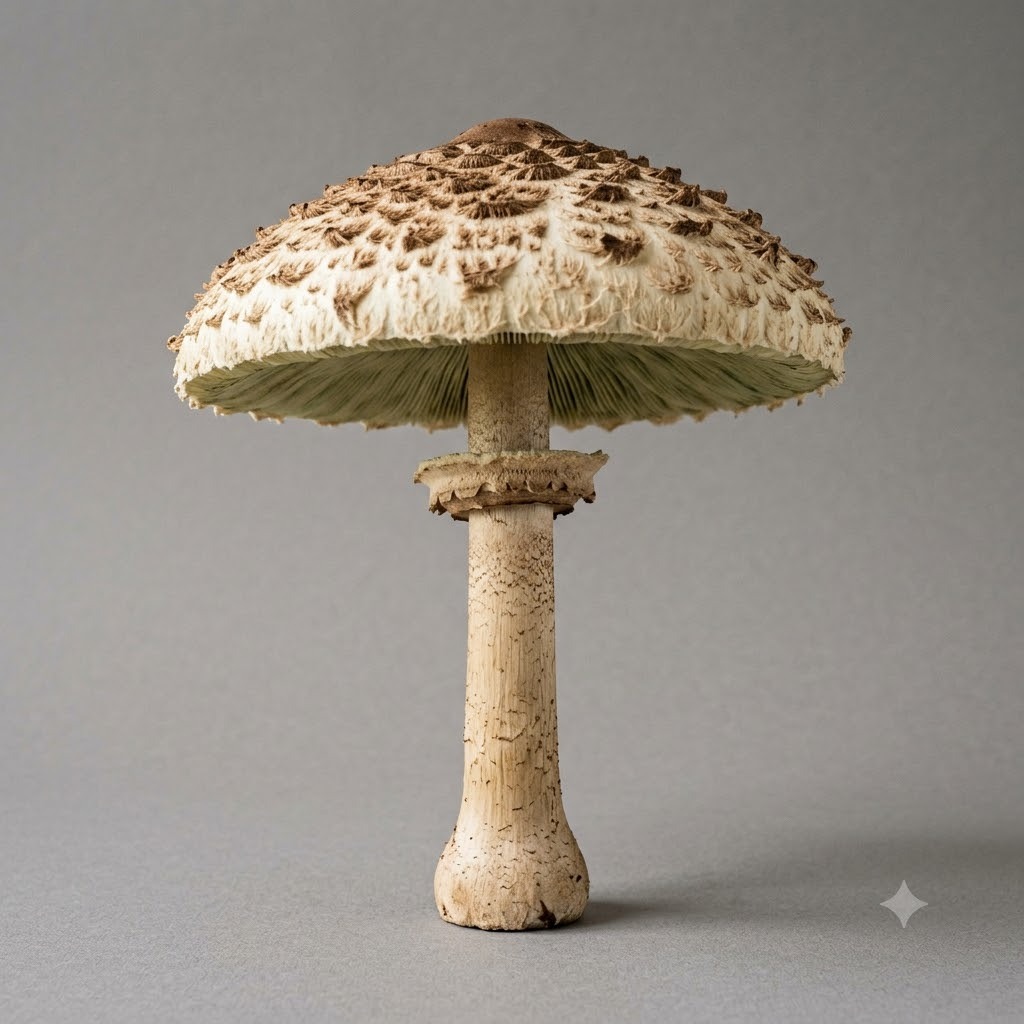
The cap is 8-30 cm across, whitish to cream, breaking up into coarse brownish scales over a paler background, convex then flattening broadly, often with a darker centre. Gills are white when young and slowly turn dull greyish-green to olive as the spores mature, which is the visible expression of the green spore print and is often the first hint in an older specimen. They are crowded and free of the stem. The stem is smooth, whitish to pale brown, with a thick movable double-edged ring and a slightly swollen base but no volva. Flesh is white and may flush faintly pinkish or brownish where cut. Spore print is green, sometimes described as grey-green or olive, and no other large lawn mushroom produces one.
Where It Grows
Green-spored parasols are saprotrophs of rich grassland, fruiting in lawns, parks, sports fields, golf courses, roadside verges, and pasture, frequently in large rings and arcs, from late spring through autumn after warm rain. They are common across the warmer parts of North America, particularly the south and midwest, and they occur in Central and South America, Africa, Asia, Australia, and increasingly in southern Europe as the climate warms. Their spread into new regions matters, because in areas where the shaggy parasol is a familiar edible, an unfamiliar green-spored species arriving in the same lawns is a genuine public health problem.
Can It Be Grown
No, and obviously not desirable. It arrives on its own in warm-climate lawns, particularly ones that are watered and fertilised, and it fruits from mycelium in the turf. Where children or dogs use a lawn, removing fruit bodies with gloves and disposing of them in sealed waste is worthwhile, since dogs eat them and are poisoned too. The mycelium remains and will fruit again after the next warm rain. Recognition is the real protection: households in affected regions should know that a big scaly mushroom on the lawn is far more likely to be this than anything edible.
Growing Conditions
Light
Not relevant to the fungus, which fruits from turf in open sun. It is a lawn and grassland species rather than a woodland one.
Watering
Fruiting follows warm rain and is strongly encouraged by irrigation, which is why watered lawns, golf courses, and sports fields produce such large flushes. Summer storms are the classic trigger.
Temperature & Substrate
Fruiting spans roughly 18-30°C in warm conditions from late spring through autumn. The substrate is rich grassland turf and the organic layer beneath, especially in irrigated and fertilised lawns.
Why It Is Not Food
The green-spored parasol contains toxins that cause severe gastrointestinal poisoning. Symptoms begin one to three hours after eating and consist of intense abdominal cramping, repeated vomiting, and profuse and often bloody diarrhoea, which can lead to significant dehydration and electrolyte disturbance. Cooking does not destroy the toxins. It is not usually fatal in healthy adults, but hospital treatment for rehydration is common, and cases in children and older people can be serious. Its reputation as the most commonly eaten poisonous mushroom in North America is a direct consequence of where it grows and what it resembles.
Health & Poisoning Pattern
Onset is typically one to three hours, occasionally up to six. The illness is violent, with cramping, vomiting, and diarrhoea that may contain blood, and it commonly lasts many hours. The main clinical risk is dehydration. Treatment is supportive, principally fluids, and most people recover within a day or two. Anyone with prolonged vomiting or diarrhoea, blood in the stool, or signs of dehydration should be seen medically, and children should be assessed early. Dogs are frequent victims because they eat mushrooms from lawns, and veterinary attention should be sought promptly. Keep a specimen or photograph for identification.
Common Identification Traps
- Skipping the spore print - the entire poisoning problem disappears if a print is taken. It is the one mushroom where a single test is completely decisive.
- Judging by young white gills - young specimens have white gills, and the green only develops with maturity. The print is the reliable test, not the gill colour on the day.
- Confusion with the shaggy parasol - similar size, scales, and ring, but a white spore print and flesh that flushes saffron red-orange when cut.
- Confusion with the true parasol - taller, with a snakeskin-patterned stem and a white spore print.
- Assuming a lawn mushroom is safe - lawns are exactly where this species grows.
The Rule That Prevents This
Take a spore print of every large scaly parasol-type mushroom before it goes anywhere near a pan. Cut the cap off, place it gills-down on white paper, cover it with a bowl, and leave it for several hours. White or cream means you have one of the parasol group and can continue checking other features; green means discard the entire collection immediately. This is the single clearest example in mushroom hunting of one simple test that removes essentially all risk from a common and serious poisoning.
Best Suited For
- Learning to take spore prints, using the species where it matters most.
- Teaching families in warm regions to recognise the commonest lawn poisoner.
Not food. Cooking does not make it safe.
FAQ
How do I tell it from an edible parasol? Spore print. Green means this species; white means one of the parasol group. Shaggy parasol flesh also flushes saffron red-orange where cut, which this species does not do in the same way.
Are the gills always green? No, and that is the trap. Young gills are white and turn greenish only as spores mature. Take a print rather than judging by gill colour.
My dog ate one from the lawn. What now? Contact a vet promptly and take a specimen or photograph. Dogs are common victims and dehydration is the main concern.
Never eat a large scaly lawn mushroom without taking a spore print. It takes a few hours and a sheet of paper, and it separates the most commonly eaten poisonous mushroom in North America from its edible relatives with total reliability.
🪴 Foraging kit worth a look
Nothing here identifies a mushroom for you - identification stays with your field guides and local experts. These are simply the basics foragers carry.
Links go to Amazon or a partner store (such as Adagio Teas) and may earn us a commission at no extra cost to you. As an Amazon Associate we earn from qualifying purchases. We link gear types, not sponsors' picks: you choose the exact product.