Huitlacoche
Huitlacoche (Ustilago maydis) is a plant disease that became a delicacy.
🗓️ Last reviewed: August 2026
Overview
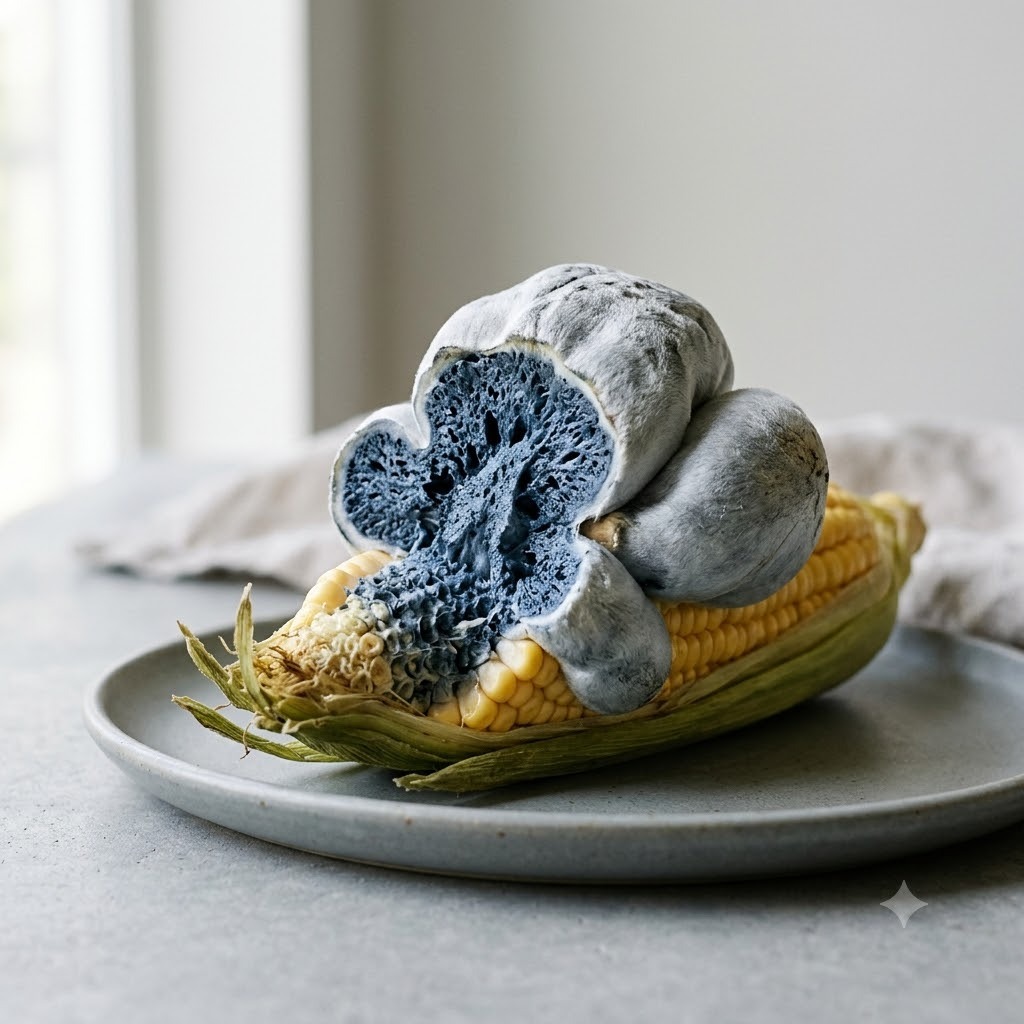
Huitlacoche (Ustilago maydis) is a plant disease that became a delicacy. It is corn smut, a fungus that infects maize and turns the developing kernels into swollen, blue-grey, spore-filled galls, and to a farmer in the American Midwest it is a loss of yield. To a cook in Mexico it is one of the great ingredients, sold fresh in markets, folded into quesadillas and tamales, and prized for a dense, smoky, earthy flavour somewhere between mushroom, sweetcorn, and truffle. The two attitudes coexist awkwardly: the same fungus is deliberately inoculated onto maize in Mexico and sprayed against in the United States, though a small speciality trade has grown up in North America for exactly the reason Mexican cooks have known for centuries.
Identification & Appearance
Infected kernels swell into irregular galls, from the size of a marble to the size of a fist, replacing normal corn kernels on the cob. Young galls are firm, silvery-white to pale grey on the outside with a soft, moist, pale interior streaked with blue-black. As they mature the outer membrane darkens and thins, and the interior turns to a dry, powdery, blue-black mass of spores. The edible stage is young: firm, moist, and only partly darkened inside, before the gall bursts and releases spores. The infection can also affect tassels, leaves, and stems, causing distortion. It is genuinely unmistakable on maize, since nothing else produces swollen grey galls in place of kernels, but a cook should still handle only galls from a known plant grown for the purpose.
Where It Grows
Ustilago maydis infects maize and its wild relative teosinte, and it occurs wherever maize is grown, across the Americas, Europe, Asia, and Africa. Infection happens through wounds and young tissue, encouraged by hail damage, insect injury, mechanical damage from cultivation, and by hot weather following rain. The galls develop over two to three weeks after infection. In Mexico it is harvested from ordinary field maize as a valued secondary crop, and in the central highlands it has been eaten since pre-Columbian times, with the Nahuatl-derived name reflecting that history. Commercial production for the speciality market involves deliberate inoculation of maize plants under controlled conditions, mostly in Mexico and on a small scale in the United States.
How to Grow at Home
This is one of the few fungi in this catalogue that a gardener can genuinely cultivate deliberately, provided they are willing to sacrifice a maize crop. The method is to grow sweetcorn or field maize, then inject a spore suspension into the developing ears at the silk stage using a syringe, which introduces the fungus directly into the tissue where galls form. Infection rates vary widely and are better in warm, humid conditions. Galls appear within two to three weeks and must be harvested young, while still firm and pale inside. Success is unpredictable, typically well under half of inoculated ears, and the maize itself is lost where infection takes. Spore material is available commercially in some countries. Before doing this anywhere near commercial maize, check local plant health rules, since deliberately propagating a crop pathogen is regulated in some jurisdictions and is a genuinely poor neighbour in a maize-growing region.
Growing Conditions
Light
Full sun for the maize plants, which need to grow strongly to produce ears worth infecting. The fungus itself develops inside the plant tissue.
Watering
Maize needs consistent water, and infection is favoured by humid conditions and by rain following warm weather. Dry conditions reduce natural infection rates markedly.
Temperature & Substrate
Gall development runs best in warm summer conditions, roughly 20-30°C. The substrate is living maize tissue; this fungus is a biotroph and cannot be grown on sawdust, straw, or compost.
Culinary Use
Harvest galls young, while firm and only partly blue inside, and use them quickly, within a day or two, since they deteriorate fast. Cut them from the cob, chop, and cook in fat with onion, garlic, chilli, and epazote, the traditional Mexican herb pairing. The flavour is deep, smoky, and earthy with a sweetcorn undertone, and the texture turns soft and slightly inky. Classic uses are quesadillas, tacos, tamales, soups, and crepes, and it also works in risotto and with eggs. It stains dishes grey-black, which is normal. Cook it thoroughly. Canned and frozen huitlacoche is widely available outside Mexico and is a reasonable substitute, though fresh is considerably better. Do not use old galls that have gone dry and powdery inside.
Health & Nutrition
Huitlacoche is nutritionally more interesting than most fungi in a specific way: research on its amino acid profile has repeatedly found it higher in lysine than the maize it grows on, and lysine is the limiting amino acid in maize-based diets, so the infected kernels are in some respects nutritionally superior to the healthy ones. It also provides fibre, beta-glucans, and various minerals. That said, it is eaten in small quantities and is not a dietary staple. There is no established toxicity in the edible stage, and it has centuries of food use behind it. The practical caution is agricultural rather than dietary: this is a crop pathogen, spores are wind-dispersed, and deliberately cultivating it near commercial maize is inconsiderate at best and regulated at worst.
Common Problems
- Harvested too late - dry, powdery, spore-filled galls are past eating. Take them young, firm, and pale inside.
- Low infection rates - normal. Inoculation success is unpredictable and often below half of treated ears.
- Spoiling quickly - fresh huitlacoche keeps only a day or two. Cook or freeze it promptly.
- Upsetting the neighbours - spores spread. In maize-growing regions, deliberate cultivation is a genuine problem for others and may be restricted.
- Grey-black staining - normal and unavoidable in cooking; not a fault.
Pros & Cons
Pros
- A deep, smoky, complex flavour available from nothing else.
- Genuinely cultivable at home, unlike most prized fungi.
- Higher in lysine than the maize it replaces.
- Centuries of documented culinary use in Mexico.
Cons
- It is a crop disease, and propagating it may be restricted or antisocial.
- Very short shelf life once harvested.
- Unpredictable infection rates and a lost maize crop where it succeeds.
- Fresh supply is hard to find outside Mexico.
Best Suited For
- Home gardeners growing maize who are willing to sacrifice ears for a delicacy.
- Cooks exploring Mexican regional cuisine.
- Anyone interested in the line between crop disease and food.
Not ideal for anyone near commercial maize production, or gardeners who want their sweetcorn.
FAQ
Is it safe to eat a plant disease? In the young stage, yes. Huitlacoche has been eaten in Mexico since pre-Columbian times and is sold commercially. Harvest young galls, cook them thoroughly, and discard dry powdery ones.
Can I buy it instead of growing it? Yes. Canned and frozen huitlacoche is widely sold in Mexican grocery shops and online. Fresh is better but rarely available outside Mexico.
Will growing it spread the disease? Yes, spores are wind-borne. Do not do this near commercial maize, and check local plant health regulations first.
Never eat a fungal gall on a crop plant without 100% expert identification. Corn smut on maize is distinctive, but confirm the plant, the stage, and the identification with an experienced source before eating anything, and use only young firm galls.
🪴 Foraging kit worth a look
Nothing here identifies a mushroom for you - identification stays with your field guides and local experts. These are simply the basics foragers carry.
Links go to Amazon or a partner store (such as Adagio Teas) and may earn us a commission at no extra cost to you. As an Amazon Associate we earn from qualifying purchases. We link gear types, not sponsors' picks: you choose the exact product.