Jack-o'-Lantern
The jack-o'-lantern (Omphalotus olearius in Europe and Omphalotus illudens in eastern North America, with related species elsewhere) is a vivid orange mushroom that grows in dense clusters at the base of trees and stumps, and it is one of the most frequent causes of mushroom poisoning in the temperate world.
🗓️ Last reviewed: August 2026
Overview
The jack-o'-lantern (Omphalotus olearius in Europe and Omphalotus illudens in eastern North America, with related species elsewhere) is a vivid orange mushroom that grows in dense clusters at the base of trees and stumps, and it is one of the most frequent causes of mushroom poisoning in the temperate world. The reason is simple: it is bright orange, it fruits in autumn, and inexperienced foragers see chanterelles. It is not fatal, but it produces violent vomiting and diarrhoea lasting many hours, and it lands people in hospital every autumn. It also has a genuinely remarkable property that most people never see, because it requires patience and total darkness: the gills glow faintly green.
Identification & Appearance
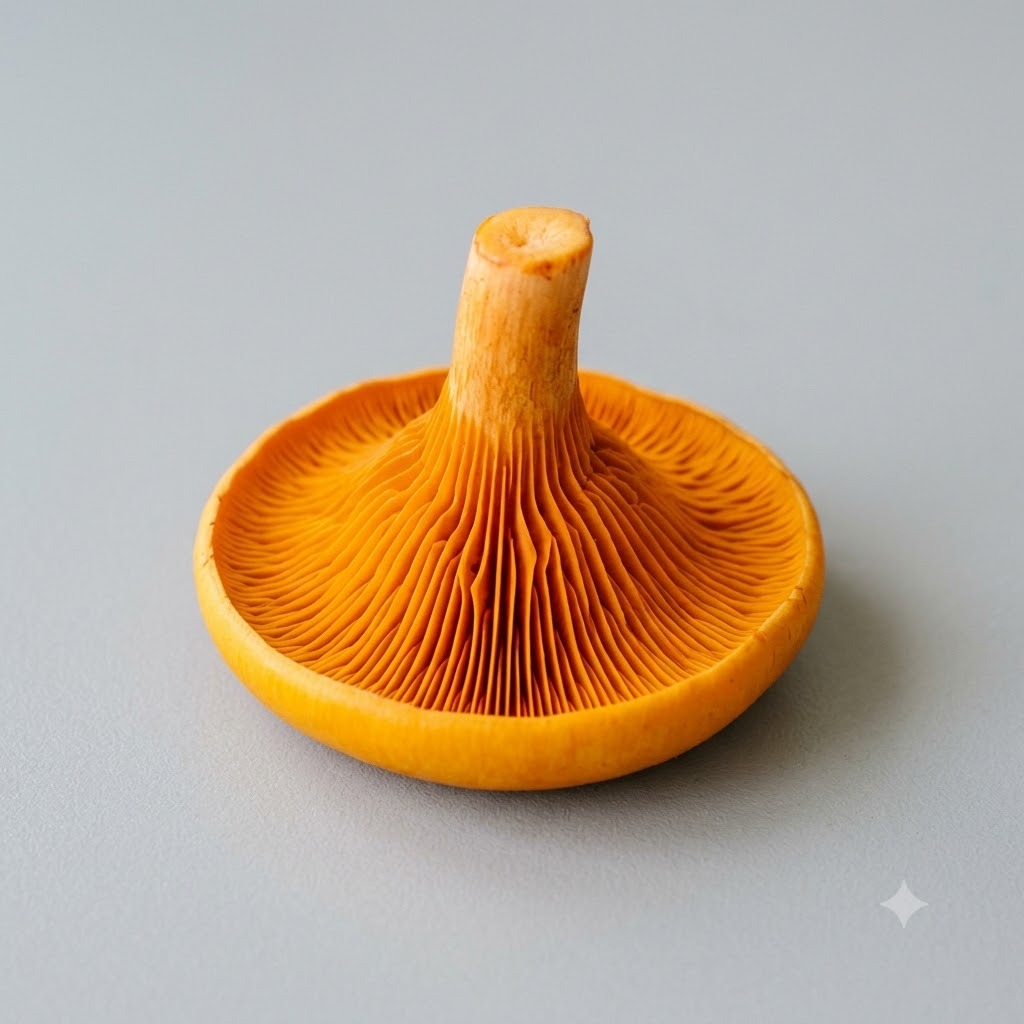
Caps are 5-20 cm across, bright orange to pumpkin or brownish-orange, smooth, convex then flattening and finally funnel-shaped with a wavy margin. The gills are the critical feature: they are true gills, thin, sharp-edged, blade-like, crowded, and deeply decurrent, running well down the stem, and they are the same orange as the cap. Stems are orange, tapering downwards, often fused at the base where clusters join. Flesh is orange throughout. Spore print is white to pale cream. The mushroom grows in dense clusters on wood, stumps, buried roots, and the bases of living and dead trees, never singly from soil. Fresh gills exhibit bioluminescence, glowing dim green in complete darkness after twenty minutes of dark adaptation, which is genuinely diagnostic though rarely convenient.
Where It Grows
Jack-o'-lanterns are wood-decay fungi, growing on stumps, buried roots, and the bases of living and dead hardwoods, especially oak and olive in southern Europe and oak in North America. They fruit from late summer through autumn in woodland, parks, and gardens, often appearing to grow from soil when they are in fact on buried roots. The European and North American species are close relatives with the same effects. They are common and conspicuous, and because they favour park and garden trees they are encountered by exactly the population most likely to misidentify them, namely people who are not deep in the woods and are not expecting to meet anything dangerous.
Can It Be Grown
No, and there is no reason to. It is a wood decayer and could presumably be cultured, but nobody does. Where it appears in a garden it indicates dead wood or root decay, sometimes at the base of a living tree that is worth looking at. If children or dogs use the ground, remove the fruit bodies with gloves and dispose of them sealed, and understand that the fungus lives in the wood and will fruit again. The useful investment is not removal but recognition: anyone who gathers chanterelles should be able to identify this species instantly, and the check takes seconds.
Growing Conditions
Light
Not relevant to the fungus, which lives in wood and roots and fruits at tree bases in shade or open ground. Darkness matters only for observing bioluminescence, which needs complete dark and adapted eyes.
Watering
Fruiting follows late summer and autumn rain, producing sudden large clusters. The bioluminescence is strongest in fresh young specimens and fades as they age.
Temperature & Substrate
Fruiting spans roughly 10-20°C from late summer into autumn. The substrate is hardwood, particularly oak, as stumps, buried roots, and the bases of living trees.
Why It Is Not Food
Jack-o'-lanterns contain illudins, sesquiterpene compounds that cause severe gastrointestinal poisoning. Symptoms begin thirty minutes to a few hours after eating and consist of intense abdominal cramps, repeated vomiting, and profuse diarrhoea, often lasting six to twelve hours and sometimes longer, with dehydration the main clinical concern. Poisonings are rarely fatal in otherwise healthy adults, but they are genuinely severe, and dehydration is dangerous in children and older people. Cooking does not destroy illudins. Interestingly, illudin S has been studied as a starting point for anticancer drug development, which is a footnote of chemistry rather than any suggestion that the mushroom is beneficial.
Health & Poisoning Pattern
Onset is fast, typically within thirty minutes to three hours, which distinguishes it clinically from the delayed-onset amatoxin group. The illness is violent but self-limiting: cramping, vomiting, diarrhoea, sweating, and weakness, resolving over half a day to a day with fluids and rest. Hospital treatment is supportive, principally rehydration. Anyone with severe or prolonged vomiting, or anyone who is very young, elderly, or unwell, should seek medical care. It is also worth saying clearly that a rapid-onset gastrointestinal illness after a mushroom meal is better news than a delayed one, because delayed onset points towards the amatoxin group, so the timing should always be reported to a doctor.
Common Identification Traps
- Mistaking it for chanterelles - the classic error. Chanterelles have blunt, forking, vein-like ridges, not sharp blade-like gills, and they grow singly from soil, not in clusters on wood.
- Assuming orange means chanterelle - colour is the least reliable feature in mushroom identification.
- Growth from buried roots - clusters can look as though they emerge from soil. Dig down and find the wood.
- Confusing it with chicken of the woods - a bracket on a trunk, not a gilled mushroom, but the colour causes confusion at a distance.
- Expecting to see the glow - bioluminescence is faint and needs total darkness and twenty minutes of dark adaptation. Its absence proves nothing.
The Rule That Prevents This
Three checks separate this from a chanterelle every time. First, the underside: chanterelles have blunt, forking, vein-like ridges you can smear with a thumb; jack-o'-lanterns have true thin blade-like gills. Second, the habit: chanterelles grow singly or scattered from soil in mycorrhizal partnership with trees; jack-o'-lanterns grow in dense clusters on wood. Third, the flesh: chanterelle flesh is white or pale inside, jack-o'-lantern flesh is orange throughout. Any one of those settles it, and all three take under a minute.
Best Suited For
- Learning to rule out when hunting chanterelles.
- Teaching the difference between true gills and false ridges.
- Observing bioluminescence in a safe, hands-off way.
Not food. Cooking does not make it safe.
FAQ
How do I tell it from a chanterelle? Look underneath. Chanterelles have blunt forking ridges; jack-o'-lanterns have sharp blade-like gills. Also, chanterelles grow from soil singly, jack-o'-lanterns in clusters on wood, and their flesh is orange right through.
Will it kill me? Very unlikely in a healthy adult, but it causes violent vomiting and diarrhoea for many hours, and dehydration is a real risk for children and older people.
Do the gills really glow? Yes, faintly green, in fresh specimens in complete darkness after about twenty minutes of eye adaptation. It is dim, and not seeing it does not mean the mushroom is something else.
Never eat an orange gilled mushroom growing in clusters on wood. Confirm ridges versus gills, growth habit, and internal flesh colour before eating anything you believe is a chanterelle, and have first collections checked by an experienced identifier.
🪴 Foraging kit worth a look
Nothing here identifies a mushroom for you - identification stays with your field guides and local experts. These are simply the basics foragers carry.
Links go to Amazon or a partner store (such as Adagio Teas) and may earn us a commission at no extra cost to you. As an Amazon Associate we earn from qualifying purchases. We link gear types, not sponsors' picks: you choose the exact product.