Larch Bolete
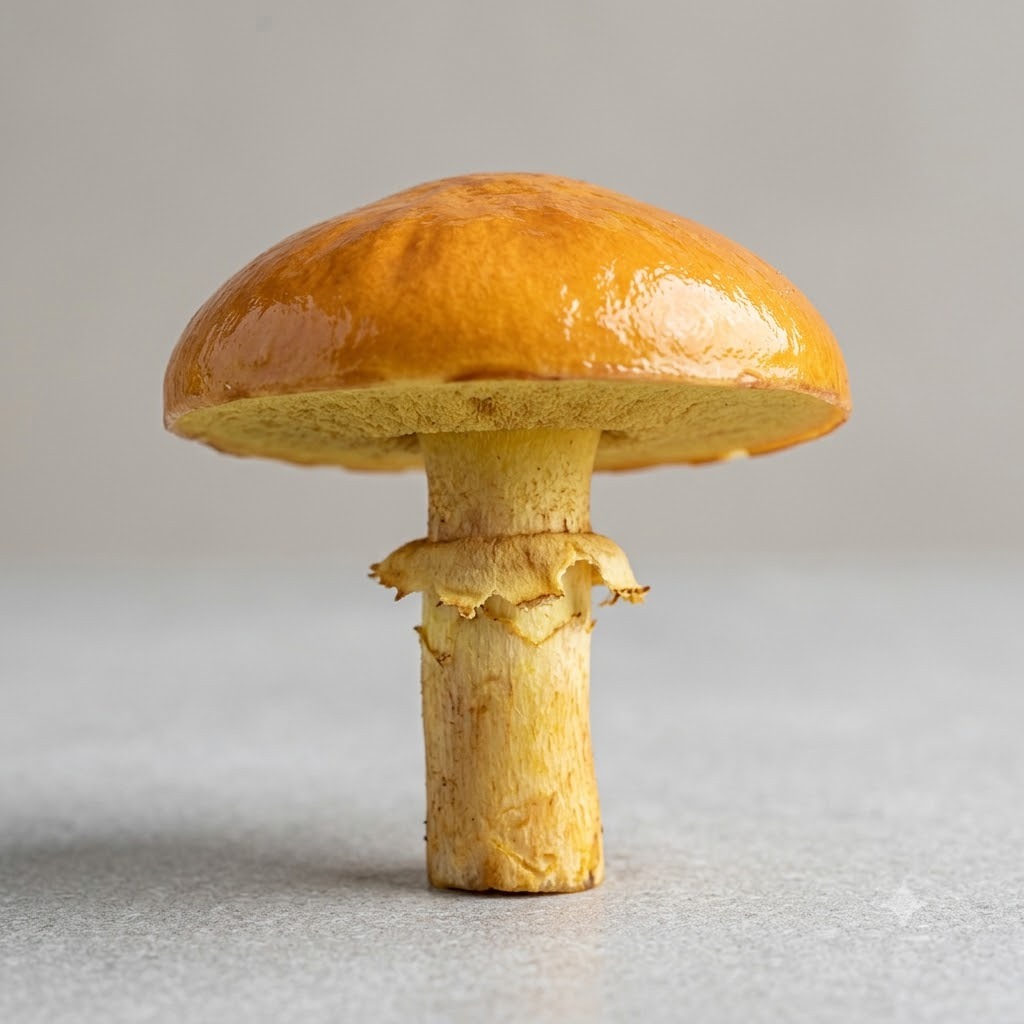
The larch bolete (Suillus grevillei) is the bright yellow-orange, sticky-capped bolete that grows under larch and nowhere else.
🗓️ Last reviewed: August 2026
Overview
The larch bolete (Suillus grevillei) is the bright yellow-orange, sticky-capped bolete that grows under larch and nowhere else. It is one of the easiest wild mushrooms to identify with confidence, because the host tree does most of the work: if there is no larch overhead, it is not this species. It is a modest edible rather than a great one, mild and pleasant when young, and infamous for a slimy cap cuticle that most cooks peel away. Larch is widely planted in forestry across Europe and North America, which means this mushroom turns up in plantations, park avenues, and garden specimen trees, making it one of the more accessible boletes for a forager without deep woodland access.
Identification & Appearance
The cap is 4-12 cm across, brilliant golden yellow to orange or chestnut-brown in older specimens, and distinctly sticky or slimy when damp, drying to a glossy sheen. Pores are small, bright lemon yellow at first, ageing dull ochre and bruising brownish. The stem is yellow above and browner below, and young specimens carry a ring, a whitish then brownish band left by the partial veil, which is unusual among boletes and a useful confirmation. Above the ring the stem is finely netted with yellow; below it is streaky brown. Flesh is pale yellow, sometimes staining faintly pinkish brown when cut. Spore print is ochre to olive-brown. The set of features that matters: larch host, sticky yellow-orange cap, yellow pores, and a ring on the stem. No European bolete with these features together is dangerous, but as always the full picture is required, not one feature.
Where It Grows
Strictly mycorrhizal with larch, this species fruits wherever larch grows: forestry plantations, mixed woodland with planted larch, avenues, parks, and large gardens. It is common across Europe and has spread with planted larch into North America, Australia, and New Zealand. The season runs from summer into late autumn, with heavy flushes after rain, and it often fruits in troops of dozens under a single tree. Larch is deciduous among conifers, so its needle litter is soft and the ground beneath is usually open and mossy, which makes searching easy. Once a productive larch is known, it produces year after year for as long as the tree stands, and a single mature tree can supply more mushrooms than a household can use.
How to Grow at Home
Not possible in any practical sense. Suillus species are ectomycorrhizal and depend on living larch roots for their sugars; no substrate, kit, or bag will produce them. What is possible is habitat: larch planted in a large garden will often arrive from the nursery with its mycorrhizal partners already attached to the roots, and in time the tree may fruit them naturally. That is a decade-scale proposition, not a cultivation method. Otherwise this is a foraging species, and the relevant skills are identifying larch in and out of leaf, noting productive trees, and returning after rain. Because larch is planted rather than wild in much of its range, permission matters: plantations, parks, and estates all have owners, and picking rules vary widely by country.
Growing Conditions
Light
Not applicable to the fungus, which lives in the soil. The relevant condition is a healthy larch and undisturbed ground beneath it; heavily compacted or cleared ground under a tree fruits poorly.
Watering
Fruiting follows rain, typically a week to ten days after a soaking. Larch boletes are among the more prolific responders to a wet spell and can appear in troops after summer rain, then again in autumn.
Temperature & Substrate
Fruiting spans roughly 8-22°C across summer and autumn. The substrate is needle litter and soil threaded with living larch roots, and no home substrate reproduces it.
Culinary Use
Larch boletes are decent everyday mushrooms rather than delicacies. The standard preparation is to peel the sticky cuticle off the cap, which comes away easily in one piece when the mushroom is fresh, and to remove the pore layer on anything but the youngest specimens. Slice and cook thoroughly; they fry acceptably, work well in mixed mushroom dishes, and are good in soups and sauces. The texture is softer than a porcini and the flavour mild, so they benefit from company. They dry reasonably well, though the slimy cuticle makes preparation fiddly, and they pickle nicely in the eastern European tradition. There is one practical reason to peel beyond texture: the slime layer of Suillus species has a laxative effect on some people, and eating them unpeeled in quantity is a well-known way to spend an uncomfortable evening.
Health & Nutrition
Nutritionally typical for a bolete: low calorie, useful fibre and protein, B vitamins, potassium, selenium, and copper, plus beta-glucans. The species-specific caution is the one above, that the cap slime disagrees with some people and peeling is standard practice for good reason. Beyond that, the usual wild mushroom advice applies: boletes accumulate heavy metals from soil, so gather away from roads, industry, and contaminated ground; eat a small portion the first time to check individual tolerance; and never eat any wild mushroom raw. Some people react to Suillus species even when peeled, and that individual sensitivity is worth discovering with a small test portion rather than a full plate.
Common Problems
- Slimy, unpleasant texture - the cuticle was left on. Peel it; it lifts off cleanly from fresh caps.
- Digestive upset after a large meal - Suillus slime is a known laxative for some people, and individual sensitivity varies. Peel and start small.
- Maggot damage - common in warm weather. Check the stem before picking.
- Spongy waterlogged pores - remove the pore layer on all but young specimens.
- Picking without permission - larch is usually a planted tree, so the ground under it is usually someone's plantation, park, or estate.
Pros & Cons
Pros
- Extremely easy to identify thanks to its exclusive larch partnership and stem ring.
- Often fruits in large troops, so a single tree yields plenty.
- Found in accessible places: plantations, parks, and avenues.
- No dangerous look-alike under larch.
Cons
- Slimy cap needing peeling before every meal.
- Laxative effect on some people, especially unpeeled.
- Soft texture and modest flavour compared with better boletes.
- Access often requires permission from a landowner.
Best Suited For
- Beginners learning to identify by host tree rather than by cap alone.
- Foragers with access to larch plantations, parks, or avenues.
- Cooks who pickle or use mushrooms in mixed dishes rather than as a centrepiece.
Not ideal for anyone with a sensitive digestion, or cooks wanting a firm, meaty mushroom.
FAQ
Do I have to peel the cap? It is strongly advisable. The slime layer is unpleasant in texture and has a laxative effect on some people. On fresh specimens the cuticle peels off easily in one piece.
Can I find them without larch trees? No. This species is mycorrhizal with larch exclusively. Learn to recognise larch, a conifer that drops its needles in winter, and the mushroom follows.
Why did I get an upset stomach after eating them? Either the caps were unpeeled or you are one of the people who react to Suillus species. Try a small peeled portion next time, or leave the genus alone.
Never eat a larch bolete without 100% expert identification. Confirm larch as the host, the sticky yellow-orange cap, yellow pores, and the ring on the stem with an experienced identifier. Never eat any bolete with red or orange pores.
🪴 Foraging kit worth a look
Nothing here identifies a mushroom for you - identification stays with your field guides and local experts. These are simply the basics foragers carry.
Links go to Amazon or a partner store (such as Adagio Teas) and may earn us a commission at no extra cost to you. As an Amazon Associate we earn from qualifying purchases. We link gear types, not sponsors' picks: you choose the exact product.