Milky Mushroom
The milky mushroom (Calocybe indica) is the tropical answer to a problem most temperate growers never face: what to cultivate when the room never drops below 30°C.
🗓️ Last reviewed: August 2026
Overview
The milky mushroom (Calocybe indica) is the tropical answer to a problem most temperate growers never face: what to cultivate when the room never drops below 30°C. Developed into a crop in India from the 1970s onwards, it is now the third most cultivated mushroom on the subcontinent after button and oyster mushrooms, and it thrives in exactly the heat that shuts down every other gourmet species. The fruit bodies are strikingly white, thick-stemmed, and firm, with a long shelf life that is unusual for a cultivated mushroom, and they grow on rice and wheat straw, which is abundant wherever rice is grown. For anyone growing in a genuinely hot climate without cooling equipment, this is the species that makes cultivation possible rather than merely difficult.
Identification & Appearance
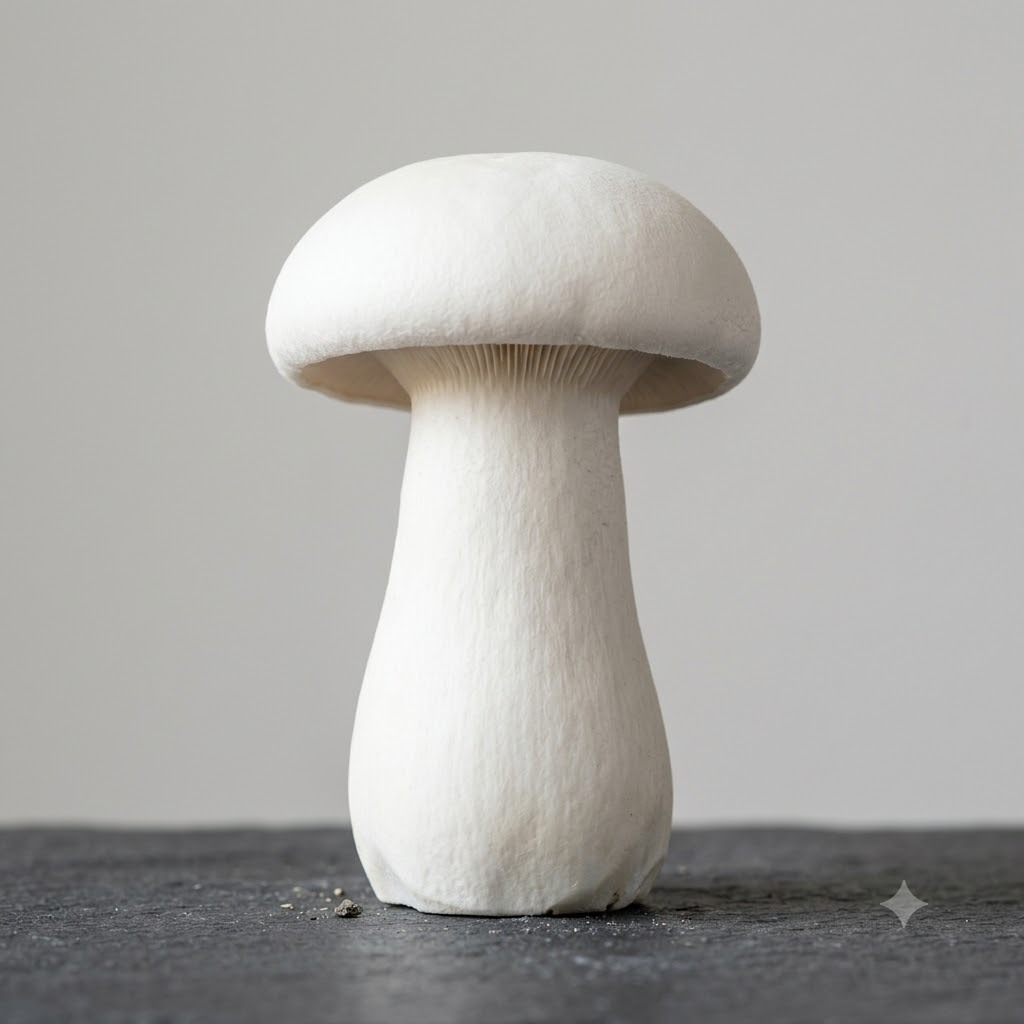
Milky mushrooms are pure milk-white throughout, which is the origin of the name. Caps are 5-14 cm across, convex at first and flattening with age, smooth, dry, and often developing a faintly cream or buff centre as they mature. Gills are white, crowded, and free or narrowly attached to the stem. The stem is the distinctive part: thick, solid, cylindrical or slightly club-shaped, often 4-10 cm long and unusually substantial for a mushroom of this size, making up a large share of the harvest weight. Flesh is white, firm, and does not discolour appreciably when cut. Spore print is white. This is overwhelmingly a cultivated species and the identification question rarely arises in the field; when it does grow wild in tropical grassland and roadside soil, the same rule applies as for any white gilled mushroom, which is that white-gilled, white-spored mushrooms include the deadliest species known and no white mushroom should ever be eaten on appearance alone.
Where It Grows
Calocybe indica is a soil-inhabiting saprotroph originally described from West Bengal, and found wild in humid tropical regions on decaying organic matter in grassland, gardens, and roadsides during the monsoon. Commercially it is grown across India, Bangladesh, Sri Lanka, and increasingly in other tropical and subtropical regions, on pasteurised paddy straw or wheat straw with a casing layer of soil on top. That casing layer is the key difference from oyster cultivation and the reason milky mushroom growing looks more like button mushroom growing: the fungus needs a moist, microbially active soil layer to trigger fruiting.
How to Grow at Home
The method is straightforward but distinctly different from bag-grown oysters, and skipping the casing step is the usual reason a first attempt produces nothing. Chop rice or wheat straw, soak it, then pasteurise by hot water treatment or steam, and drain to field capacity. Mix in grain spawn at roughly four to six per cent of wet substrate weight, pack into bags or trays, and colonise in the dark at 30-35°C for two to three weeks. Once the substrate is fully white, apply a casing layer two to three centimetres deep of pasteurised garden soil mixed with well-rotted compost or coir, keep it damp, and wait. Pinning follows within eight to twelve days, and the first harvest usually comes three to four weeks after casing. Expect several flushes over two to three months from a single bed. The casing layer must never dry out and must never be waterlogged, and it should be misted lightly and often rather than watered heavily.
Growing Conditions
Light
Low indirect light is sufficient, roughly eight to twelve hours a day. The species is less light-dependent than oyster mushrooms, but complete darkness during fruiting still gives fewer and poorer fruit bodies. Direct tropical sun on a growing bed is destructive and dries the casing layer within hours.
Watering
Mist the casing layer lightly two or three times a day to keep it evenly damp, never soggy. Relative humidity should sit at 80-90 per cent during fruiting. Water on the caps themselves encourages bacterial spotting, so aim at the casing and the air rather than the mushrooms.
Temperature & Substrate
This is a genuine high-heat species: colonisation at 30-35°C and fruiting at 30-35°C, with growth slowing markedly below 25°C and stopping near 20°C. Substrate is pasteurised paddy or wheat straw, sometimes supplemented with a small amount of bran; the casing layer is pasteurised soil, coir, or a soil-compost blend. Sugarcane bagasse and other tropical crop residues also work.
Culinary Use
Milky mushrooms are mild, faintly sweet, and firm, with a texture closer to a king oyster than to a button mushroom, especially in the thick stem which is fully edible and often the best part. They hold shape in curries, biryanis, and slow-cooked dishes where softer mushrooms disintegrate, which is why they are popular in South Indian cooking. Slice the stems into rounds and sear them, or cut everything into chunks for a curry base. They absorb spice readily and do not compete with it. Cook them thoroughly, as with every mushroom. Their standout practical quality is shelf life: they hold at room temperature for two to three days and refrigerated for well over a week, which in hot climates without reliable cold chains is a real advantage over the button mushrooms they compete with.
Health & Nutrition
Milky mushrooms are low in fat, provide a useful protein content for a fungus, and contribute dietary fibre, B vitamins including riboflavin and niacin, potassium, and phosphorus. Like other cultivated mushrooms they carry beta-glucans, and Indian food-science literature has studied them extensively for antioxidant activity, though as always this is nutrition research rather than a basis for treating any condition. Because they are grown on a casing layer of soil, hygiene during cultivation matters: use pasteurised casing material rather than raw garden soil, and wash the harvested mushrooms before cooking to remove casing grit.
Common Problems
- No pinning after casing - casing layer too dry, too thick, or applied before full colonisation. Check that the substrate was uniformly white first.
- Casing layer green with mould - unpasteurised soil. Always pasteurise the casing material.
- Long thin stems with small caps - insufficient fresh air during fruiting, the same problem as with oysters.
- Brown spots on caps - water sitting on the mushrooms. Mist the casing, not the fruit bodies.
- Slow or stalled growth - temperature dropped below the mid twenties. This species will not perform in a cool room.
Pros & Cons
Pros
- Fruits at 30-35°C where every temperate species fails.
- Exceptional shelf life for a fresh mushroom.
- Grows on abundant rice and wheat straw.
- Thick edible stems give high usable weight per fruit body.
Cons
- Needs a casing layer, an extra step compared with oyster cultivation.
- Useless in a cool climate without a heated growing room.
- Mild flavour that relies on the dish around it.
- Casing hygiene adds a contamination route absent from bag culture.
Best Suited For
- Growers in tropical and subtropical climates without cooling equipment.
- Cooks making curries and slow-cooked dishes that destroy softer mushrooms.
- Small producers who need a crop that survives a day at market without refrigeration.
Not ideal for temperate growers, or anyone unwilling to prepare and manage a casing layer.
FAQ
Why does my milky mushroom bed produce nothing after full colonisation? Almost always the casing layer. It must be pasteurised, two to three centimetres deep, and kept evenly damp; without it the fungus simply does not pin.
Can I grow milky mushrooms in a temperate country? Only with a heated growing space held above 28°C. In an unheated room in a cool climate it will colonise slowly and never fruit properly.
Is the thick stem edible? Yes, and it is arguably the best part. Slice it into rounds and sear or add it to curries; it stays firm where caps soften.
Never eat a wild white mushroom without 100% expert identification. White cap, white gills, and white spores describe both this species and several deadly ones. Cultivated beds are unambiguous, wild white mushrooms are not.
🪴 Foraging kit worth a look
Nothing here identifies a mushroom for you - identification stays with your field guides and local experts. These are simply the basics foragers carry.
Links go to Amazon or a partner store (such as Adagio Teas) and may earn us a commission at no extra cost to you. As an Amazon Associate we earn from qualifying purchases. We link gear types, not sponsors' picks: you choose the exact product.