Orange Birch Bolete
The orange birch bolete (Leccinum versipelle) is the birch bolete's better-looking, better-tasting relative: same scabrous stem, same birch partnership, but with a vivid orange to brick-red cap and firm flesh that actually holds together in the pan.
🗓️ Last reviewed: August 2026
Overview
The orange birch bolete (Leccinum versipelle) is the birch bolete's better-looking, better-tasting relative: same scabrous stem, same birch partnership, but with a vivid orange to brick-red cap and firm flesh that actually holds together in the pan. In northern and eastern Europe it is one of the most prized wild mushrooms of the season, gathered in quantity and dried or salted for winter. It shares a group with the red-capped scaber stalk of aspen woods, and the two are often lumped together in cookery even though they favour different host trees. The one visual quirk that alarms newcomers is harmless: the white flesh turns grey, then blue-black, within minutes of cutting, and the cooked mushroom is often nearly black.
Identification & Appearance
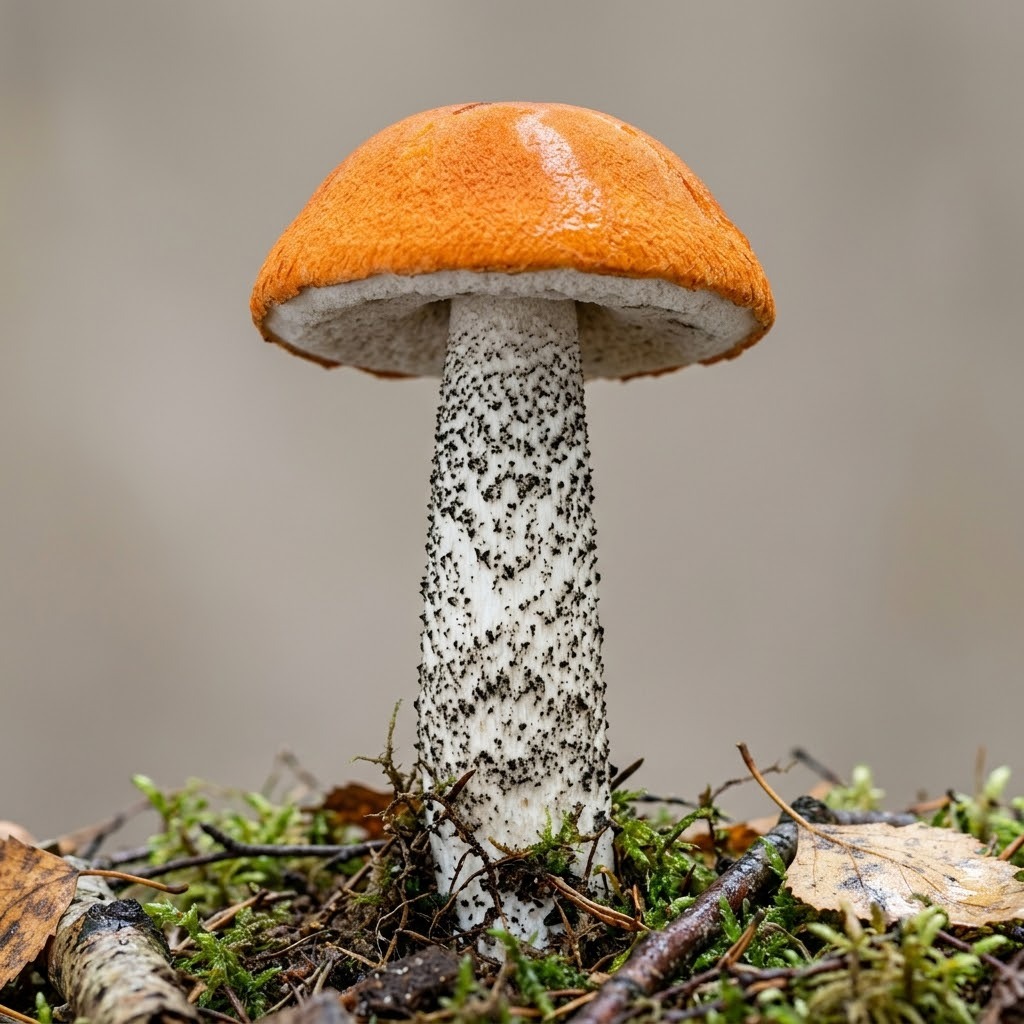
The cap is 6-20 cm across, orange to orange-brown or brick red, dry and slightly downy, with the cuticle overhanging the pore layer at the margin as a small pale rim. Pores are whitish to pale grey, ageing dull buff, bruising brownish. The stem is tall, robust, tapering upwards, whitish, and covered in dense scabers that are dark grey to black rather than the brown of the birch bolete, and which darken further with age. The flesh is white and stains in stages when cut: first pinkish grey, then slate grey, then blue-black in the stem base, all within a few minutes. Spore print is snuff brown. The combination of an orange cap, blackish scabers, birch host, and dramatic grey-to-black staining is distinctive. The related red-capped scaber stalk (Leccinum aurantiacum) is very similar but associates with aspen and poplar; both are edible and the distinction matters more to a mycologist than to a cook.
Where It Grows
This is a birch specialist, mycorrhizal with birch and fruiting in birch woods, on birch-scattered heaths, in mossy northern forests, and along the birch edges of conifer stands. It prefers damp, mossy, acidic ground and often appears in the same places as the ordinary birch bolete but in smaller numbers. The season runs from midsummer into autumn, peaking after warm rain. It is common across northern and central Europe, Scandinavia, the Baltics, and northern Asia, and is one of the archetypal mushrooms of Nordic and eastern European foraging culture. Because it depends on living birch roots, productive spots recur year after year as long as the woodland stands.
How to Grow at Home
It cannot be cultivated. Leccinum species are ectomycorrhizal and depend on a living birch partner, and no substrate, kit, or growing bag will fruit them. Commercial attempts to cultivate mycorrhizal boletes have consistently failed. The only meaningful home version is to look after habitat: retain mature birch, leave moss and leaf litter undisturbed, do not fertilise or dig the root zone, and accept a timescale of years. If you have birch on your land, the fungus may already be there and simply waiting for a wet late summer. Everything else about this species is a foraging skill rather than a growing one, and the skills worth developing are reading weather, recognising birch habitat, and judging specimen quality on the spot.
Growing Conditions
Light
Irrelevant to the fungus itself, which lives in the soil in shade. The relevant variable is the health of the birch stand overhead and an undisturbed layer of moss and litter at ground level.
Watering
Fruiting follows rain. A soaking followed by mild humid days in July, August, or September is the trigger; in a dry summer the species is scarce regardless of how good the woodland is.
Temperature & Substrate
It fruits across roughly 10-22°C from midsummer to mid autumn, tending to appear a little earlier in the season than many boletes. The substrate is damp acidic soil laced with living birch roots, moss, and leaf litter. This cannot be reproduced at home.
Culinary Use
This is a genuinely good edible, firmer and more substantial than the ordinary birch bolete. Young specimens with tight pale pores are best; on larger caps remove the pore layer, which goes spongy. Slice and cook thoroughly, and expect the flesh to blacken, which is normal and harmless but means the dish will be dark. Northern European tradition puts them in cream sauces, pies, and mushroom soups, and they are also excellent dried, where the flavour concentrates well, or salted in the Baltic and Russian manner for winter. They are firm enough to fry properly, which sets them apart from most of the genus. Never eat them raw. Discard maggoty specimens; like all Leccinum they are popular with fly larvae, and a stem that looks clean outside may be tunnelled through.
Health & Nutrition
Low in calories, with a reasonable protein content for a mushroom, plus fibre, B vitamins, selenium, potassium, and copper, alongside the beta-glucans typical of edible fungi. The standing caution for wild boletes applies here as well: they take up heavy metals from the soil, and in regions affected by historical nuclear fallout wild mushrooms can carry radiocaesium, which is why several northern and eastern European agencies have issued long-running advice on moderation for certain wild species. In practice, gather from clean woodland away from industry and roads, eat wild mushrooms as a seasonal food rather than a daily staple, and cook them fully. Anyone eating a wild mushroom for the first time should try a small portion and wait a day.
Common Problems
- Alarm at the blackening flesh - entirely normal for this species. Grey, then blue-black staining within minutes is expected, not a warning sign.
- Maggot tunnels - very common in this genus. Split the stem and inspect before adding it to the basket.
- Spongy pore layer - remove it from all but the youngest caps; it holds water and turns slimy.
- Dark, unattractive dishes - unavoidable. Use them in dark sauces, soups, and pies rather than pale cream dishes.
- Confusion with other Leccinum species - most are edible, but learn the local set rather than assuming; some North American red-capped species have caused digestive upset.
Pros & Cons
Pros
- Firm flesh that fries and holds shape, unusually good for the genus.
- Bright orange cap makes it easy to spot in moss.
- Excellent dried or salted for winter storage.
- No deadly look-alike within its habitat.
Cons
- Blackens dramatically when cooked, spoiling pale dishes.
- Very attractive to fly larvae.
- Cannot be cultivated at all.
- Bioaccumulates heavy metals and caesium in some regions.
Best Suited For
- Foragers in northern birch woodland who want a bolete worth frying fresh.
- Cooks who dry or salt mushrooms for winter storage.
- Beginners learning the scaber-stalk group with a distinctive, colourful species.
Not ideal for anyone who wants pale-coloured mushroom dishes, or foragers without birch woodland access.
FAQ
Why does the flesh turn black when I cut it? Oxidation of pigments in the flesh. It happens in stages, pink-grey then slate then blue-black, and it is completely normal for this species. Cooked mushrooms will be dark.
Is it the same as the red-capped scaber stalk? No, but they are close relatives and are cooked identically. The orange birch bolete grows with birch; the red-capped scaber stalk favours aspen and poplar.
Should I remove the pores? On young firm specimens, no. On larger caps, yes, since the pore layer holds water and turns to slime in the pan.
Never eat an orange birch bolete without 100% expert identification. Confirm the birch host, blackish scabers on the stem, whitish non-blueing pores, and brown spore print with an experienced identifier. Never eat any bolete with red or orange pores.
🪴 Foraging kit worth a look
Nothing here identifies a mushroom for you - identification stays with your field guides and local experts. These are simply the basics foragers carry.
Links go to Amazon or a partner store (such as Adagio Teas) and may earn us a commission at no extra cost to you. As an Amazon Associate we earn from qualifying purchases. We link gear types, not sponsors' picks: you choose the exact product.