Panther Cap
The panther cap (Amanita pantherina) is the fly agaric's more dangerous and less famous relative: a brown-capped, white-spotted Amanita containing the same neurotoxic compounds in generally higher concentrations.
🗓️ Last reviewed: August 2026
Overview
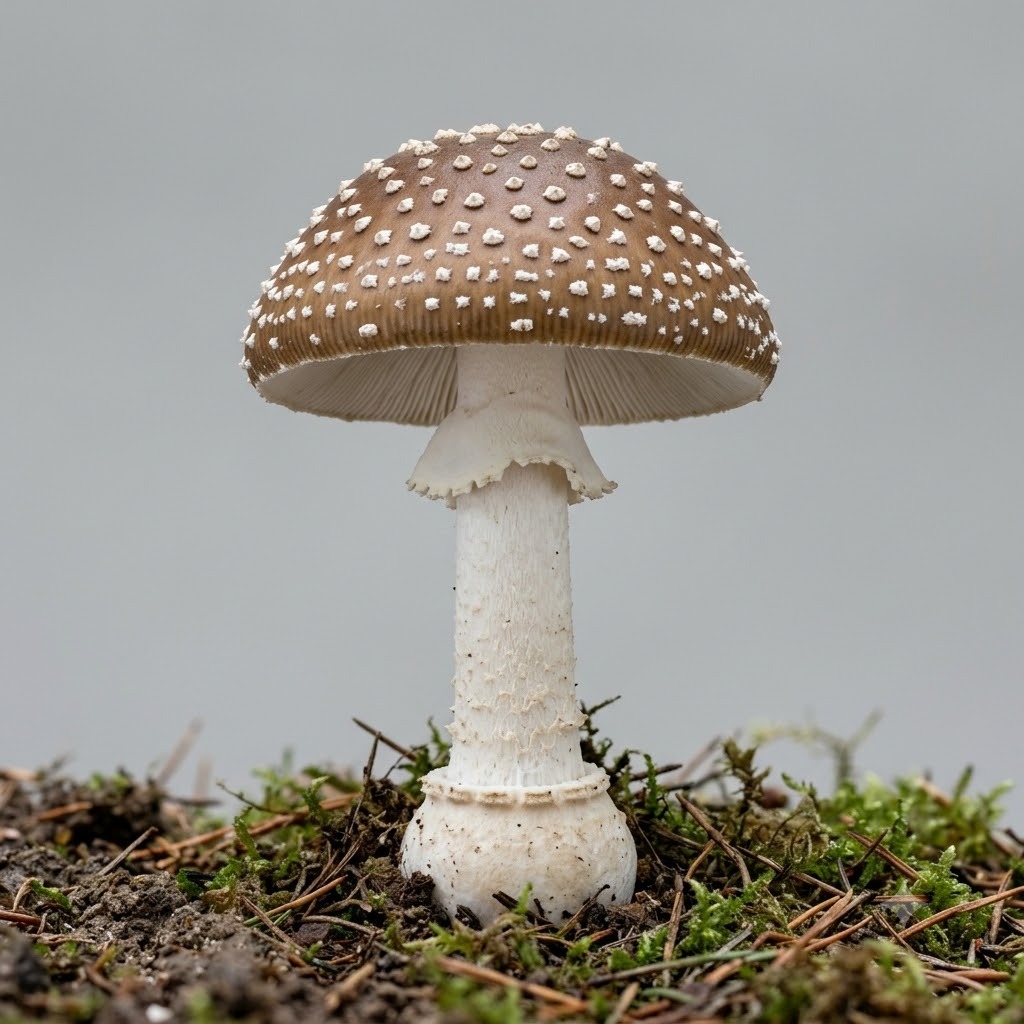
The panther cap (Amanita pantherina) is the fly agaric's more dangerous and less famous relative: a brown-capped, white-spotted Amanita containing the same neurotoxic compounds in generally higher concentrations. Where the scarlet fly agaric announces itself, the panther cap looks unremarkable, a plain brown mushroom with white flecks that could pass for something ordinary at a glance, and that is precisely why it causes more serious poisonings in Europe than its showy cousin. It has also been mistaken for the edible blusher and for the grey-brown Amanita excelsa, both of which are gathered in some regions, and those confusions have put people in intensive care.
Identification & Appearance
The cap is 5-12 cm across, tan to greyish or dark brown, sometimes almost olive, covered in pure white, evenly scattered wart-like flecks that are more regular and whiter than those of the blusher, and the cap margin is usually distinctly grooved or striate at the edge, which is a useful feature. Gills are white, crowded, and free. The stem is white with a ring that is usually smooth-edged and positioned quite low, and the base is bulbous with a distinct rim or collar at the top of the bulb, plus one or more narrow hoop-like bands above it, rather than the loose sac of a death cap. Flesh is white and, critically, does not turn pink or red when cut or bruised, which separates it from the blusher. Spore print is white.
Where It Grows
Panther caps are ectomycorrhizal with beech, oak, birch, and conifers, fruiting from summer through autumn in woodland, parkland, and occasionally gardens with mature trees. They favour richer soils and are common in beech woodland in particular. The species is widespread across Europe and Asia, with related taxa in North America where the group has been split into several species. It appears in exactly the same habitats and at the same times as several mushrooms that people do gather, including the blusher, which is eaten in parts of Europe after cooking, and that overlap is the source of most poisonings rather than deliberate consumption.
Can It Be Grown
No. Like all Amanita species it is mycorrhizal and cannot be cultivated, and there would be no reason to try. Where it appears in a garden with beech or oak, the sensible response for households with children or dogs is to remove the fruit bodies with gloves and dispose of them sealed, understanding that the fungus lives on in tree roots. The far more useful protection is the standing rule that nothing growing in the garden is ever picked or tasted by children, and that any wild mushroom brought into the kitchen is checked by someone who knows the Amanita structure.
Growing Conditions
Light
Not relevant to the fungus, which lives on tree roots and fruits in woodland shade or open parkland according to where its host trees stand.
Watering
Fruiting follows summer and autumn rain. Heavy rain can wash the white flecks off the cap, which removes one of the most obvious identification features and makes a plain brown cap look like something else.
Temperature & Substrate
Fruiting spans roughly 12-22°C from summer into autumn. The substrate is soil around living beech, oak, birch, and conifer roots, particularly on richer soils.
Why It Is Not Food
Panther cap contains ibotenic acid and muscimol, the same neurotoxins as the fly agaric, and typically at higher concentrations, which makes poisonings more severe. Symptoms appear rapidly, and the clinical picture includes agitation, confusion, hallucinations, drowsiness, muscle twitching, and in serious cases seizures and coma. There is no safe preparation. Parboiling advice circulating for fly agaric is unreliable in any case and doubly so here, since toxin content is higher and varies unpredictably between specimens. This mushroom should be treated as strictly off-limits, and the only reason to learn it is to rule it out when identifying other species.
Health & Poisoning Pattern
Onset is fast, typically thirty minutes to three hours after eating. The pattern is nausea and vomiting, then neurological effects: dizziness, confusion, visual disturbance, alternating drowsiness and agitation, muscle twitching, and in serious cases delirium, convulsions, and prolonged coma-like sleep. Recovery generally occurs over twelve to twenty-four hours with supportive hospital care, but severe cases require intensive monitoring, and children are at substantially greater risk. Anyone who has eaten a panther cap should go to hospital promptly, taking mushroom material or a photograph. Do not leave someone who is drowsy, confused, or twitching to sleep it off unobserved.
Common Identification Traps
- Confusion with the blusher - the crucial one. The blusher's flesh turns pink to reddish where cut, bruised, or maggot-damaged; panther cap flesh stays white. Check the cut flesh every time.
- Rain-washed caps - the white flecks can disappear, leaving a plain brown cap.
- Assuming brown means safe - the panther cap is proof that dull colouring means nothing.
- Skipping the stem base - the rimmed bulb with hoop-like bands is a key feature and is often left in the ground.
- The grey spotted Amanita group generally - several similar species exist, some edible after cooking in some traditions, and separating them reliably is expert work.
The Rule That Prevents This
Treat the whole Amanita genus as off-limits unless you are an expert. White gills, a ring, and a bulbous or sac-like base is the architecture to learn and refuse. Within that group, the specific check that separates the panther cap from the blusher is the flesh reaction: reddening flesh means blusher, unchanging white flesh with a rimmed bulb and a grooved cap margin means panther cap. Beginners should not be making that call at all, and there is no dish worth the risk of getting it wrong.
Best Suited For
- Learning to distinguish dangerous Amanita species from the ones foragers gather.
- Teaching the flesh-colour check and the importance of excavating the stem base.
Not food. No preparation makes it safe.
FAQ
How do I tell it from the blusher? Cut the flesh. The blusher turns pink to reddish where cut or damaged. Panther cap flesh stays white. Also check the stem base: panther cap has a rimmed bulb with narrow hoop-like bands.
Is it more dangerous than fly agaric? Generally yes. It contains the same neurotoxins, usually at higher concentrations, and poisonings tend to be more severe.
Are the symptoms delayed like a death cap? No. Onset is fast, usually within thirty minutes to three hours, which is one of the few helpful things about it clinically.
Never eat any mushroom with white gills, a ring, and a bulbous base. That architecture defines the Amanita group. Learn to recognise it and avoid the entire genus unless an expert has confirmed a specific collection.
🪴 Foraging kit worth a look
Nothing here identifies a mushroom for you - identification stays with your field guides and local experts. These are simply the basics foragers carry.
Links go to Amazon or a partner store (such as Adagio Teas) and may earn us a commission at no extra cost to you. As an Amazon Associate we earn from qualifying purchases. We link gear types, not sponsors' picks: you choose the exact product.