Porcelain Fungus
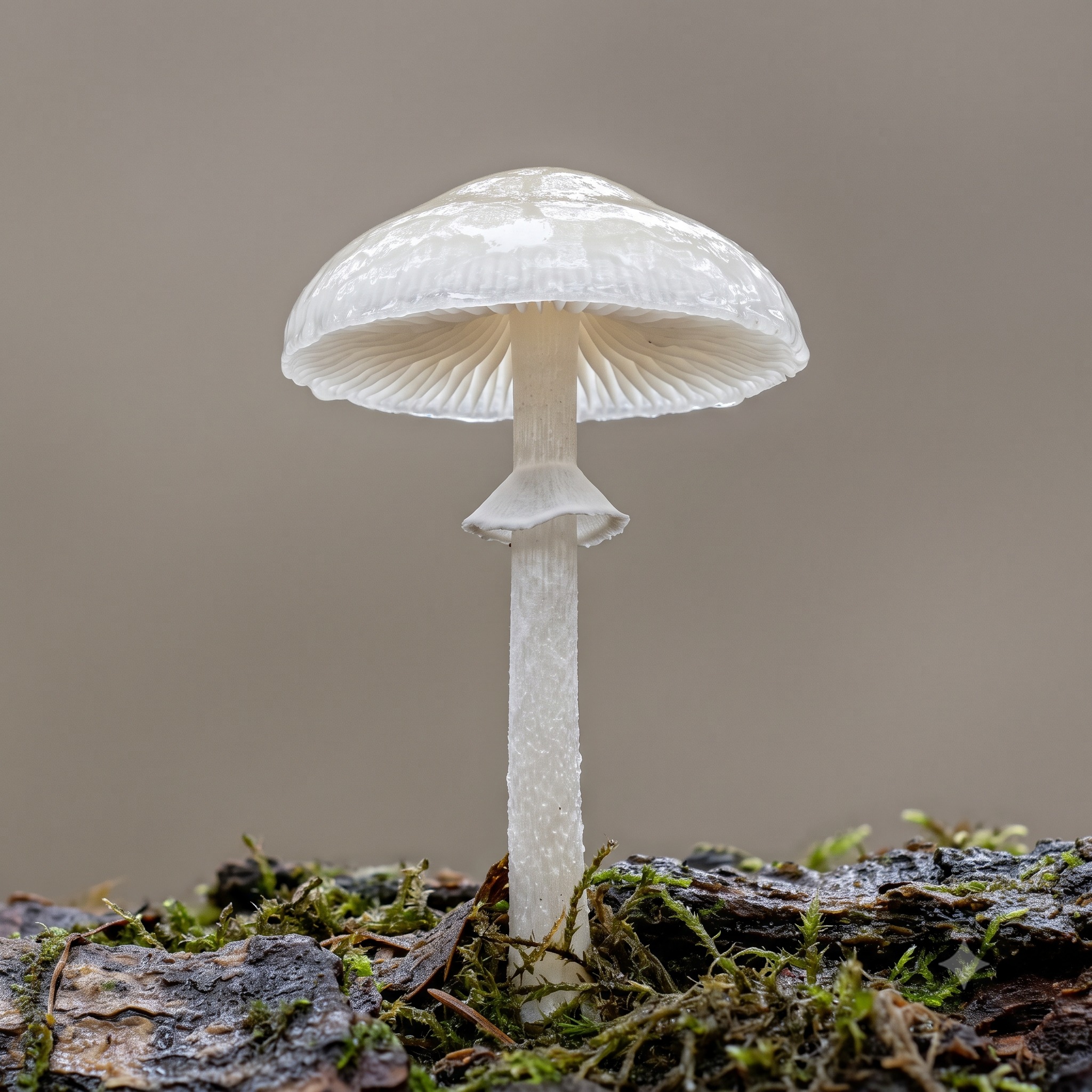
The porcelain fungus (Oudemansiella mucida) is the translucent, glassy white mushroom that hangs in clusters from dead beech branches, often high overhead, glistening as though it were made of wet porcelain or ice.
🗓️ Last reviewed: August 2026
Overview
The porcelain fungus (Oudemansiella mucida) is the translucent, glassy white mushroom that hangs in clusters from dead beech branches, often high overhead, glistening as though it were made of wet porcelain or ice. It is one of the most beautiful fungi in European woodland and one of the most immediately recognisable, since almost nothing else is that white, that slimy, and that specifically attached to beech. It is edible after the slime is dealt with, though it is more admired than eaten. Its real claim to fame is chemical: it produces strobilurin compounds that suppress competing fungi, and those molecules became the template for one of the most important families of agricultural fungicides in the world.
Identification & Appearance
Caps are 2-8 cm across, pure white to slightly grey or ivory, thin-fleshed, convex then flattening, and covered in a thick layer of clear slime that makes them shine and makes them slip out of your fingers. The cap is often translucent enough that the gills show faintly through it. Gills are white, broad, and well spaced. The stem is white, slender, tough, and bears a distinct ring, above which it is smooth and below which it is often finely scaly, and the base is frequently slightly swollen. Flesh is white and thin. Spore print is white. It grows in clusters on dead beech wood: standing trunks, fallen branches, and dead limbs still attached to living trees. The combination of glassy slime, pure white colour, a ringed stem, and beech as host is essentially unique in European woodland.
Where It Grows
Porcelain fungus is a saprotroph and weak parasite almost exclusively on beech, occasionally on other broadleaved trees, and it is one of the characteristic autumn species of beech woodland across Europe. It fruits on dead standing trunks, on fallen branches, and very commonly on dead limbs high in living beeches, which is why it is often photographed against the sky rather than picked. The season runs from late summer through autumn. Where beech is dominant, it can be abundant. It plays a normal role in beech woodland decay, and the strobilurin compounds it produces appear to help it hold onto its patch of wood by inhibiting rival fungi, which is a nice example of chemical warfare between species that ended up transforming crop protection.
How to Grow at Home
It is not commercially cultivated and there is no spawn on the market. As a beech-wood saprotroph it can be grown in laboratory culture, and it is well studied for that reason, but nobody farms it, largely because it is thin, slimy, and low-yielding, which is a poor combination commercially. Home cultivation on beech logs is theoretically possible with a wild culture but not practical. The realistic engagement with this species is woodland: leave dead beech limbs and fallen branches in place, and it will appear on its own in any beech wood with a normal amount of standing and fallen deadwood. It is a good species to look for as an indicator that a beech wood is being allowed to age naturally rather than being tidied.
Growing Conditions
Light
Not relevant to the fungus. It fruits from dead beech wood at any height, in shade or filtered light, and the presence of dead beech is the only thing that matters.
Watering
Fruiting follows autumn rain, and the slime layer is at its most spectacular in wet weather. In dry spells the caps dry to a dull, slightly sticky finish and lose their glassy appearance.
Temperature & Substrate
Fruiting spans roughly 5-18°C from late summer into autumn. The substrate is dead beech wood, standing or fallen, including dead limbs on living trees. It will not grow on conifer.
Culinary Use
Edible, but it needs work, and the work is removing the slime. The standard preparation is to peel or scrape the slimy cuticle from the cap, or to blanch the caps briefly and rinse them, before cooking. Discard the tough stems. Once de-slimed the caps are mild, faintly nutty, and pleasant, and they suit frying with garlic, being added to mixed mushroom dishes, or going into soups where the slight residual gelatinous quality actually helps the texture. The flesh is thin, so a lot of caps make a modest dish. Cook thoroughly. Realistically, most foragers who find it either photograph it or take a handful as a curiosity. It is not in the same league as the ceps and chanterelles that fruit in the same beech woods at the same time, and there is no shame in leaving it hanging.
Health & Nutrition
Nutritionally slight: mostly water, low calorie, small amounts of protein and fibre. The interesting content is pharmacological rather than nutritional. Porcelain fungus produces strobilurin A and related compounds, which inhibit fungal respiration, and chemists used those natural molecules as the starting point for the strobilurin class of agricultural fungicides, including azoxystrobin, which became one of the best-selling crop protection products worldwide. That is a genuine and well-documented case of a woodland mushroom shaping modern agriculture. It does not mean eating the mushroom has a medicinal effect, and the quantities involved in a meal are trivial. The usual wild mushroom rules apply: cook it fully, try a small portion first, and gather from clean woodland.
Common Problems
- Impossible to hold - the slime is legendary. Carry them in a rigid container rather than a bag.
- Slimy texture in the pan - peel or blanch the caps before cooking; unpeeled they stay unpleasantly gelatinous.
- Growing out of reach - very common, since much of the fruiting happens on dead limbs high in living beeches.
- Tough stems - discard them.
- Thin yield - a large number of caps produce a small dish. Manage expectations.
Pros & Cons
Pros
- Unmistakable and beautiful, one of the easiest species to identify.
- Common wherever beech grows.
- Fruits late in the season alongside the best autumn species.
- A genuinely interesting story in the history of crop protection.
Cons
- Very slimy; requires peeling or blanching before cooking.
- Thin flesh and low yield.
- Often growing too high to reach.
- Mild flavour that is easily outclassed by neighbours in the same wood.
Best Suited For
- Photographers and naturalists in beech woodland.
- Foragers who like preparing a curiosity rather than filling a basket.
- Anyone learning to recognise wood-inhabiting mushrooms by host tree.
Not ideal for cooks wanting a substantial mushroom, or anyone unwilling to deal with the slime.
FAQ
Why is it so slimy? The thick clear gel layer helps the thin-fleshed mushroom retain water and may protect it from insects. It is normal, not a sign of decay.
Can I eat it without peeling? You can, but the texture is unpleasantly slippery. Peeling or a brief blanch and rinse makes it much better.
Is it true that a fungicide came from this mushroom? Yes. Strobilurin compounds produced by this species and its relatives were the chemical starting point for the strobilurin fungicide family used on crops worldwide.
Never eat a porcelain fungus without 100% expert identification. Confirm the pure white slimy cap, ringed stem, white spore print, and growth on dead beech with an experienced identifier before eating.
🪴 Foraging kit worth a look
Nothing here identifies a mushroom for you - identification stays with your field guides and local experts. These are simply the basics foragers carry.
Links go to Amazon or a partner store (such as Adagio Teas) and may earn us a commission at no extra cost to you. As an Amazon Associate we earn from qualifying purchases. We link gear types, not sponsors' picks: you choose the exact product.