Red Cracking Bolete
The red cracking bolete (Xerocomellus chrysenteron) is one of the most common boletes in European woodland and one of the least celebrated.
🗓️ Last reviewed: August 2026
Overview
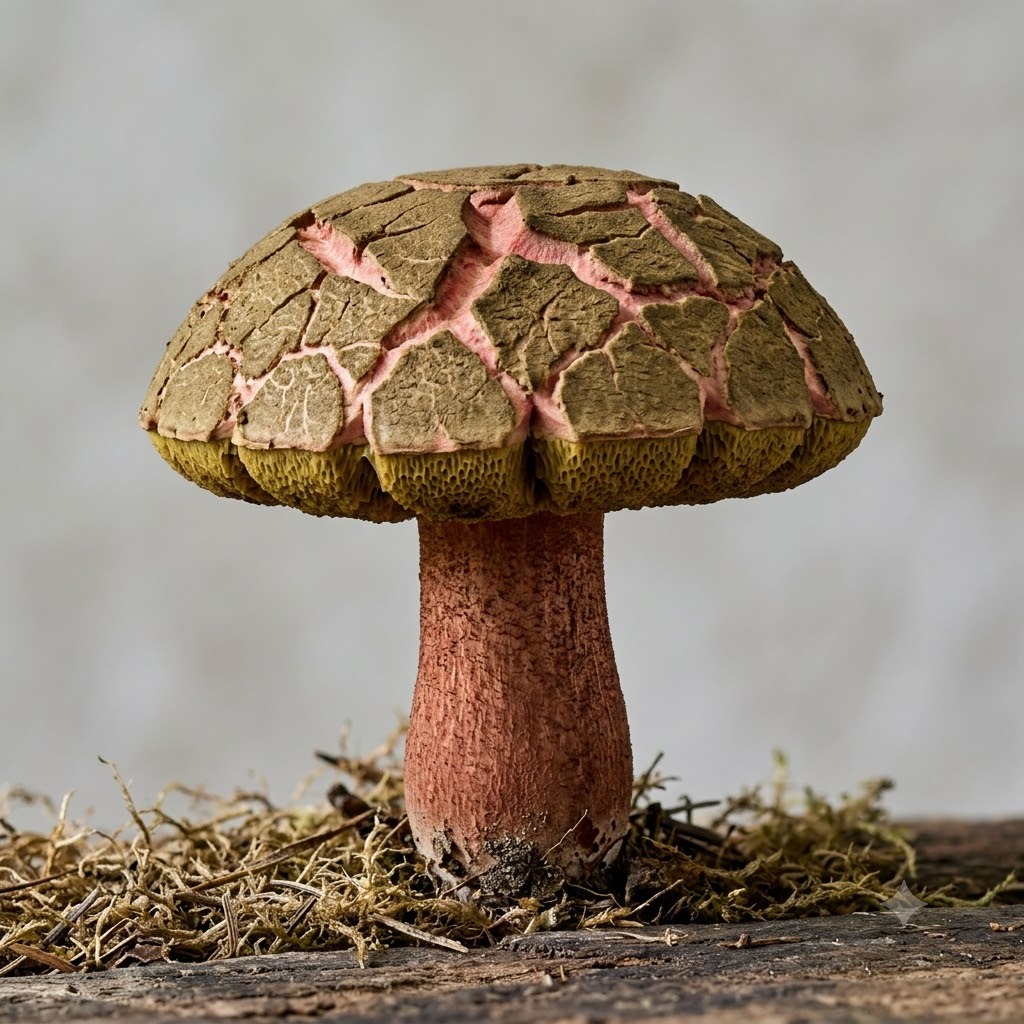
The red cracking bolete (Xerocomellus chrysenteron) is one of the most common boletes in European woodland and one of the least celebrated. Its trademark is a cap that dries into a crazed mosaic of cracks with pinkish-red flesh showing through the gaps, which makes it easy to recognise and gives it the name. It is edible, mild, and soft, and most experienced foragers walk past it because the texture goes to mush and because a large share of any given crop is infected with a parasitic gold mould. Where it earns its place is as a teaching species: it is abundant, harmless, and shows the classic bolete features clearly, so it is a good mushroom to learn the group on before hunting anything more valuable.
Identification & Appearance
The cap is 3-10 cm across, olive-brown to grey-brown, dry and velvety at first, and typically cracking into a network of small plates as it expands, with pinkish red flesh visible in the cracks. Pores are relatively large and angular, yellow at first, ageing olive-yellow and bruising blue-green fairly quickly. The stem is slender, yellow at the apex, streaked with red or carmine fibres over most of its length, and has no ring and no raised net. The flesh is pale yellow, reddish just under the cap cuticle and in the stem base, and turns weakly blue when cut. Spore print is olive-brown. The cracked cap with red in the cracks, red-streaked stem, and weak blue bruising are the practical field marks. Several closely related species in the same group differ in subtle details and are treated identically in the kitchen; none of the group is dangerous, though none is worth much either.
Where It Grows
This is a mycorrhizal species of broadleaved and mixed woodland, associating with oak, beech, birch, and other hardwoods, and it is one of the first boletes to appear each season and one of the last to stop. It fruits from early summer through late autumn on woodland paths, banks, mossy edges, and in parks and gardens with mature trees. It is abundant across Europe, common in parts of Asia, and present in North America, though the taxonomy of the group differs there. Because it is so widespread and so tolerant, it turns up in urban parks and suburban gardens as readily as in old woodland, which is part of what makes it a good species to practise identification on.
How to Grow at Home
Not possible. Like other mycorrhizal boletes it lives in partnership with living tree roots and cannot be persuaded to fruit on straw, sawdust, or any other prepared substrate. It also has no commercial value, so no one has tried very hard. What a gardener can do is keep mature broadleaved trees and their root zones undisturbed, since this species is one of the most likely mycorrhizal fungi to appear spontaneously in a garden with an established oak or beech. If it appears, that is a sign of a healthy, undisturbed root system rather than a harvest opportunity, and it is a good excuse to teach children what a bolete looks like without any of the anxiety attached to more valuable finds.
Growing Conditions
Light
Not relevant to the fungus. It fruits in the shade of broadleaved trees, and what matters is the presence of a mature host and undisturbed soil and litter around its roots.
Watering
Fruiting follows rain across a long season. This species is less rain-dependent than many boletes and can appear in modest numbers even in indifferent weather, which is one reason it is seen so often.
Temperature & Substrate
It fruits across a broad range, roughly 8-24°C, from early summer to late autumn. The substrate is woodland soil and litter around living hardwood roots; there is no home equivalent.
Culinary Use
Honest assessment: this is a filler mushroom. Young, firm specimens are mild and acceptable fried, but the flesh softens quickly and older caps cook to a watery, greyish mush that adds little. Cut away the pore layer, which goes spongy early, slice the caps, and cook them hot and fast alongside firmer species. They are not worth drying, since the flavour is thin, and they do not pickle particularly well. The most common use in practice is padding out a mixed mushroom fry-up when the good species are scarce. Never eat them raw, and never eat specimens carrying the gold mould described below. If you are after a bolete worth cooking on its own, this is not it, and there is no shame in leaving it in the woods.
Health & Nutrition
Nutritionally unremarkable in the way most mushrooms are unremarkable: low calorie, some protein and fibre, B vitamins, potassium, and trace minerals, plus beta-glucans. The health note that matters for this species is the parasitic mould rather than the mushroom itself. A very large share of red cracking boletes in some seasons are attacked by Hypomyces or Sepedonium species, which coat the fruit body in a bright golden-yellow powdery layer and deform it. Those infected specimens should be discarded; the safe rule with any mould-infected wild mushroom is that it goes in the bin, not the pan. Beyond that, the standard bolete cautions apply: heavy metal uptake from contaminated ground, moderation with wild mushrooms generally, and full cooking every time.
Common Problems
- Golden yellow powdery coating - a parasitic mould, extremely common in this species. Discard infected fruit bodies entirely.
- Watery, grey mush in the pan - specimens were too old or the pore layer was left on. Use only young firm caps.
- Maggot damage - frequent, as in most boletes.
- Confusion within the group - several closely related cracked-cap boletes exist and are hard to separate. None is dangerous, so the confusion has no practical consequences.
- Overestimating it - foragers new to boletes sometimes fill a basket with this species expecting porcini quality. It is not in that league.
Pros & Cons
Pros
- Very common and easy to find across a long season.
- Distinctive cracked cap with red in the cracks.
- Harmless and an excellent species for learning bolete features.
- Appears in gardens and parks, not just deep woodland.
Cons
- Soft, watery texture that collapses when cooked.
- Very frequently infected by a parasitic gold mould.
- Thin flavour, not worth drying or pickling.
- Often maggot-ridden.
Best Suited For
- Beginners practising bolete identification on an abundant, harmless species.
- Teaching children and new foragers what pores, bruising, and a bolete stem look like.
- Padding out a mixed mushroom dish when better species are scarce.
Not ideal for anyone hoping for a mushroom worth cooking on its own merits.
FAQ
What is the yellow powder on some of these mushrooms? A parasitic mould in the Hypomyces or Sepedonium group, which attacks this species heavily. Infected fruit bodies should be discarded, not cleaned and cooked.
Is the blue bruising a warning sign? No. Weak blue staining is normal in this species and in many harmless boletes. Colour change alone never determines edibility.
Is it worth picking at all? Only young, firm, mould-free specimens, and only to bulk out a mixed dish. Most experienced foragers leave it and look for something better.
Never eat a red cracking bolete without 100% expert identification. Confirm the cracked cap with red in the cracks, angular yellow pores, red-streaked ringless stem, and weak blue bruising with an experienced identifier. Never eat any bolete with red or orange pores.
🪴 Foraging kit worth a look
Nothing here identifies a mushroom for you - identification stays with your field guides and local experts. These are simply the basics foragers carry.
Links go to Amazon or a partner store (such as Adagio Teas) and may earn us a commission at no extra cost to you. As an Amazon Associate we earn from qualifying purchases. We link gear types, not sponsors' picks: you choose the exact product.