Shaggy Parasol
The shaggy parasol (Chlorophyllum rhacodes) is a big, handsome, coarsely scaled mushroom of gardens, hedgerows, and conifer-shaded ground, and one of the most divisive edibles in the northern hemisphere.
🗓️ Last reviewed: August 2026
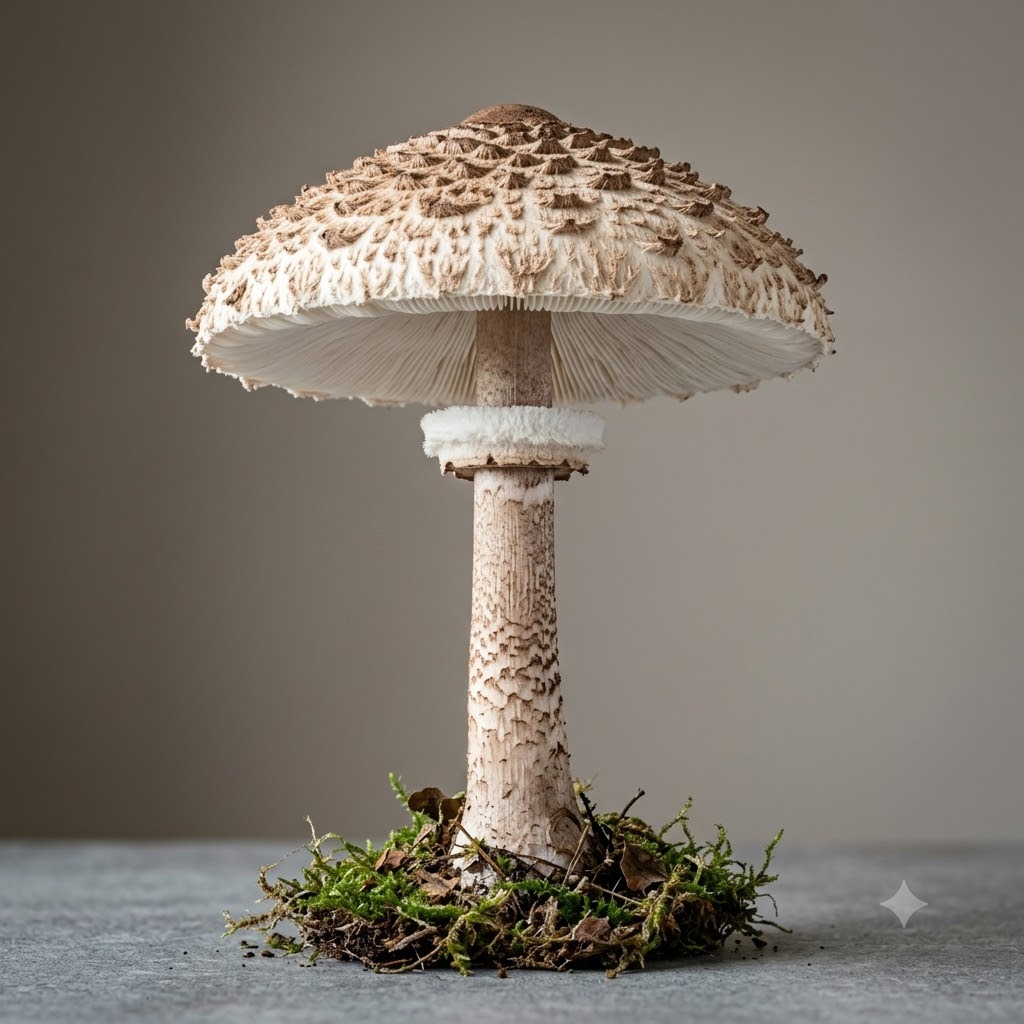
Overview
The shaggy parasol (Chlorophyllum rhacodes) is a big, handsome, coarsely scaled mushroom of gardens, hedgerows, and conifer-shaded ground, and one of the most divisive edibles in the northern hemisphere. Many foragers eat it happily every autumn; a minority get severe stomach upset from the same meal, which is why guides that once called it a straightforward edible now hedge. It looks like the true parasol mushroom but is shorter, stockier, and has a stem without the snakeskin patterning, and the flesh turns dramatically red-orange when cut. Most importantly, it shares a genus and a general appearance with the green-spored parasol, the mushroom responsible for more poisonings in North America than any other, which makes learning this species properly a matter of some urgency for anyone in its range.
Identification & Appearance
The cap is 6-15 cm across, starting as a rounded drumstick and expanding to a flattish disc, pale buff to greyish, and breaking up into large coarse upturned brown scales that give it a shaggy, tousled look. Gills are white, crowded, and free of the stem, bruising reddish then browning with age. The stem is smooth, whitish to pale brown, without the snakeskin banding of the true parasol, bulbous at the base, and carries a thick movable double-edged ring. The critical feature is the flesh: cut the stem or cap and it flushes bright saffron to orange-red within a minute or two, then darkens to brownish. Spore print is white, which is the single most important check, because the dangerous green-spored parasol has a distinctly green spore print. Never skip the spore print with any large scaly white-gilled parasol-type mushroom.
Where It Grows
Shaggy parasols like rich, disturbed, nitrogen-enriched ground: garden borders, compost heaps, conifer plantations, shelterbelts, hedge banks, and the edges of paths. They are far more a garden and plantation species than a deep woodland one, and they often fruit in rings or arcs in the same spot for many years. The season runs from late summer through autumn. The species is widespread in Europe, North America, and beyond, and the taxonomy has been revised repeatedly, with several closely related species now separated out; from an eater's perspective they behave the same, which is to say generally edible and occasionally not tolerated. Because they favour gardens and cultivated ground, spray history matters as much as identification.
How to Grow at Home
There is no commercial cultivation and no reliable home method. It is a saprotroph on rich organic matter, so it is not impossible in principle, and it sometimes colonises compost heaps and wood-chip mulch spontaneously, which is the closest thing to growing it deliberately. Gardeners who find it appearing in a mulched border can encourage it simply by continuing to mulch with the same material, leaving the ground undisturbed, and avoiding fungicide. Given that a proportion of people cannot digest this mushroom, the honest advice is that encouraging it is more an ecological curiosity than a food strategy. If you want a large, meaty, reliable mushroom in your garden, an inoculated wine cap bed will serve you far better.
Growing Conditions
Light
Not relevant to the fungus, which fruits from soil and mulch in shade or partial shade. Rich, undisturbed, well-mulched ground under conifers or in a shrub border is the habitat.
Watering
Fruiting follows autumn rain. Mulched ground that holds moisture evenly produces more reliably than exposed soil that dries out between downpours.
Temperature & Substrate
Fruiting runs roughly 8-20°C from late summer into autumn. The substrate is nitrogen-rich decaying organic matter: compost, leaf mould, wood chip, and conifer litter.
Culinary Use
When it agrees with you, this is a good mushroom: firm, meaty, with a nutty flavour, and large enough that a couple of caps make a meal. The stems are fibrous and usually discarded. Cook it thoroughly, and never eat it raw, which is true of all mushrooms but especially of this one. The standard advice is to try a small portion the first time, cooked well, and wait 24 hours before eating more, because a meaningful minority of people get significant gastrointestinal upset from a mushroom their friends eat happily. That reaction appears to be individual sensitivity rather than misidentification, and it is not something cooking reliably removes. Anyone who has reacted once should not try again. Caps grill well, take breadcrumbs and frying, and hold up in stews.
Health & Nutrition
The nutritional profile is standard for a large gilled mushroom: low calories, useful fibre and protein, B vitamins, potassium, and trace minerals. The health story here is not nutrition but tolerance and identification. First, individual intolerance is real and well documented; the mushroom is listed as edible with caution in most modern guides for exactly that reason. Second, and more seriously, this species grows in the same gardens and parkland as the green-spored parasol in North America and increasingly elsewhere as that species spreads, and that mushroom causes violent vomiting and diarrhoea. A white spore print is the decisive check, and it takes twenty minutes and a sheet of paper. Third, garden and parkland ground is often sprayed or contaminated, which is a further reason for caution with a species that specialises in it.
Common Problems
- Green spore print - not a shaggy parasol. Discard the entire collection; that is the green-spored parasol, a serious gastrointestinal poison.
- Stomach upset in one person and not another - documented individual intolerance. Test with a small portion; if you react, never eat it again.
- Confusion with the true parasol - the true parasol has a snakeskin-patterned stem and does not flush red when cut. Both are edible, but the shaggy parasol is the one with the tolerance issue.
- Confusion with young Amanita species - any white-gilled mushroom with a ring needs the stem base excavated to check for a volva, the sac-like cup of a deadly Amanita.
- Fibrous stems - normal; use the caps only.
Pros & Cons
Pros
- Large, meaty caps with good nutty flavour.
- Common in gardens, parks, and plantations, so easily accessible.
- Distinctive red-orange flesh reaction aids identification.
- Fruits in the same spot for years once established.
Cons
- A minority of people cannot digest it, however well cooked.
- Shares appearance and habitat with the dangerous green-spored parasol.
- Garden ground is often sprayed or contaminated.
- Stems are inedible and much of the mushroom is wasted.
Best Suited For
- Experienced foragers who have already established that they tolerate it.
- Gardeners who find it appearing naturally in mulched borders.
- Cooks who want a large cap for grilling or breadcrumbing.
Not ideal for beginners, anyone in a region where the green-spored parasol occurs and who is not confident taking spore prints, or anyone with a sensitive digestion.
FAQ
Why do some people get ill from it? Individual intolerance, not misidentification. A minority of people react with gastrointestinal upset to properly identified, properly cooked shaggy parasols. Test small, and stop permanently if you react.
How do I take a spore print? Cut the cap off, place it gills-down on white paper, cover with a bowl, and leave for several hours. A white print supports shaggy parasol; a green print means the poisonous green-spored parasol.
Is it the same as the parasol mushroom? No. The true parasol is taller with a snakeskin-patterned stem and does not turn red when cut. Shaggy parasol is stockier, plain-stemmed, and flushes saffron to red-orange.
Never eat a shaggy parasol without 100% expert identification. Take a spore print every time, check the stem base for any volva, and have an experienced identifier confirm your first collections.
🪴 Foraging kit worth a look
Nothing here identifies a mushroom for you - identification stays with your field guides and local experts. These are simply the basics foragers carry.
Links go to Amazon or a partner store (such as Adagio Teas) and may earn us a commission at no extra cost to you. As an Amazon Associate we earn from qualifying purchases. We link gear types, not sponsors' picks: you choose the exact product.