Sulphur Tuft
The sulphur tuft (Hypholoma fasciculare) is one of the most abundant mushrooms in temperate woodland, forming dense sulphur-yellow clusters on stumps and dead wood from spring to winter.
🗓️ Last reviewed: October 2026
Overview
The sulphur tuft (Hypholoma fasciculare) is one of the most abundant mushrooms in temperate woodland, forming dense sulphur-yellow clusters on stumps and dead wood from spring to winter. It is poisonous, causing gastrointestinal illness, and it is a frequent cause of poisoning precisely because it grows in exactly the same places, at the same times, and in the same clustered habit as several edible wood mushrooms. It is also intensely bitter, which is the practical safety net that has saved a great many people: anyone who tastes a small piece and spits it out immediately learns what they need to know. That is not a recommended identification technique, but it explains why serious poisonings are less common than the mushroom's abundance would suggest.
Identification & Appearance
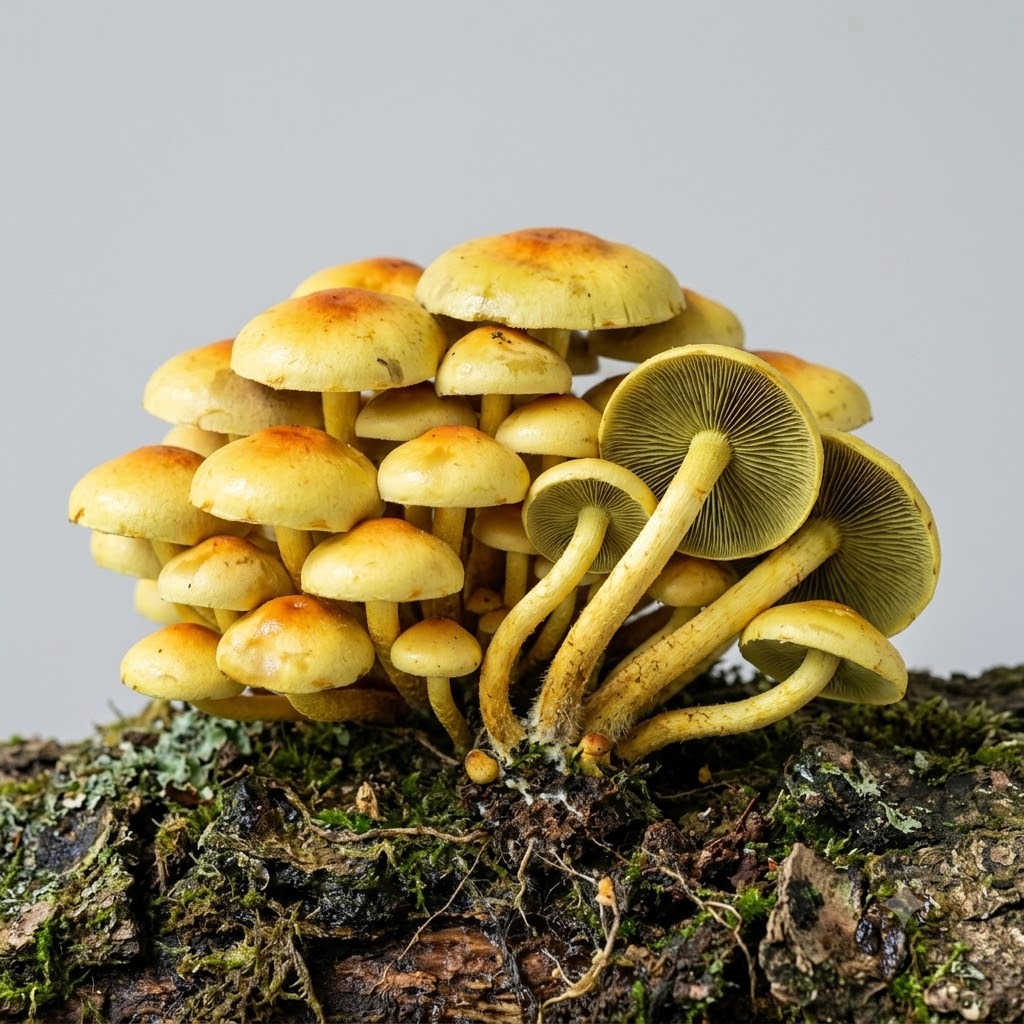
Caps are 2-6 cm across, bright sulphur-yellow to yellow-orange, usually with a distinctly darker orange-brown or tawny centre, smooth, convex then flattening. The gills are the key feature: they start sulphur-yellow, then turn distinctly greenish-yellow, and finally purple-brown to almost black as spores mature, and that greenish phase is characteristic. Stems are yellow, slender, often curved, and fused together at the base of dense clusters, with a faint fibrous ring zone rather than a proper ring. Flesh is yellow and intensely bitter. Spore print is purple-brown to dark chocolate. Clusters are typically large and tightly packed on stumps, logs, and buried roots of both hardwood and conifer.
Where It Grows
Sulphur tufts are wood-decay fungi, fruiting in dense clusters on stumps, fallen logs, buried roots, and wood debris of both broadleaved trees and conifers. They appear from spring through to the first hard frosts and often persist in mild winters, making them one of the longest-fruiting species in the woods. They are extremely common across Europe, North America, and Asia, and they turn up in gardens on old stumps as readily as in woodland. Because they are so abundant and so long-lived in season, they are among the first clustered wood mushrooms most beginners encounter, which is why learning them early is worthwhile.
Can It Be Grown
No, and no reason to. It is a common wood decayer that arrives on its own wherever there are stumps and buried wood. Where clusters appear on a garden stump and children have access, remove them with gloves and dispose of them sealed, understanding that the stump will keep producing. Ecologically the species is a normal and useful decomposer, and there is no need to eradicate it. The practical value here is recognition: anyone learning to gather honey fungus, sheathed woodtuft, or velvet shank needs to be able to identify sulphur tuft instantly, since it grows alongside all three.
Growing Conditions
Light
Not relevant to the fungus, which fruits from wood in shade or open ground. It is equally at home on a woodland stump and a garden log pile.
Watering
Fruiting follows rain across a very long season, from spring through to winter frosts. In mild damp autumns it can be the most conspicuous mushroom in the woods.
Temperature & Substrate
Fruiting spans roughly 2-20°C over an exceptionally long season. The substrate is dead wood of both hardwoods and conifers, as stumps, logs, buried roots, and woody debris.
Why It Is Not Food
Sulphur tuft contains bitter compounds including fasciculol derivatives that cause gastrointestinal poisoning: nausea, vomiting, diarrhoea, and abdominal cramps, in some reported cases with more severe effects including temporary vision disturbance and, in a small number of serious cases, liver involvement. Cooking does not remove the toxins and does not remove the bitterness. The intense bitterness is a genuine deterrent that stops most people mid-mouthful, but relying on that is a poor plan, particularly in a mixed dish where strong seasoning can mask it. Assume it is poisonous and leave it.
Health & Poisoning Pattern
Onset is often delayed, typically five to ten hours after eating. The usual course is vomiting, diarrhoea, and cramping that resolves over a few days with fluids and rest. Reported severe cases are uncommon but do exist, including instances of collapse and liver enzyme derangement, which is why medical assessment is sensible rather than optional if a meaningful quantity has been eaten. Anyone with persistent vomiting, or who is very young, elderly, or unwell, should seek medical care. As with any suspected mushroom poisoning, note what was eaten and when, and keep any remaining material for identification.
Common Identification Traps
- Confusion with honey fungus - honey fungus has a white spore print, a proper woolly ring, and a mild taste; sulphur tuft has a purple-brown print, only a ring zone, and is intensely bitter.
- Confusion with velvet shank - velvet shank has a white spore print and a dark velvety stem base.
- Confusion with sheathed woodtuft - woodtuft has a rust-brown print and a scaly stem below the ring.
- Confusion with the brick cap - Hypholoma lateritium is a close relative with a brick-red cap centre, eaten in some regions, and separating the two requires care.
- Assuming clustered wood mushrooms are interchangeable - they are not, and this cluster is the poisonous one.
The Rule That Prevents This
Spore print colour separates the clustered wood mushrooms cleanly and takes a few hours. White means honey fungus or velvet shank, rust-brown means sheathed woodtuft or the deadly funeral bell, and purple-brown to black means sulphur tuft or its relatives. Combine the print with gill colour, since the greenish-yellow gill phase of sulphur tuft is distinctive. Field guides also describe the intense bitterness, but taste-testing a poisonous species is a technique for trained identifiers, not something we suggest. And never, ever mix clusters from different logs in the same bag.
Best Suited For
- Learning to rule out when gathering clustered wood mushrooms.
- Teaching spore print discipline with an abundant, easily found species.
Not food. Cooking does not remove the toxins or the bitterness.
FAQ
How do I tell it from honey fungus? Spore print and taste. Honey fungus gives a white print and tastes mild after cooking; sulphur tuft gives a purple-brown print and is intensely bitter. Honey fungus also has a proper woolly ring.
Is it deadly? Not usually. It causes vomiting and diarrhoea, occasionally more serious effects, and severe cases including liver involvement have been reported. It is a genuine poisoning, not a mild upset.
Why are the gills green? The greenish-yellow phase occurs as the yellow young gills darken towards their final purple-brown. It is characteristic and useful for identification.
Never eat clustered yellow mushrooms from stumps. Take a spore print, check gill colour through the greenish phase, and have any clustered wood mushroom collection confirmed by an experienced identifier before eating.
🪴 Foraging kit worth a look
Nothing here identifies a mushroom for you - identification stays with your field guides and local experts. These are simply the basics foragers carry.
Links go to Amazon or a partner store (such as Adagio Teas) and may earn us a commission at no extra cost to you. As an Amazon Associate we earn from qualifying purchases. We link gear types, not sponsors' picks: you choose the exact product.