The Prince
The Prince (Agaricus augustus) is the aristocrat of the field mushroom family: a large, handsome, brown-scaled mushroom that smells strongly of bitter almonds and tastes as good as any wild Agaricus.
🗓️ Last reviewed: August 2026
Overview
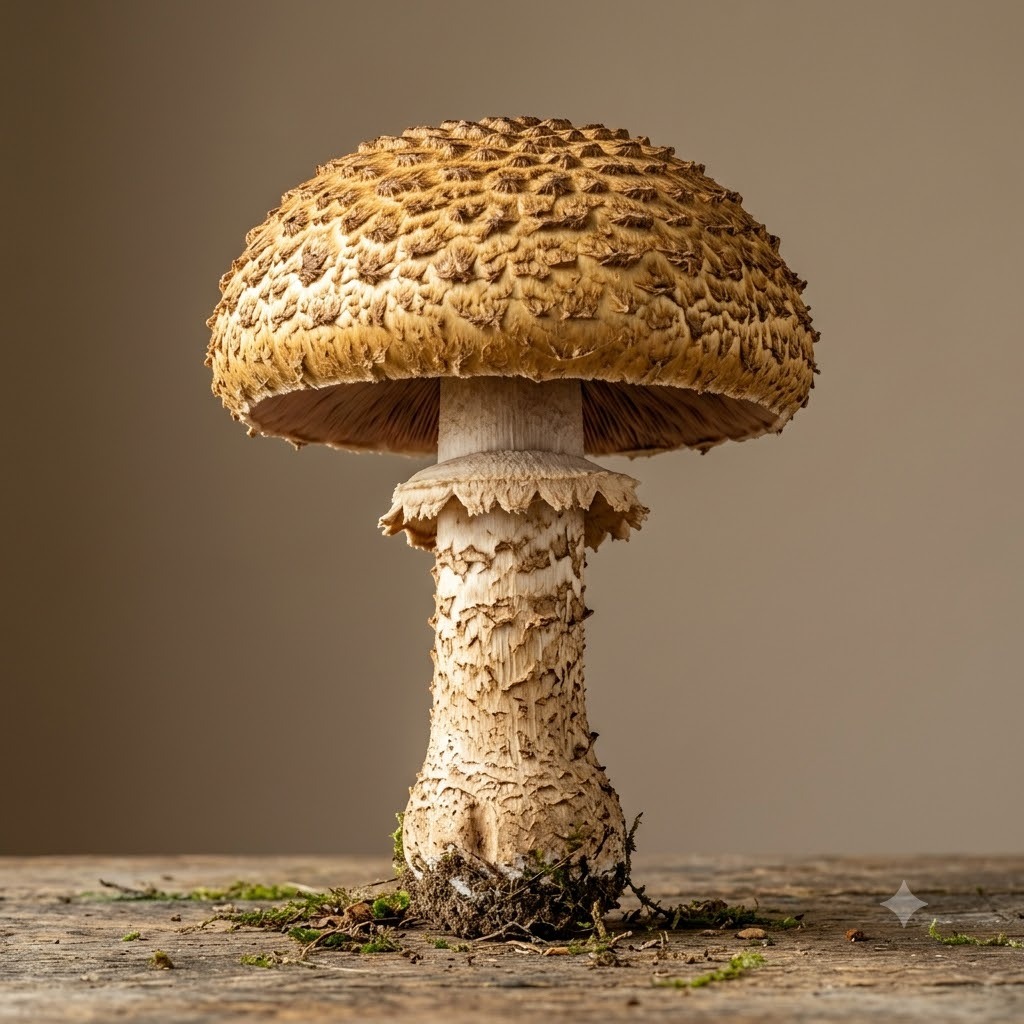
The Prince (Agaricus augustus) is the aristocrat of the field mushroom family: a large, handsome, brown-scaled mushroom that smells strongly of bitter almonds and tastes as good as any wild Agaricus. Caps can reach the size of a dinner plate, and a single specimen can feed a family. It grows in woodland edges, hedgerows, gardens, and disturbed ground, often near conifers, and it has the useful habit of fruiting in the same spot for years. Among the Agaricus species it is one of the safest to learn, because the combination of size, scaly golden-brown cap, almond smell, and yellowing that is mild rather than chrome-bright separates it clearly from the yellow stainer that catches so many beginners.
Identification & Appearance
The cap is 10-25 cm across and occasionally larger, domed then flattening, covered in fine golden-brown to tawny fibrous scales over a paler background, giving a shaggy, tiled appearance. Gills start pale greyish-pink, deepening through pink to chocolate brown and finally near black as spores mature; they are free of the stem. The stem is stout, white, bearing a large pendulous ring with a cog-wheel or scaly underside, and it is shaggy-scaly below the ring. The flesh is white, slowly bruising yellowish where handled, but a soft ochre-yellow rather than the flaring chrome yellow of the yellow stainer. The smell is the clincher: a strong sweet almond or marzipan aroma, sometimes described as aniseed. Spore print is dark brown. Almond smell plus mild yellowing plus a big scaly ring equals The Prince; ink or carbolic smell plus flaring chrome yellow at the stem base equals something to discard.
Where It Grows
The Prince favours disturbed, nutrient-rich ground: woodland edges, hedge banks, path sides, garden shrubberies, compost-enriched borders, and especially ground near conifers such as spruce, pine, and cedar, including planted specimens in parks and large gardens. It fruits from midsummer into autumn, sometimes in scattered groups and sometimes singly, and it returns to productive spots year after year. It is widespread across Europe, North America, and parts of Asia. Because it likes gardens and parkland as much as woodland, it is one of the wild Agaricus species most likely to appear where people actually live, which is both convenient and a reason to think about what has been sprayed on the ground it grew in.
How to Grow at Home
The Prince is not commercially cultivated, and unlike the button mushroom it has resisted straightforward domestication. It is a saprotroph rather than a mycorrhizal species, so cultivation is not theoretically impossible in the way it is for boletes, but no reliable home method exists and spawn is not sold in any general way. The practical approach is habitat management: if it already fruits in your garden, leave the ground undisturbed, keep mulching with leaf litter and woody compost, avoid fungicides, and do not clear the area where it appears. Some foragers have had partial success by scattering mature caps or gill washings in similar ground, though results are anecdotal at best. Treat this as a wild mushroom that sometimes chooses to live in your garden, not a crop.
Growing Conditions
Light
Not applicable to the fungus, which fruits from soil in shade or partial shade. What matters is undisturbed, humus-rich ground, usually near conifers or in a shrubby border.
Watering
Fruiting follows rain in the warm half of the year, typically within a week or two of a good soaking. In gardens, ground that stays evenly damp under mulch produces more reliably than ground that swings between bone dry and flooded.
Temperature & Substrate
Fruiting runs roughly 12-24°C from midsummer into autumn. The substrate is rich woodland or garden soil with plenty of decaying organic matter, often with conifer roots nearby, and it is not something a grower prepares.
Culinary Use
This is one of the best wild mushrooms of the Agaricus genus. The flesh is firm, thick, and full-flavoured, with the almond aroma carrying through into the cooked dish as a pleasant nutty sweetness. Young specimens with pink gills are the ones to take; the flavour coarsens and the texture softens once the gills go dark chocolate. Slice thickly and fry hard, grill whole caps, or stuff and bake them. They are excellent in cream sauces, on toast, and in anything where a big mushroom flavour is welcome. They dry well and rehydrate with the almond note intact. Always cook thoroughly. Clean with a brush rather than water, since the scaly cap holds grit but also soaks up liquid readily.
Health & Nutrition
Like other Agaricus species, The Prince is low in calories and supplies protein, fibre, B vitamins including riboflavin and niacin, selenium, potassium, and copper, and it produces vitamin D on exposure to ultraviolet light. There is one caution specific to this species that is worth taking seriously: Agaricus augustus is known to accumulate cadmium at higher levels than most edible mushrooms, particularly when growing in enriched or contaminated ground. That is a reason to enjoy it as an occasional seasonal treat rather than eating large quantities every week through the season, and a reason to avoid specimens from roadsides, industrial ground, or old orchards where metal-containing sprays were used. As with every wild mushroom, try a small portion the first time.
Common Problems
- Confusion with the yellow stainer - the important one. Cut the stem base: bright chrome yellow plus an ink or phenol smell means discard. The Prince yellows softly and smells of almonds.
- Grit in the scaly cap - brush rather than wash, and trim the cap edge if necessary.
- Old specimens with black gills - past their best; flavour coarsens and the texture goes soft.
- Maggot damage - large caps are often occupied. Split the stem and check.
- Picking from sprayed ground - garden and park specimens may have been treated; know the history of the ground.
Pros & Cons
Pros
- Excellent flavour, among the best of the wild Agaricus species.
- Very large, so a single specimen makes a meal.
- Distinctive almond smell aids confident identification.
- Often fruits in gardens and parks, returning to the same spot yearly.
Cons
- Accumulates cadmium more than most edible mushrooms.
- Shares habitat with the poisonous yellow stainer.
- Cannot be reliably cultivated.
- Big caps are frequently maggot-infested.
Best Suited For
- Foragers who want a large, high-quality wild mushroom for the table.
- Gardeners with conifers and mulched borders where it appears naturally.
- Cooks who grill or stuff whole caps.
Not ideal for anyone who wants to eat wild mushrooms in large quantities regularly, given the cadmium issue.
FAQ
How do I tell it from the yellow stainer? Smell and stem base. The Prince smells of almonds or marzipan and yellows gently; the yellow stainer smells of ink, iodine, or carbolic and flashes bright chrome yellow when the stem base is cut.
Why does the flesh turn yellow at all? Mild yellowing on handling is normal in several Agaricus species including this one. It is the intensity, speed, and the accompanying smell that separate a good species from a bad one.
Can I eat it every week during the season? Better not to. This species concentrates cadmium more than most, so treat it as an occasional seasonal dish rather than a staple.
Never eat a Prince without 100% expert identification. Confirm the almond smell, golden-brown scaly cap, pink-to-brown free gills, dark brown spore print, large ring, and absence of chrome yellow staining with an experienced identifier.
🪴 Foraging kit worth a look
Nothing here identifies a mushroom for you - identification stays with your field guides and local experts. These are simply the basics foragers carry.
Links go to Amazon or a partner store (such as Adagio Teas) and may earn us a commission at no extra cost to you. As an Amazon Associate we earn from qualifying purchases. We link gear types, not sponsors' picks: you choose the exact product.