Tinder Fungus
The tinder fungus (Fomes fomentarius) is the grey hoof-shaped bracket that grows on birch and beech across the northern hemisphere, and it is probably the fungus with the longest continuous record of human use.
🗓️ Last reviewed: August 2026
Overview
The tinder fungus (Fomes fomentarius) is the grey hoof-shaped bracket that grows on birch and beech across the northern hemisphere, and it is probably the fungus with the longest continuous record of human use. Its inner layer, processed into a soft brown felt called amadou, catches a spark from flint and steel better than almost any natural material, and it kept fires alight across Europe for thousands of years. Ötzi, the 5,300-year-old body found in the Alps, carried it in a pouch alongside iron pyrite, which is about as clear a firelighting kit as archaeology produces. Amadou is still made today for fly fishing, where it dries flies beautifully, and for hats and craft goods, particularly in Transylvania where the trade survives.
Identification & Appearance
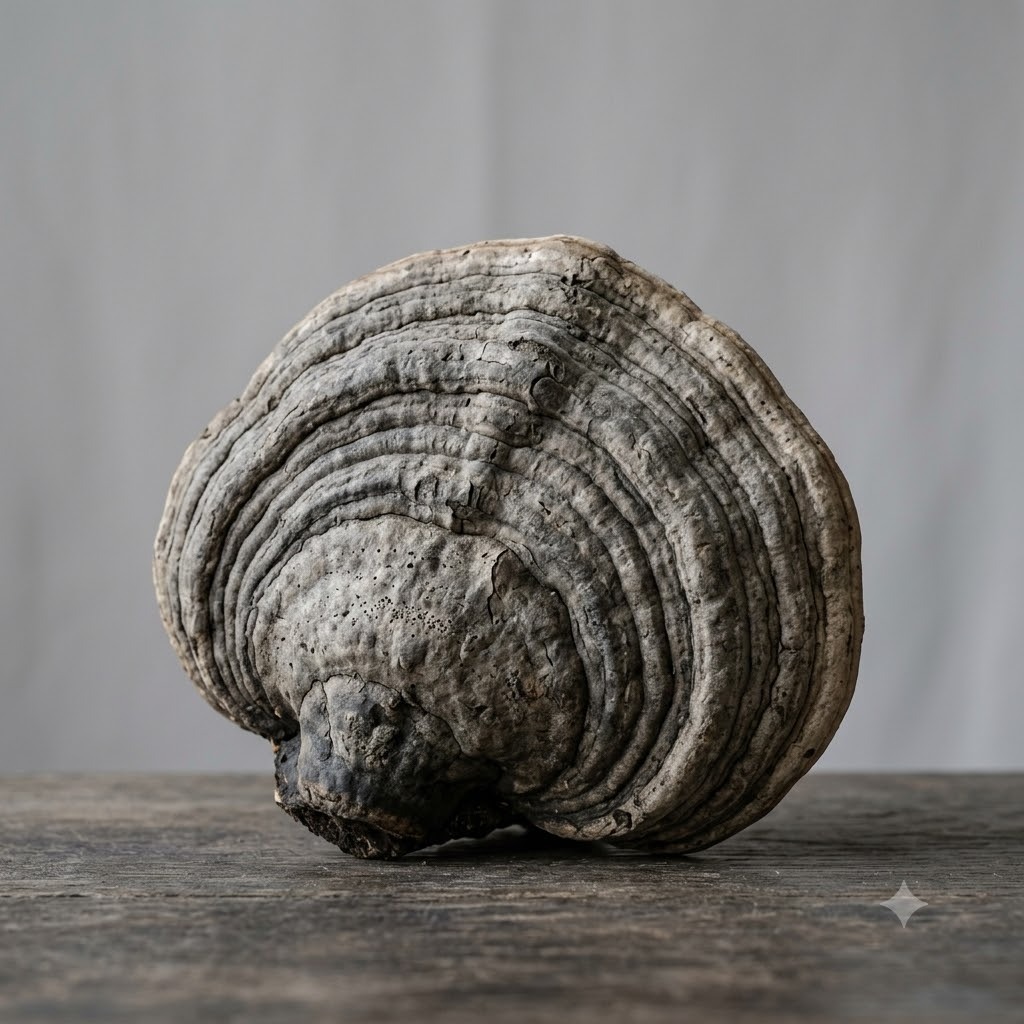
The fruit body is a hard, hoof-shaped perennial bracket, 10-45 cm across, grey to greyish-brown, with concentric ridges marking successive years of growth and a blunt rounded margin. The upper surface is hard and crusty, sometimes almost smooth, and often paler grey than the artist's conk. The underside is a fine pale brown to grey pore surface with small round pores, and unlike the artist's conk it does not bruise brown when touched, which is the quickest way to separate the two. Cut it open and the structure matters: beneath the crust is a layer of soft, fibrous, brown, suede-like tissue called the trama or context, and it is this layer that becomes amadou. Spore print is white to pale. Growth on birch and beech, hoof shape, and non-bruising pores identify it.
Where It Grows
Tinder fungus is a white-rot decayer of hardwoods, mainly birch and beech, also poplar, maple, and others, growing on standing dead trunks, dying trees, and fallen logs. It is common across Europe, northern Asia, and North America, and it is abundant in northern birch and beech forests. Being perennial, it is present year-round, adding a layer each year, and large old specimens can be decades old. In much of Europe it has become more common as forests have been allowed to accumulate deadwood, while in intensively managed woodland it is scarcer. It is an important species ecologically, since its decay creates the hollow trunks that birds, bats, and invertebrates use.
How to Grow at Home
Not cultivated and not something to encourage deliberately near valuable trees, since it decays living hardwood as well as dead. In woodland management terms, standing dead birch and beech will produce it naturally, and leaving that deadwood in place is both the method and good practice for biodiversity. For craft users, harvesting is straightforward: cut mature brackets from dead trees rather than living ones, take them in autumn or winter when they are firm, and leave plenty behind. In some countries the species is protected or its collection restricted, particularly where it has declined, so check local rules before harvesting in quantity.
Growing Conditions
Light
Not relevant to the fungus, which lives inside the wood and produces perennial brackets on trunks regardless of light.
Watering
Brackets grow their new margin in the warm damp part of the year and persist through anything. They are effectively weatherproof once formed, surviving frost, drought, and years of exposure.
Temperature & Substrate
Perennial, present all year, adding tube layers annually. The substrate is the heartwood and sapwood of birch, beech, and other hardwoods, dead or dying.
Traditional & Practical Uses
This is not food and never has been. Its use is craft, and the process is specific. Cut the bracket, discard the hard outer crust and the tube layers, and keep the soft brown fibrous middle layer. Slice it thinly, then beat it with a mallet until the fibres separate and the material becomes soft and felt-like; traditional preparation also soaks it in a weak alkaline solution or saltpetre solution and dries it, which makes it catch a spark far more readily. The finished amadou takes a spark from flint and steel or a ferrocerium rod, holds a glowing ember, and can be blown into flame in a tinder bundle. Fly fishers use untreated amadou patches to blot water from dry flies, and Transylvanian craftspeople make hats, bags, and ornaments from beaten sheets.
Health & Nutrition
Not applicable as food. Fomes fomentarius has been studied for polysaccharides and other compounds, with the usual preliminary laboratory reports of antimicrobial and anti-inflammatory activity that characterise the polypore literature, and it has a history in traditional medicine, including use as a styptic to stop bleeding, which is the origin of one of its old names, surgeon's agaric. That historical use is documented and interesting; it is not a modern recommendation, and applying fungal material to wounds risks infection. The relevant practical health note for craft users is respiratory: beating dried fungal material releases a lot of dust and spores, and it is sensible to do it outdoors or with a mask rather than over a kitchen table.
Common Problems
- Confusing it with artist's conk - press the pore surface. Artist's conk bruises brown instantly; tinder fungus does not.
- Harvesting the wrong layer - amadou comes from the soft fibrous middle layer, not the crust or the tubes.
- Amadou that will not catch - untreated material catches poorly. The traditional alkaline or saltpetre treatment makes a substantial difference.
- Dust when processing - beating dried fungal tissue releases spores and dust. Work outdoors or wear a mask.
- Taking from living trees - unnecessary and damaging. Harvest from dead standing trunks.
Pros & Cons
Pros
- The best natural spark-catching material in temperate woodland.
- Abundant, perennial, and available year-round.
- A living craft tradition with genuine modern uses in fly fishing and textiles.
- Ecologically valuable as a creator of hollow trees.
Cons
- Not edible in any form.
- Processing into amadou is laborious and dusty.
- Untreated material performs poorly as tinder.
- Protected or restricted in some regions.
Best Suited For
- Bushcraft practitioners and traditional firelighting enthusiasts.
- Fly fishers wanting a natural drying patch.
- Crafters interested in fungal textiles.
Not ideal for foragers looking for food, or anyone unwilling to do the beating and treating work.
FAQ
Is this the fungus Ötzi carried? He carried both this species and the birch polypore. Fomes fomentarius was found with iron pyrite, which together make a firelighting kit, so its role is reasonably clear.
How do I make amadou? Remove the crust and tube layers, slice the soft brown middle layer thinly, beat it until it becomes felt-like, and traditionally soak it in a weak alkaline or saltpetre solution and dry it before use.
Can I eat it? No. It is hard, woody, and inedible. Its value is entirely in craft.
Never eat any bracket fungus without 100% expert identification. This species is not food. Confirm the hoof shape, grey crusty surface, non-bruising pores, and birch or beech host before harvesting for craft.
🪴 Foraging kit worth a look
Nothing here identifies a mushroom for you - identification stays with your field guides and local experts. These are simply the basics foragers carry.
Links go to Amazon or a partner store (such as Adagio Teas) and may earn us a commission at no extra cost to you. As an Amazon Associate we earn from qualifying purchases. We link gear types, not sponsors' picks: you choose the exact product.