White Truffle
The white truffle (Tuber magnatum) is the most expensive edible fungus in the world and the one that has resisted domestication most stubbornly.
🗓️ Last reviewed: August 2026
Overview
The white truffle (Tuber magnatum) is the most expensive edible fungus in the world and the one that has resisted domestication most stubbornly. It grows underground in a narrow band of northern and central Italy and adjacent parts of the Balkans, most famously around Alba in Piedmont, and it cannot be reliably farmed the way black truffles can. Its aroma is extraordinary and unmistakable: garlic, ripe cheese, methane, and something almost animal, powerful enough to fill a room from a single tuber. Prices at the annual Alba auctions run into thousands of euros per kilo, and record single specimens have sold for six-figure sums to buyers who mostly wanted the headline. For a home grower, this is a species to understand rather than attempt.
Identification & Appearance
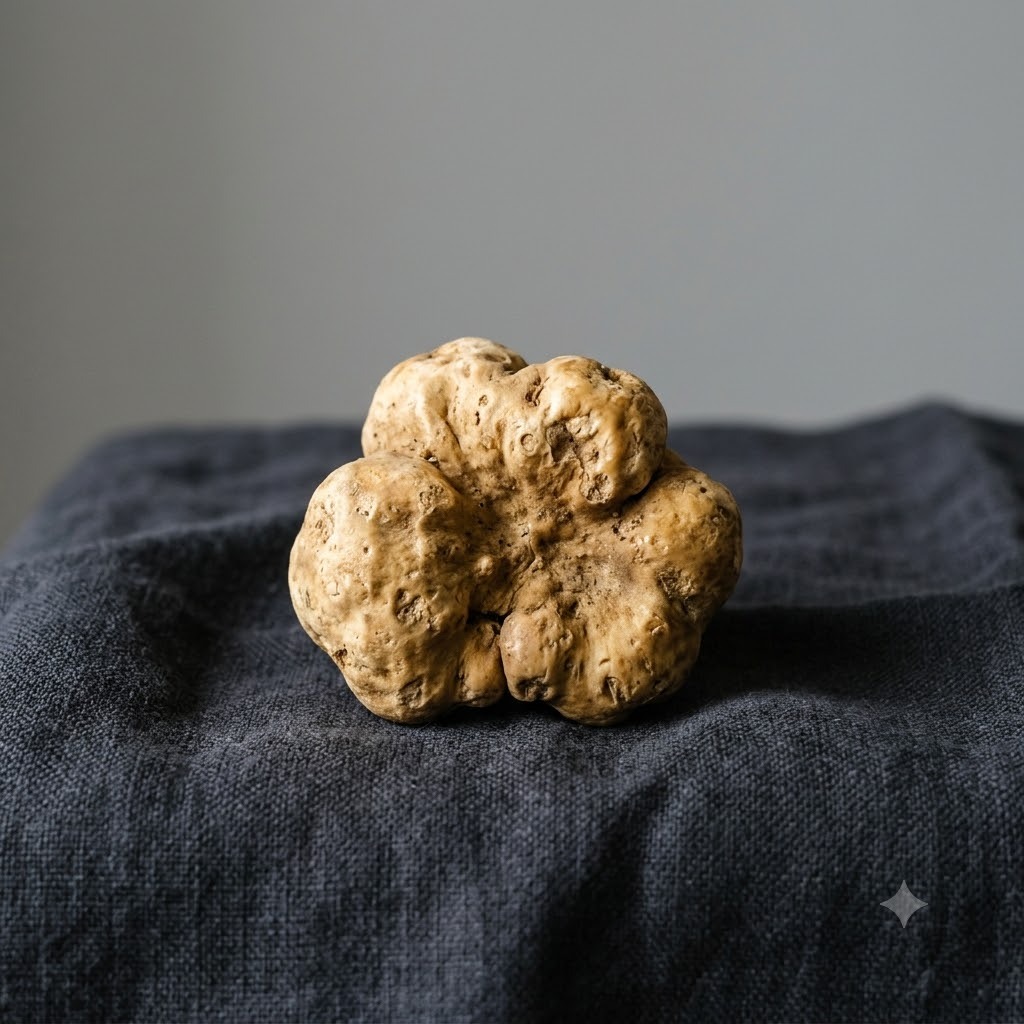
The fruit body is an irregular, lumpy underground tuber, typically 2-12 cm across, with a smooth to slightly velvety pale skin in cream, ochre, or pale tan, which is the immediate difference from the warty black truffles. Cut it open and the interior is pale cream to hazel or pinkish brown, marbled with fine white veins. The aroma is the defining feature and is far stronger than any other truffle: pungent, garlicky, cheesy, and penetrating. There is no spore print, since spores are produced internally. Several less valuable pale truffle species exist and are regularly passed off as this one, which is why the trade depends on certified origin and expert inspection. The combination of smooth pale skin, marbled interior, overwhelming aroma, and Italian provenance is what buyers pay for, and each of those can be faked separately.
Where It Grows
White truffles are ectomycorrhizal with oak, poplar, willow, hazel, hornbeam, and lime, growing in specific soils in Piedmont, Emilia-Romagna, Tuscany, Marche, and Molise in Italy, plus parts of Istria in Croatia, Slovenia, Hungary, Romania, and Serbia. They favour moist, marly, calcareous clay soils that stay damp through summer, often on north-facing slopes and near watercourses. The harvest runs from roughly September to January, peaking in October and November. Hunters work at night with trained dogs, partly for tradition and partly to keep locations secret. Wild harvest is regulated, with licences, seasons, and in Italy a legal framework that varies by region.
How to Grow at Home
Realistically, you cannot. Unlike the black Périgord truffle and the summer truffle, which are farmed successfully worldwide, Tuber magnatum has resisted cultivation for well over a century. Inoculated seedlings can be produced, and plantations have been established, but fruiting has been rare, erratic, and largely confined to areas where the species already occurs naturally. Researchers in France and Italy have reported occasional harvests from planted orchards in recent years, which is genuine progress, but nothing that amounts to a reliable crop or a home project. The soil requirements are specific and poorly understood, and the fungus appears to depend on a soil microbial community that nobody has learned to reproduce. Anyone wanting to grow truffles should plant summer or black truffles instead.
Growing Conditions
Light
Relevant only to the host trees, which are typically oak, poplar, willow, and hazel growing in open woodland, hedgerow, or riverside settings rather than dense forest.
Watering
Soil moisture through summer appears to be critical, which is why the species is associated with damp marly clays, north-facing slopes, and ground near rivers. Dry summers reduce the harvest sharply and drive prices up correspondingly.
Temperature & Substrate
Fruit bodies mature in autumn and early winter, harvested roughly September to January. The substrate is calcareous, marly, moisture-retentive clay soil hosting mycorrhizal roots of specific tree species, in a narrow geographic range that nobody has been able to replicate elsewhere.
Culinary Use
White truffle is used raw and used sparingly. Heat destroys its aromatic compounds within seconds, so it is never cooked; instead it is shaved paper-thin over a hot finished dish at the table so the warmth of the food releases the aroma. The classic vehicles are deliberately plain: tajarin pasta with butter, risotto, fried or scrambled eggs, veal carpaccio, fonduta. Fat carries the aroma, salt sharpens it, and anything strongly flavoured competes with it and wastes it. Store it in a sealed container in the fridge, wrapped in paper that is changed daily, and use it within a week at most; it loses aroma measurably every day and its weight, which is what you paid for, drops as it dries. Buy whole tubers, never pre-sliced.
Health & Nutrition
Nutritionally irrelevant, given that a serving is a few grams: negligible calories, trace minerals, a little fibre. The meaningful issues are economic and ethical. Truffle fraud is endemic at every level, from cheaper Chinese and Balkan species sold as Alba white to synthetic aroma applied to inferior tubers to outright mislabelling in restaurants. Certified provenance, whole tubers, and a supplier you trust are the only real defences. There is also a conservation dimension: wild truffle habitat has declined with land use change and drought, harvests have fallen over recent decades, and pressure on the remaining ground is intense. Buying from licensed hunters through reputable channels supports the regulated end of the trade rather than the poaching end.
Common Problems
- Paying for fakes - the central risk. Cheaper species, synthetic aroma, and false provenance are all common. Buy whole, from a reputable source.
- Losing aroma before use - truffles fade fast. Buy days before use, not weeks.
- Cooking it - destroys the aroma entirely. It goes on the dish at the table, never in the pan.
- Weight loss in storage - a truffle dries and loses weight daily, which matters when the price is per gram.
- Expecting to grow it - decades of well-funded attempts have not produced a reliable crop.
Pros & Cons
Pros
- The most intense aroma of any edible fungus, with nothing comparable.
- A genuine luxury with a documented history and a regulated regional trade.
- Very small quantities transform a simple dish.
- Supports a traditional rural economy in its home regions.
Cons
- Extremely expensive and heavily counterfeited.
- Cannot be reliably cultivated anywhere.
- Aroma fades within days of harvest.
- Wild populations are under pressure from land use change and drought.
Best Suited For
- Cooks prepared to spend heavily on a seasonal luxury and use it immediately.
- Travellers visiting Piedmont and neighbouring regions during the autumn season.
- Anyone interested in why some fungi resist domestication.
Not ideal for home growers, anyone on a budget, or anyone wanting a mushroom to cook with in the ordinary sense.
FAQ
Why can black truffles be farmed but not white ones? Nobody fully knows. Black truffle partnerships establish reliably in prepared alkaline soil, while Tuber magnatum appears to depend on soil conditions and microbial communities that have not been reproduced. Occasional harvests from planted orchards have been reported, but not a reliable crop.
Should I cook with it? No. Shave it raw over a hot finished dish. Heat destroys the aromatic compounds almost instantly.
How can I tell a real Alba truffle from a substitute? Smell, provenance documentation, and a supplier who sells whole tubers. Pre-sliced product and anything suspiciously cheap should be treated with scepticism.
Never eat a wild truffle without 100% expert identification. Several underground fungi resemble true truffles, and some are not edible. Any wild find should be confirmed by an expert before it goes near a plate.
🪴 Foraging kit worth a look
Nothing here identifies a mushroom for you - identification stays with your field guides and local experts. These are simply the basics foragers carry.
Links go to Amazon or a partner store (such as Adagio Teas) and may earn us a commission at no extra cost to you. As an Amazon Associate we earn from qualifying purchases. We link gear types, not sponsors' picks: you choose the exact product.