Yellow Stainer
The yellow stainer (Agaricus xanthodermus) is the mushroom that ruins more Sunday breakfasts than any other in Britain.
🗓️ Last reviewed: August 2026
Overview
The yellow stainer (Agaricus xanthodermus) is the mushroom that ruins more Sunday breakfasts than any other in Britain. It looks like a field mushroom or a horse mushroom, grows in the same lawns, parks, and hedge banks, appears at the same time of year, and is the single most common cause of mushroom poisoning in some European countries. It is not deadly, but it produces genuinely unpleasant vomiting, diarrhoea, and cramping, and it hits people who thought they were picking the safest wild mushroom there is. It also carries two of the most reliable warning signs in the entire genus, which means that almost every yellow stainer poisoning is preventable in about ten seconds.
Identification & Appearance
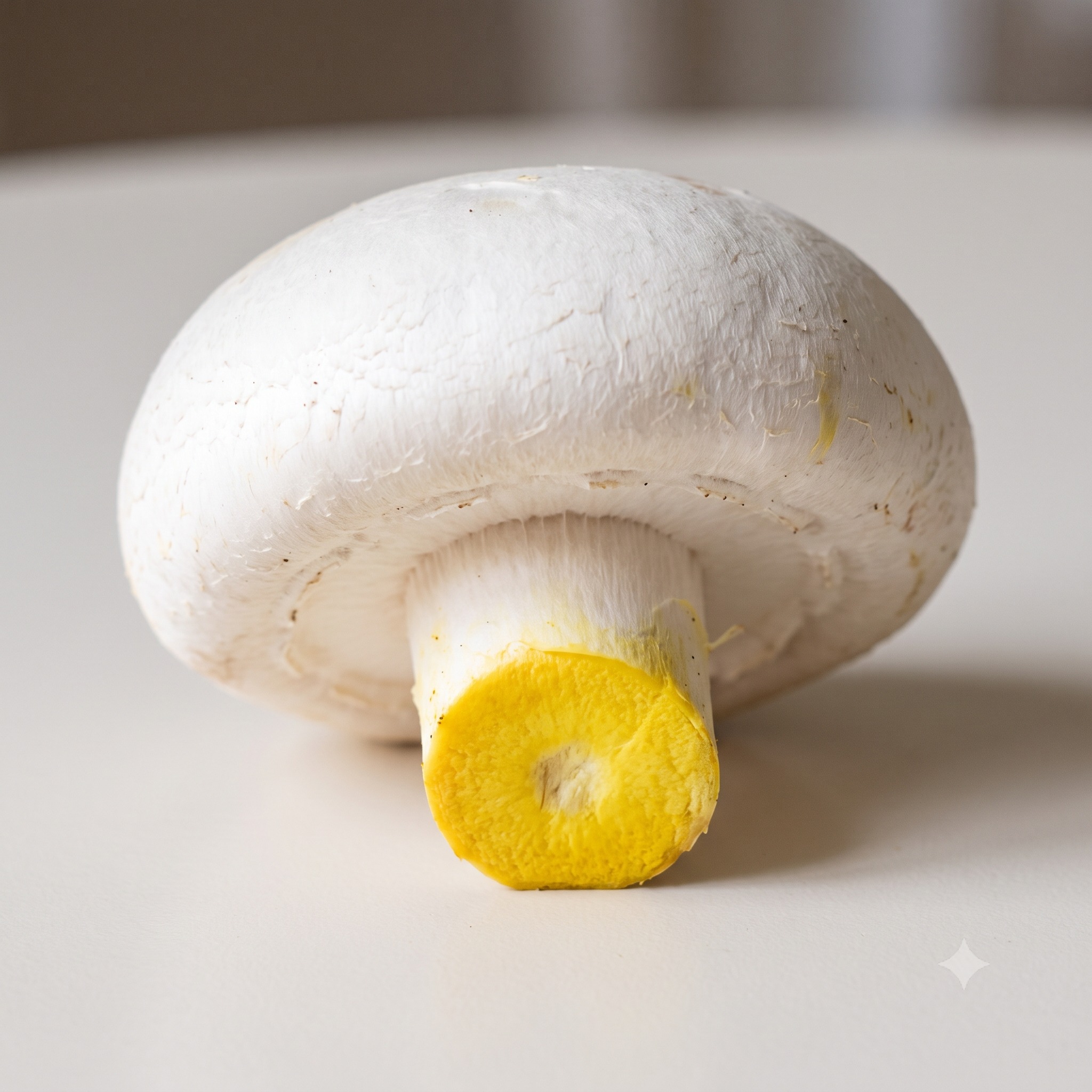
The cap is 5-15 cm across, white to greyish-white, smooth, and characteristically squared-off or flat-topped when young rather than domed, sometimes developing fine grey-brown scales with age. Gills are pale pink at first, darkening through to chocolate brown, and free of the stem, exactly like an edible field mushroom. The stem is white with a large pendulous ring and a slightly bulbous base. The two warning signs are decisive. First, cut or scratch the base of the stem: it flashes an immediate, bright chrome yellow, vivid and unmistakable, fading to brownish after some minutes. The cap margin also yellows when rubbed. Second, the smell: unpleasant, phenolic, like ink, iodine, or carbolic soap, which becomes far stronger during cooking. Spore print is dark brown.
Where It Grows
Yellow stainers grow in grassland and disturbed nutrient-rich ground: lawns, playing fields, parks, hedge banks, gardens, roadside verges, and woodland edges, often in rings or arcs, from summer through autumn. They are common across Europe, North America, Australia, and elsewhere, and they are strongly associated with human-modified ground rather than wild habitats. That is why they cause so many poisonings: they grow where people live, in exactly the same lawns and parks as the field mushroom and horse mushroom that people gather with confidence, and they often fruit in the same week and the same field.
Can It Be Grown
No, and there is no reason to. It is not cultivated. Where it appears on a lawn, the practical response is recognition rather than removal, since it fruits from mycelium in the turf and will return. If children or dogs use the lawn, removing the fruit bodies with gloves is reasonable, and disposing of them sealed. The far more valuable investment is teaching anyone in the household who picks field mushrooms to make the two checks: cut the stem base and smell it. Those two habits, applied every single time, eliminate essentially all risk from this species.
Growing Conditions
Light
Not relevant to the fungus, which fruits from turf and rich soil in open sun or partial shade, typically in mown or grazed grassland.
Watering
Fruiting follows summer and autumn rain, often within a week. Warm wet spells in late summer produce the largest flushes, which coincide exactly with the peak of field mushroom gathering.
Temperature & Substrate
Fruiting spans roughly 10-24°C from summer into autumn. The substrate is nutrient-rich grassland turf, garden soil, compost-enriched ground, and disturbed verges.
Why It Is Not Food
The yellow stainer contains phenolic compounds, including the one responsible for the ink-like smell, which cause gastrointestinal poisoning in most people who eat them. Symptoms are nausea, vomiting, diarrhoea, abdominal cramping, and sweating, generally starting within a few hours and resolving over a day. Notably, a minority of people appear to tolerate the species with no ill effects at all, which produces the recurring and dangerous claim that it is edible if cooked properly. It is not; cooking concentrates rather than removes the phenolic smell, and the fact that some people are unaffected does not make it safe for anyone else. Individual tolerance is not a food safety standard.
Health & Poisoning Pattern
Onset is usually one to three hours after eating. The illness is unpleasant but self-limiting: cramping, repeated vomiting, watery diarrhoea, and sometimes sweating and flushing, resolving within twenty-four hours with fluids and rest. Hospital treatment is supportive. Children, older people, and anyone becoming dehydrated should be seen medically. Anyone with a rapid-onset gastrointestinal illness after eating wild mushrooms should note the timing carefully and tell a doctor, because rapid onset points away from the amatoxin group and that information genuinely changes clinical thinking. Keep any uncooked remainder for identification.
Common Identification Traps
- Not cutting the stem base - the single most common failure. The chrome yellow flash is there, and it takes two seconds to check.
- Confusing mild yellowing with chrome yellowing - several edible Agaricus species yellow slightly and slowly. The yellow stainer flashes bright chrome yellow immediately in the stem base.
- Missing the smell - it is stronger in the stem base and stronger still during cooking. If a pan of mushrooms smells of ink or disinfectant, stop and throw them out.
- Assuming the flat-topped cap is decisive - it is a useful hint, not proof.
- Trusting anecdote - some people tolerate it, which fuels persistent claims that it is edible. Those claims put other people in hospital.
The Rule That Prevents This
Every Agaricus you intend to eat gets two checks, every time, no exceptions. Cut the base of the stem and watch for two full minutes: bright chrome yellow means discard. Then smell the cut surface: ink, iodine, phenol, or carbolic means discard. If the flesh stays white or flushes gently pink and the smell is mushroomy or of almonds, you are on much safer ground, and you should still confirm the pink-to-brown gills and dark spore print. Those checks separate the good field and horse mushrooms from this species reliably.
Best Suited For
- Learning to make the stem-base cut and smell test automatic.
- Teaching why the safest-looking wild mushrooms still need checking.
Not food. Cooking makes the smell worse, not the mushroom safer.
FAQ
Some people say it is edible if cooked well. Is that true? No. A minority of people tolerate it, which is not the same thing. Most people who eat it are ill, and cooking intensifies the phenolic smell rather than removing the problem.
What exactly should the yellow look like? An immediate, vivid chrome yellow in the cut base of the stem, appearing within seconds. Gentle, slow, pale yellowing is normal in several edible Agaricus species.
Will it kill me? Very unlikely. It causes several hours of vomiting, diarrhoea, and cramps. Unpleasant rather than dangerous for a healthy adult, but dehydration matters for children and older people.
Never eat an Agaricus without cutting the stem base and smelling it. Chrome yellow staining plus an ink or carbolic smell means discard the whole collection, and have first collections checked by an experienced identifier.
🪴 Foraging kit worth a look
Nothing here identifies a mushroom for you - identification stays with your field guides and local experts. These are simply the basics foragers carry.
Links go to Amazon or a partner store (such as Adagio Teas) and may earn us a commission at no extra cost to you. As an Amazon Associate we earn from qualifying purchases. We link gear types, not sponsors' picks: you choose the exact product.