Agarikon
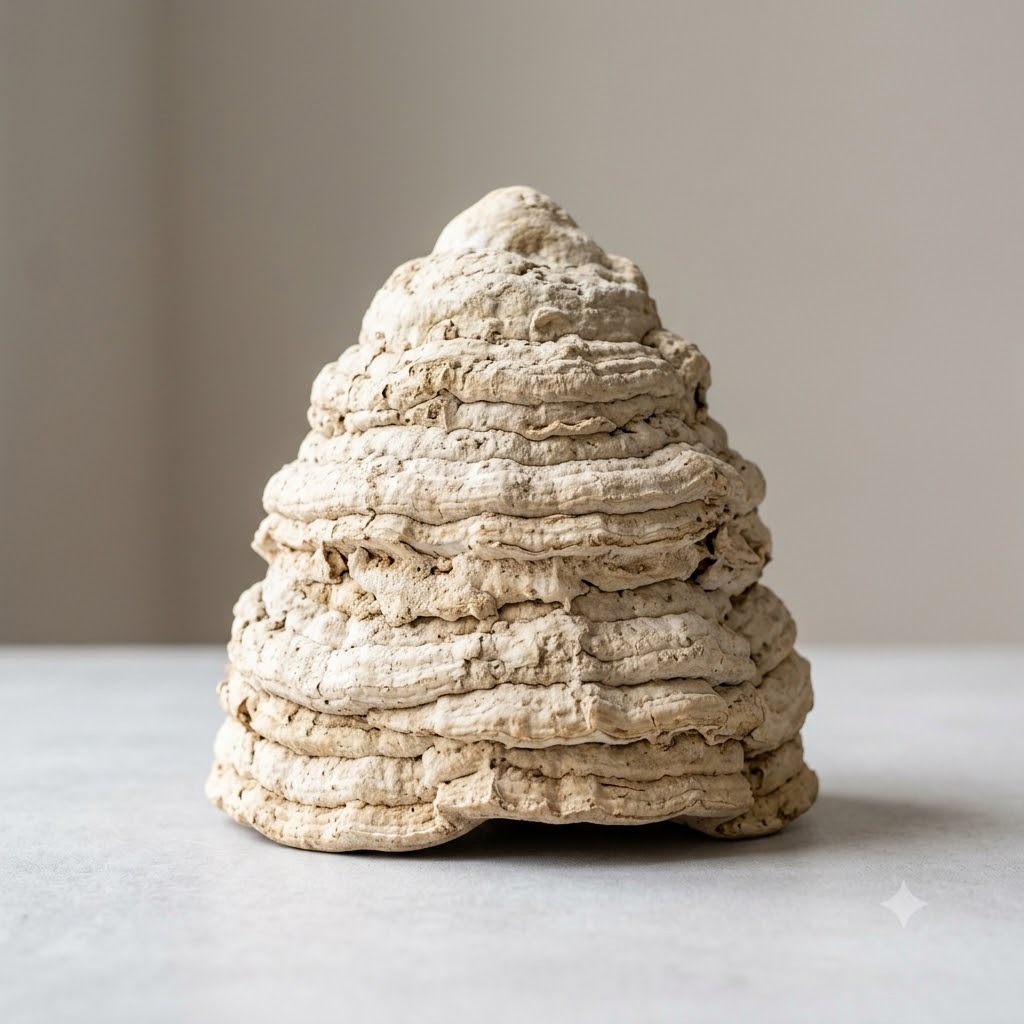
Agarikon (Fomitopsis officinalis, also placed as Laricifomes officinalis) is a large, pale, beehive-shaped bracket that grows almost exclusively on ancient conifers in old-growth forest, and it is one of the most historically important and most endangered fungi in the northern hemisphere.
🗓️ Last reviewed: August 2026
Overview
Agarikon (Fomitopsis officinalis, also placed as Laricifomes officinalis) is a large, pale, beehive-shaped bracket that grows almost exclusively on ancient conifers in old-growth forest, and it is one of the most historically important and most endangered fungi in the northern hemisphere. Dioscorides described it in the first century as a treatment for consumption, and it remained a staple of European pharmacy for well over a thousand years, exported in quantity as agaricum. That history, combined with modern laboratory interest in its antiviral compounds, has made it a target for collectors. The problem is simple and serious: it is critically rare across most of its range, cannot be cultivated for fruit bodies on any practical timescale, and its populations have collapsed with old-growth logging.
Identification & Appearance
The fruit body is a large perennial bracket, often 10-60 cm tall, hoof-shaped in youth and becoming elongated, columnar, or beehive-shaped over years of growth, hanging from the trunk of a living or dead conifer. The surface is chalky white to pale cream when young, weathering grey and becoming cracked and crumbly, with concentric zones. The flesh is white, soft and chalky rather than hard and woody, and intensely bitter, which was the basis of its use in medicine and which distinguishes it from most other conifer brackets. The pore surface is white to cream with small round pores. Spore print is white. It is found high on the trunks of very old larch, Douglas fir, and other conifers, often out of reach, which is one of the reasons a fair number of remaining specimens have survived at all.
Where It Grows
Agarikon is a heart-rot fungus of old conifers, principally larch in Europe and Douglas fir, larch, and other conifers in western North America. It requires large, old trees, and it is effectively absent from young managed forest, since the wood volumes and ages it needs simply do not exist there. Historically it ranged across Europe, northern Asia, and North America. Today its European populations are severely reduced: it is listed as Endangered by the IUCN with a documented population decline in the region of seventy per cent, it appears among the fungi flagged for conservation by European fungal conservation bodies, and it was long recorded as extinct in Ukraine's national Red Data Book, though a 2020 review found no verified Ukrainian records and the species was removed from that list in 2021. The strongholds that remain are in the old-growth forests of the Pacific Northwest of North America.
How to Grow at Home
The mycelium can be cultured in a laboratory, and it is grown commercially as mycelium on grain for the supplement trade, but fruit bodies are a different matter entirely. Agarikon conks grow slowly on very large old conifers and individual specimens can live for decades, with some estimated at up to a century, so there is no practical cultivation of the fruiting body on any human timescale. Nothing about this species suits a home grower. The appropriate stance is conservation: do not collect wild agarikon, do not buy wild-harvested conks, and support the protection of old-growth conifer forest, which is the only habitat that sustains it. Conservation guidance for the species explicitly calls for restricting collection, particularly for trade.
Growing Conditions
Light
Not relevant to the fungus, which lives inside conifer heartwood and fruits high on trunks in closed old-growth forest.
Watering
Not applicable in any managed sense. The species depends on the stable humid microclimate of intact old-growth forest, which is one reason fragmentation and drying of forest edges harms it.
Temperature & Substrate
Perennial and present year-round, growing slowly over many years. The substrate is the heartwood of very old living and dead conifers, particularly larch and Douglas fir, in old-growth stands.
Traditional & Practical Uses
Not a food; the flesh is chalky and overwhelmingly bitter. Its entire significance is medical history and modern research. From classical antiquity into the nineteenth century it was one of the most traded medicinal fungi in Europe, prescribed for respiratory illness including tuberculosis, and shipped from larch forests in Siberia and the Alps. In modern times it re-entered attention through screening programmes that reported antiviral activity in laboratory assays against several virus families, work associated in particular with research collaborations involving mycologist Paul Stamets. That research is real, and it is laboratory work. There is no clinical evidence supporting agarikon as a treatment for any human illness, and the supplement products on the market are grown mycelium, not the rare wild conks.
Health & Nutrition
Not a nutritional species. The compounds of interest are triterpenoids and polysaccharides, and published work is dominated by in vitro antiviral and antibacterial screening. Anyone reading enthusiastic claims should hold two facts together: the historical record of use is genuine and very long, and the modern evidence base in humans is essentially absent. Those are not in conflict; plenty of long-used remedies have not survived clinical testing. The additional ethical dimension is unusual for a fungus: demand driven by health claims is a documented threat to a species already listed as Endangered, so buying wild-harvested agarikon is a conservation problem in a way that buying cultivated reishi is not. Talk to a doctor about health conditions rather than to a supplement label.
Common Problems
- Wild harvesting - the central problem. This species is Endangered across much of its range and should not be collected.
- Confusing it with common conifer brackets - several white to pale brackets grow on conifers; agarikon is chalky, soft, intensely bitter, and grows on very old trees, usually high up.
- Believing the health claims - laboratory antiviral activity is not clinical evidence.
- Buying wild-sourced products - demand drives collection from a threatened species.
- Expecting to grow conks - mycelium can be cultured; fruit bodies effectively cannot on any useful timescale.
Pros & Cons
Pros
- Extraordinary documented history in European medicine spanning two millennia.
- Genuinely interesting subject of antiviral laboratory research.
- A flagship species for old-growth forest conservation.
- Distinctive and unmistakable where it survives.
Cons
- Endangered, with severe population decline and local extinctions.
- Cannot be cultivated as fruit bodies.
- Inedible and intensely bitter.
- Health claims far exceed the evidence and drive harvesting pressure.
Best Suited For
- Conservationists and old-growth forest ecologists.
- Anyone interested in the history of pharmacy.
- Naturalists who want to understand why some fungi cannot be harvested sustainably.
Not ideal for foragers, home growers, or anyone seeking a proven remedy.
FAQ
Can I collect agarikon if I find it? No. It is Endangered across much of its range with an estimated population decline of around seventy per cent, and conservation guidance explicitly calls for restricting collection. Photograph it and report the location to a local mycological society.
Does it actually work against viruses? Laboratory screening has reported antiviral activity for extracts. That is not the same as evidence of effect in people, and no clinical trials support treating any illness with it.
Why can it not be farmed? The mycelium can be cultured, but the conks grow slowly on very large old conifers over many years, with some individuals estimated to live up to a century. There is no practical cultivation of fruit bodies.
Never eat or self-treat with agarikon. It is not a food, the evidence for medicinal effect in humans is absent, and collecting it damages a threatened species. Leave it where it grows.
🪴 Foraging kit worth a look
Nothing here identifies a mushroom for you - identification stays with your field guides and local experts. These are simply the basics foragers carry.
Links go to Amazon or a partner store (such as Adagio Teas) and may earn us a commission at no extra cost to you. As an Amazon Associate we earn from qualifying purchases. We link gear types, not sponsors' picks: you choose the exact product.