Amethyst Deceiver
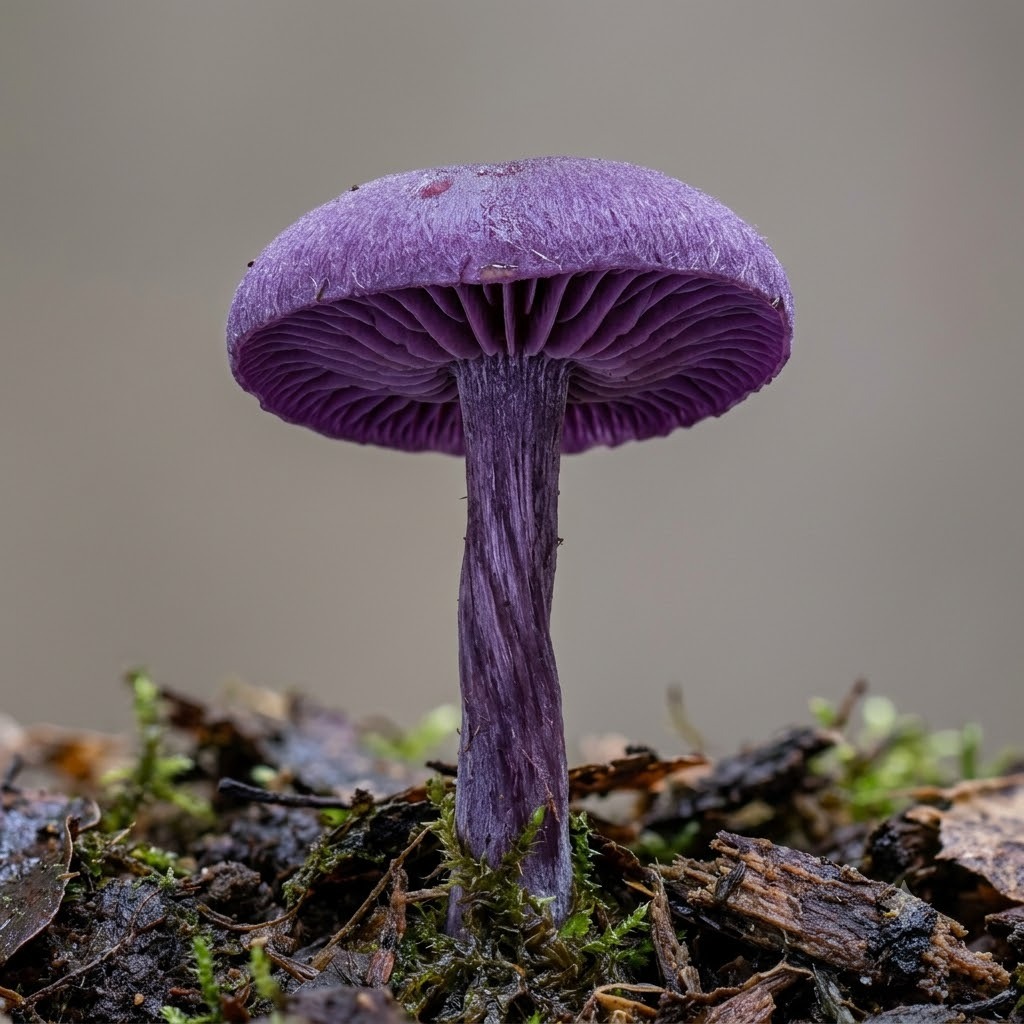
The amethyst deceiver (Laccaria amethystina) is the small, intensely violet mushroom that lights up damp woodland floors from late summer to late autumn.
🗓️ Last reviewed: August 2026
Overview
The amethyst deceiver (Laccaria amethystina) is the small, intensely violet mushroom that lights up damp woodland floors from late summer to late autumn. The name captures its problem and its charm: it is unmistakably purple when fresh and wet, and it fades to a dull buff-lilac or almost white as it dries, deceiving anyone who identified it by colour alone. It is edible, mild, and pretty on a plate, and it grows in enormous numbers in beech and oak woodland. It is also a documented accumulator of arsenic, which is the single most important thing to know about it and the reason most experienced foragers treat it as a photograph rather than a meal.
Identification & Appearance
The cap is 1-6 cm across, deep violet to lilac when fresh and moist, convex then flattening with a slightly depressed centre, and the surface is finely scurfy rather than smooth. As it dries it fades dramatically, sometimes to pale buff with only a hint of lilac left, which is the deceiving part. Gills are the most reliable feature: thick, widely spaced, and deep violet, holding their colour longer than the cap does. The stem is slender, fibrous, tough, and the same violet as the cap, often twisted, with white woolly mycelium at the base. Flesh is thin and lilac. Spore print is white, which matters because the other common purple mushrooms in the same woodland, the wood blewit and the field blewit, have pale pink spore prints and are much larger and fleshier. The combination of small size, thick widely spaced violet gills, fibrous violet stem, and white spore print identifies it.
Where It Grows
Amethyst deceivers are mycorrhizal with broadleaved trees, especially beech and oak, and also with birch and conifers. They fruit in damp woodland, in leaf litter, moss, and on mossy banks, from late summer through late autumn, often in large scattered troops. They favour damp, shaded, acidic sites, and they are among the most common woodland fungi across Europe, with related species in North America and Asia. They are frequently found in the same woodland as the far more valuable chanterelles and ceps, which is why so many foragers know them well as scenery. The species is often present in large numbers, which makes it excellent for teaching identification without pressure.
How to Grow at Home
Not possible. Laccaria species are ectomycorrhizal and depend on living tree roots. Interestingly, Laccaria is one of the genera used in scientific research on mycorrhizal partnerships, and Laccaria bicolor was the first ectomycorrhizal fungus to have its genome sequenced, so the biology is unusually well understood; that has not translated into cultivation, and no spawn is sold. The practical version is habitat: mature broadleaved trees, undisturbed damp leaf litter, no fungicide. Given the arsenic issue below, encouraging it as a food crop would be a poor idea in any case. It is worth having in a woodland garden as an indicator of healthy mycorrhizal soil rather than as a harvest.
Growing Conditions
Light
Not relevant to the fungus. It fruits in shade in damp woodland litter, and the presence of a healthy mycorrhizal host is what determines whether it appears.
Watering
Fruiting follows autumn dampness and is very responsive to rain. The colour is also moisture-dependent: fresh wet specimens are vividly purple, dry ones fade almost beyond recognition.
Temperature & Substrate
Fruiting spans roughly 5-18°C from late summer into late autumn. The substrate is damp acidic woodland litter and soil around living beech, oak, birch, or conifer roots. There is no home equivalent.
Culinary Use
Amethyst deceivers are technically edible, mild, and unremarkable in flavour. The caps are small and thin, the stems are tough and fibrous and are usually discarded, and the violet colour largely survives light cooking, which makes them a decorative addition to a plate. In practice, the honest advice is not to eat them in quantity. This species is a well-documented accumulator of arsenic, taking up considerably more than most edible fungi, with levels varying by site and by soil. There is no reliable way for a forager to know how contaminated a given patch is. A few caps as a garnish are a different proposition from a regular dish, and most modern guides now flag the species as one to enjoy visually rather than gastronomically. If you do cook them, cook them thoroughly, and treat them as an occasional curiosity.
Health & Nutrition
Nutritionally there is nothing remarkable here: a thin, low-calorie mushroom with some fibre and trace minerals. The arsenic accumulation is the point. Studies of wild fungi have repeatedly found Laccaria amethystina among the species with elevated arsenic concentrations, and the ability appears to be a genuine physiological trait of the genus rather than simply a reflection of polluted ground, though contaminated sites make it much worse. Arsenic exposure is cumulative and chronic rather than acute at these levels, which means the risk is about habitual consumption over time rather than a single meal. That is exactly why the sensible position is to admire it. Anyone who wants a purple mushroom for the table should learn the wood blewit instead, which is larger, better flavoured, and does not carry this issue.
Common Problems
- Faded specimens that no longer look purple - the classic deception. Check the gills, which hold colour longest, and take a spore print.
- Confusion with wood blewit - blewits are much larger, fleshier, and have a pale pink spore print. Both are purple; only one is worth eating.
- Tough fibrous stems - normal; discard them.
- Small yield for the effort - thin caps mean a large number are needed for a meal, which conflicts directly with the arsenic caution.
- Confusion with small purple Cortinarius species - some webcaps are dangerously toxic, so the white spore print and absence of a cobwebby veil must both be confirmed.
Pros & Cons
Pros
- Beautiful, unmistakable when fresh, and excellent for teaching.
- Extremely common in damp broadleaved woodland.
- Holds its colour when lightly cooked.
- No acute toxicity when correctly identified.
Cons
- Accumulates arsenic more than most fungi, so not a species to eat regularly.
- Thin flesh and tough stems mean poor yield.
- Fades to a nondescript buff when dry, deceiving beginners.
- Purple Cortinarius species in the same habitat include dangerous ones.
Best Suited For
- Photographers and naturalists.
- Beginners learning to distinguish spore print colours in a common, low-stakes species.
- Occasional decorative use on a plate, in very small quantities.
Not ideal for anyone wanting a wild mushroom to eat in quantity, given the arsenic accumulation.
FAQ
Is it safe to eat? It is not acutely poisonous, but it accumulates arsenic more than most edible fungi, and levels depend on the site. Treat it as an occasional garnish at most, or simply enjoy it where it grows.
How do I tell it from a wood blewit? Size and spore print. Blewits are much larger and fleshier with a pale pink spore print; amethyst deceivers are small and thin with a white spore print.
Why do some look purple and others almost white? Moisture. The cap fades dramatically as it dries. The gills keep their violet colour longest, which is why they are the better identification feature.
Never eat an amethyst deceiver without 100% expert identification. Purple woodland mushrooms include dangerous webcaps. Confirm the white spore print, thick widely spaced violet gills, and absence of a cobwebby veil with an experienced identifier, and think carefully about whether to eat it at all.
🪴 Foraging kit worth a look
Nothing here identifies a mushroom for you - identification stays with your field guides and local experts. These are simply the basics foragers carry.
Links go to Amazon or a partner store (such as Adagio Teas) and may earn us a commission at no extra cost to you. As an Amazon Associate we earn from qualifying purchases. We link gear types, not sponsors' picks: you choose the exact product.