Birch Bolete
The birch bolete (Leccinum scabrum) is the mushroom that teaches most northern European foragers what a bolete is.
🗓️ Last reviewed: August 2026
Overview
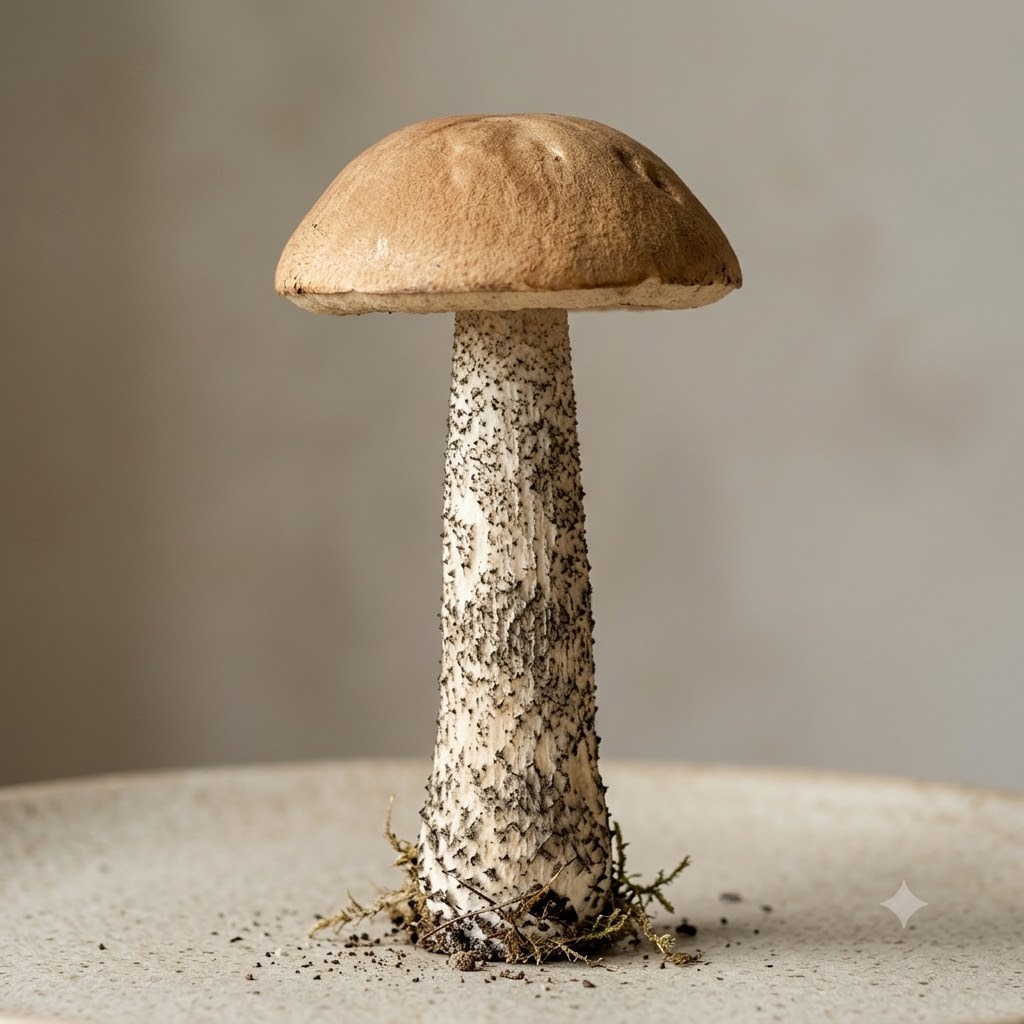
The birch bolete (Leccinum scabrum) is the mushroom that teaches most northern European foragers what a bolete is. It grows exclusively with birch, appears in enormous numbers in good years, and is easy to recognise from the dark scabers, the rough dark flecks that stipple its pale stem like a five o'clock shadow. It is a decent rather than outstanding edible: mild, nutty when young, and prone to turning soft and slightly slimy when cooked, which is why experienced pickers take only firm young specimens and leave the big soggy ones. It cannot be cultivated because it lives in partnership with living birch roots, so this is a foraging species and a good excuse to learn one tree properly.
Identification & Appearance
The cap is 5-15 cm across, greyish-brown to dull tan or almost beige, dry and slightly felty, becoming greasy in wet weather and often overhanging the pores at the margin. Underneath there are pores rather than gills, whitish to pale grey at first, ageing dirty buff, and bruising brownish rather than blue. The stem is the identifier: tall, slender, tapering upwards, whitish, and covered in small dark brown to black scabers arranged in rough rows, which is the signature of the genus Leccinum. The flesh is white and either stays white or turns faintly pinkish or greyish when cut, without the strong blue flush of some boletes. Spore print is snuff brown. The combination of birch as host, scabrous stem, whitish pores that do not bruise blue, and white flesh is consistent, but as always no single feature stands alone.
Where It Grows
Birch boletes are mycorrhizal with birch and only with birch, which makes them one of the easiest mushrooms to search for: find birch, search under birch. They appear from early summer through autumn in birch woods, on heaths with scattered birch, in parks and gardens with planted birch, and along the birch fringes of conifer plantations. They favour damp, mossy, slightly acidic ground and fruit heavily after rain. The species is widespread across Europe, northern Asia, and has been introduced with planted birch in parts of North America and the southern hemisphere. Because the fungus depends on living roots, the same patches produce year after year as long as the trees remain, and a mature birch stand can carry a remarkable population.
How to Grow at Home
You cannot grow birch boletes in a bag, a kit, or a bed. Like all Leccinum species they are ectomycorrhizal, wrapping their hyphae around living birch roots and trading mineral nutrients for sugars from the tree. Without a healthy host tree there is no mushroom. Attempts to cultivate mycorrhizal boletes commercially have almost entirely failed, and the few mycorrhizal species that are farmed, such as truffles, require an orchard of inoculated seedlings and a decade of patience. The realistic version of growing them is habitat gardening: if you have space, plant birch, leave the leaf litter and moss undisturbed beneath it, avoid fertiliser and heavy digging around the root zone, and in time a birch that came from a nursery with mycorrhizal roots may fruit. That is a long game measured in years, not a cultivation project.
Growing Conditions
Light
Not relevant to the fungus, which lives underground in shade. What matters is the health of the birch above it; a shaded, undisturbed root zone with intact moss and leaf litter is the habitat, and clearing that litter for tidiness is the fastest way to lose the fruiting.
Watering
Birch boletes fruit after rain, usually within a week or two of a good soaking followed by mild humid weather. In dry summers they are scarce. Nothing a forager does affects this; reading the weather is more useful than any technique.
Temperature & Substrate
They fruit through the warm and cool halves of the season alike, roughly 10-22°C, appearing earlier than many autumn boletes. The substrate is not something you provide: it is damp, mossy, mildly acidic soil threaded with living birch roots, and no home substrate reproduces it.
Culinary Use
Birch boletes are mild and pleasant but soft, and their weakness is texture rather than flavour. Young, firm specimens with tight pale pores are the ones worth taking; older caps go spongy and produce a slippery, grey, unappealing result. Cut the pore layer away from anything but the youngest specimens, slice the caps, and cook them thoroughly. They fry acceptably, work well in mixed mushroom dishes where firmer species carry the texture, and are genuinely excellent dried, which concentrates the flavour and sidesteps the sogginess entirely. In much of northern and eastern Europe they are also salted or pickled, which is the traditional answer to a glut. The flesh often darkens to grey-black on cooking, which is normal and harmless but does mean they colour a cream sauce unattractively.
Health & Nutrition
Boletes are low in calories with useful protein, fibre, B vitamins, and minerals including selenium, potassium, and copper, along with the beta-glucans common to edible fungi. The significant caveat for this group is bioaccumulation: boletes are known to take up heavy metals and, in some regions affected by past nuclear fallout, radiocaesium from the soil. Northern and eastern European guidance has long advised moderation in wild mushroom consumption for this reason. Practically, gather from clean woodland well away from industry, mine spoil, and busy roads, do not eat very large quantities habitually, and treat wild mushrooms as a seasonal pleasure rather than a staple. Cook them fully; raw boletes are indigestible.
Common Problems
- Maggot damage - Leccinum species are heavily targeted by fly larvae. Split the stem and check for tunnels; discard anything riddled.
- Soft, spongy caps - too old. Take only firm specimens, and remove the pore layer on anything but the youngest.
- Grey-black flesh after cooking - normal for this species, harmless, but unattractive in pale dishes.
- Confusion with other Leccinum species - most are edible, but some cause stomach upset for some people, particularly in North America where several red-capped species have caused reactions. Learn which Leccinum species occur locally.
- Overpicking a patch - taking every specimen removes the spore source; leave older ones to release spores.
Pros & Cons
Pros
- Very easy to find: one host tree, one search image.
- Abundant in good years, often in large numbers.
- No deadly look-alike in the classic sense within its habitat.
- Dries excellently, which fixes its texture problem.
Cons
- Soft, sometimes slimy texture when fried fresh.
- Frequently maggot-infested.
- Cannot be cultivated at all.
- Bioaccumulates heavy metals and caesium in some regions.
Best Suited For
- Beginners learning the bolete group in birch woodland.
- Foragers who dry or pickle their harvest rather than frying everything fresh.
- Anyone with birch woodland or a birch-lined park nearby.
Not ideal for cooks wanting a firm meaty mushroom fresh from the pan, or anyone hoping to grow their own.
FAQ
Why do birch boletes go slimy when I fry them? The flesh holds a lot of water and softens fast, especially in older specimens. Take young firm ones, remove the pore layer, and cook them hot and uncrowded, or dry them instead.
Are all mushrooms with scabers on the stem safe? They are all Leccinum, and no European species is deadly, but some cause digestive upset in some people, and North American red-capped species have a worse record. Learn your local species rather than trusting the genus.
Can I plant birch to get them? You can create the habitat, and nursery birch often carries mycorrhizal partners on its roots, but there is no guarantee and no timetable. Treat it as gardening for decades, not cultivation.
Never eat a birch bolete without 100% expert identification. Confirm the birch host, scabrous stem, pale non-blueing pores, and brown spore print with an experienced identifier. Never eat any bolete with red or orange pores.
🪴 Foraging kit worth a look
Nothing here identifies a mushroom for you - identification stays with your field guides and local experts. These are simply the basics foragers carry.
Links go to Amazon or a partner store (such as Adagio Teas) and may earn us a commission at no extra cost to you. As an Amazon Associate we earn from qualifying purchases. We link gear types, not sponsors' picks: you choose the exact product.