Blue Oyster Mushroom
The blue oyster (Pleurotus ostreatus var.
🗓️ Last reviewed: August 2026
Overview
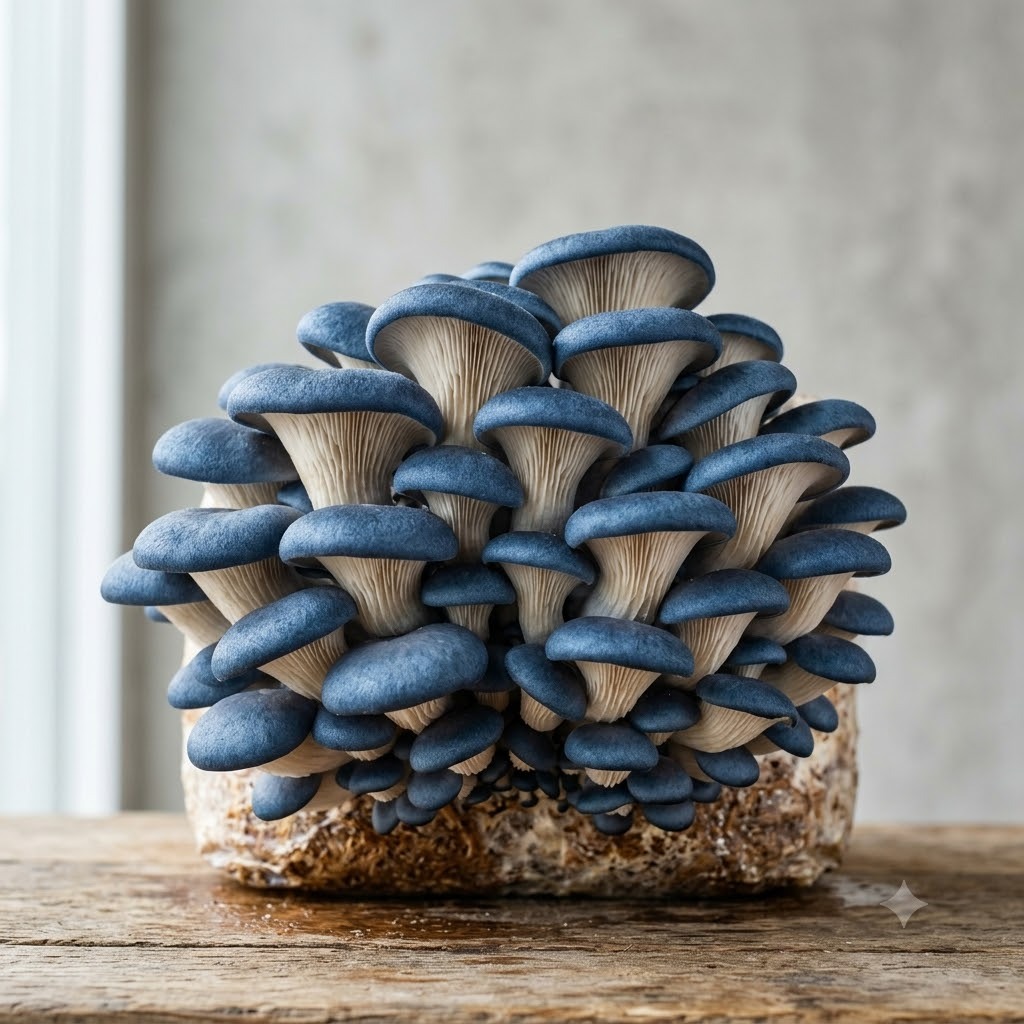
The blue oyster (Pleurotus ostreatus var. columbinus) is the cool-weather face of the common oyster mushroom, and the strain most home growers fall for first. Young caps emerge a startling slate blue to steel grey, darkening almost to navy in cold air, then fading to grey-brown as they flatten out. That colour is temperature-driven rather than permanent, which surprises people who expect a blue mushroom on the plate. What makes this strain worth its own place in a growing shelf is not the colour but the season: it fruits happily at temperatures where other oyster strains stall, which makes it the obvious choice for an unheated garage, a cellar, or an autumn-to-spring growing cycle. It is fast, forgiving, and productive, and it will grow on substrates most other gourmet species refuse.
Identification & Appearance
Caps are 5-15 cm across, fan or shell shaped, with an inrolled margin when young that flattens and often waves at the edge with age. The colour is the giveaway in the first days: deep blue-grey to blue-black on the young pins, cooling to dove grey and then tan as the cluster matures. Gills are white to cream, decurrent, meaning they run down onto the stem rather than stopping at it. The stem is short, off-centre or almost absent, and clusters grow shelved on top of one another in the classic oyster fashion. Flesh is white, firm, and smells faintly of aniseed or damp flour. Spore print is white to pale lilac-grey. In cultivation you are not identifying a wild find, so the practical check is simpler: healthy blue oyster pins are firm and evenly coloured, and a substrate block that smells sour or shows green or black patches has been contaminated and should be discarded rather than harvested from.
Where It Grows
Wild Pleurotus ostreatus is a wood-rotting saprotroph found on dead and dying hardwoods across Europe, Asia, and North America, especially beech, poplar, willow, and elm. It is a white-rot fungus, which means it breaks down lignin as well as cellulose and leaves pale, fibrous, crumbly wood behind. The columbinus variety is associated with cooler conditions and, in parts of Europe, with conifer wood as well as hardwood. In cultivation none of that matters much, because it has been bred to fruit on pasteurised straw, hardwood sawdust, coffee grounds, cardboard, and paper waste. Its willingness to colonise agricultural residues is exactly why oyster mushrooms are the entry point for small commercial growers worldwide, and why blue oyster kits are the ones sold for kitchen windowsills.
How to Grow at Home
This is one of the genuinely easy gourmet mushrooms, and the honest advice is to start with a ready-made block rather than trying to sterilise substrate on a first attempt. A pre-colonised block wants three things: a cut in the bag, humidity, and fresh air. Slice an X in the plastic, mist the exposed face twice a day, keep the block out of direct sun, and pins appear within a week or two. From scratch, the usual route is pasteurised wheat straw or hardwood sawdust supplemented with wheat bran, inoculated with grain spawn at roughly five per cent of the wet substrate weight, bagged, and left to colonise in the dark at 20-24°C for two to three weeks until the substrate is uniformly white. Then move it to fruiting conditions: cooler air, high humidity, light, and above all fresh air. Poor air exchange is the single most common failure, producing long stems and tiny caps that look like coral rather than mushrooms. Expect two or three flushes from a block, with the first the largest, then compost the spent substrate in the garden.
Growing Conditions
Light
Indirect light for roughly 12 hours a day. Mushrooms do not photosynthesise, but oysters use light as a signal for where to point their caps, and blocks grown in complete darkness produce pale, distorted, stemmy fruit. A north-facing windowsill or a cheap LED strip is plenty; direct sun dries the block and is the wrong kind of help.
Watering
Mist the exposed substrate face and the air around it two or three times a day, aiming for 85-95 per cent humidity during fruiting. Do not soak the block or let water pool inside the bag, which invites bacterial blotch. A humidity tent made from a clear bag with slits, or a small chamber with a perlite tray, holds moisture far better than misting alone.
Temperature & Substrate
Colonisation runs best at 20-24°C. Fruiting is where this strain earns its keep: it pins reliably at 10-18°C and tolerates conditions down towards 7°C, when the blue colour is at its deepest. Substrate options are broad, including pasteurised straw, hardwood sawdust with bran, spent coffee grounds mixed with straw, and cardboard for very small batches. Avoid conifer sawdust for the cultivated strain and never use substrate that already smells sour.
Culinary Use
Blue oysters cook down to the same mild, savoury, faintly seafood-like flavour as any oyster mushroom, with a texture that is silkier than a button mushroom and firmer than an enoki. The colour largely cooks out, so choose the strain for its season rather than for a blue plate. They want high heat and a dry pan first: crowd them and they steam and go slippery. Tear rather than slice the clusters so the fibres stay long, sear until the edges brown, then add fat and seasoning. They take well to garlic, soy, cream sauces, and anything acidic. Always cook them thoroughly, since raw oyster mushrooms are hard to digest and can cause mild stomach upset. They freeze best cooked rather than raw, and they dry acceptably though they lose more character than shiitake or porcini do.
Health & Nutrition
Oyster mushrooms are low in calories, contain useful amounts of protein for a vegetable-shelf item, and provide fibre, B vitamins including niacin and riboflavin, potassium, and copper. Like all mushrooms, they produce vitamin D when exposed to ultraviolet light, so sun-drying gill-side up genuinely raises their vitamin D content. They are a well-studied source of beta-glucans, and Pleurotus species naturally contain lovastatin, the same molecule family used in cholesterol drugs, though the quantities in a plate of mushrooms are nowhere near a therapeutic dose and no one should treat dinner as medication. One practical caution: oyster mushroom spores are a known respiratory irritant for growers working with large quantities in enclosed spaces, so harvest before caps flatten and release heavy spore loads, and ventilate a growing room.
Common Problems
- Long stems, tiny caps - the classic sign of too little fresh air. Increase air exchange rather than humidity.
- Green or black mould on the block - Trichoderma or similar contamination. Do not try to cut it out; bag the block and discard it.
- Dry, cracked cap surfaces - humidity too low or the block sitting in a draught of dry air.
- Wet, slimy, foul-smelling patches - bacterial blotch from standing water. Mist less, ventilate more.
- No pins after four weeks - the block may need a cold shock; move it somewhere cooler for 24-48 hours.
Pros & Cons
Pros
- Fruits in cool conditions where most gourmet strains stall.
- Very fast from block to harvest, often under two weeks.
- Grows on cheap agricultural waste, straw, and coffee grounds.
- Striking blue pins make it the best-looking beginner mushroom.
Cons
- The blue colour fades with maturity and largely disappears when cooked.
- Heavy spore release can irritate the airways of growers.
- Shelf life is short; they go limp within days of harvest.
- Needs genuine fresh air exchange, not just a humid box.
Best Suited For
- Beginners who want a visually rewarding first grow.
- Growers with an unheated garage, cellar, or shed and no climate control.
- Cooks who want a fast, high-yield mushroom for stir fries and sautés.
Not ideal for anyone hoping the blue colour survives to the plate, or growers who cannot provide fresh air exchange during fruiting.
FAQ
Are blue oysters actually blue when cooked? No. The blue is strongest on young pins in cold air, fades to grey as caps expand, and mostly disappears with heat. Grow this strain for its cold tolerance rather than its colour.
Can I grow them on coffee grounds alone? Small batches work, but pure coffee grounds contaminate easily. Mixing grounds with pasteurised straw or sawdust gives far more reliable results.
Why do my mushrooms look like white antlers? That is carbon dioxide build-up from poor ventilation. Caps need fresh air to form properly, so open the chamber more often or add passive airflow.
Never eat a wild oyster mushroom without 100% expert identification. Cultivated blocks are unambiguous, but wild pale gilled mushrooms on wood include species that are not edible. If you cannot confirm decurrent gills, a white to lilac spore print, and growth on wood, do not eat it.
🪴 Foraging kit worth a look
Nothing here identifies a mushroom for you - identification stays with your field guides and local experts. These are simply the basics foragers carry.
Links go to Amazon or a partner store (such as Adagio Teas) and may earn us a commission at no extra cost to you. As an Amazon Associate we earn from qualifying purchases. We link gear types, not sponsors' picks: you choose the exact product.