Candy Cap
The candy cap is the mushroom that smells of maple syrup, and it is the only wild fungus in wide culinary use as a dessert ingredient.
🗓️ Last reviewed: August 2026
Overview
The candy cap is the mushroom that smells of maple syrup, and it is the only wild fungus in wide culinary use as a dessert ingredient. Fresh specimens are unremarkable, faintly sweet at most; dried, they develop an extraordinary aroma of maple syrup, butterscotch, and burnt sugar, strong enough to scent an entire kitchen from a small jar. Bakers on the west coast of North America use them in ice cream, cookies, panna cotta, and shortbread. Several species carry the name, principally Lactarius rubidus in California and the Pacific states and Lactarius camphoratus in Europe and eastern North America, and while they are relatives rather than the same species, they share the trick and are used the same way.
Identification & Appearance
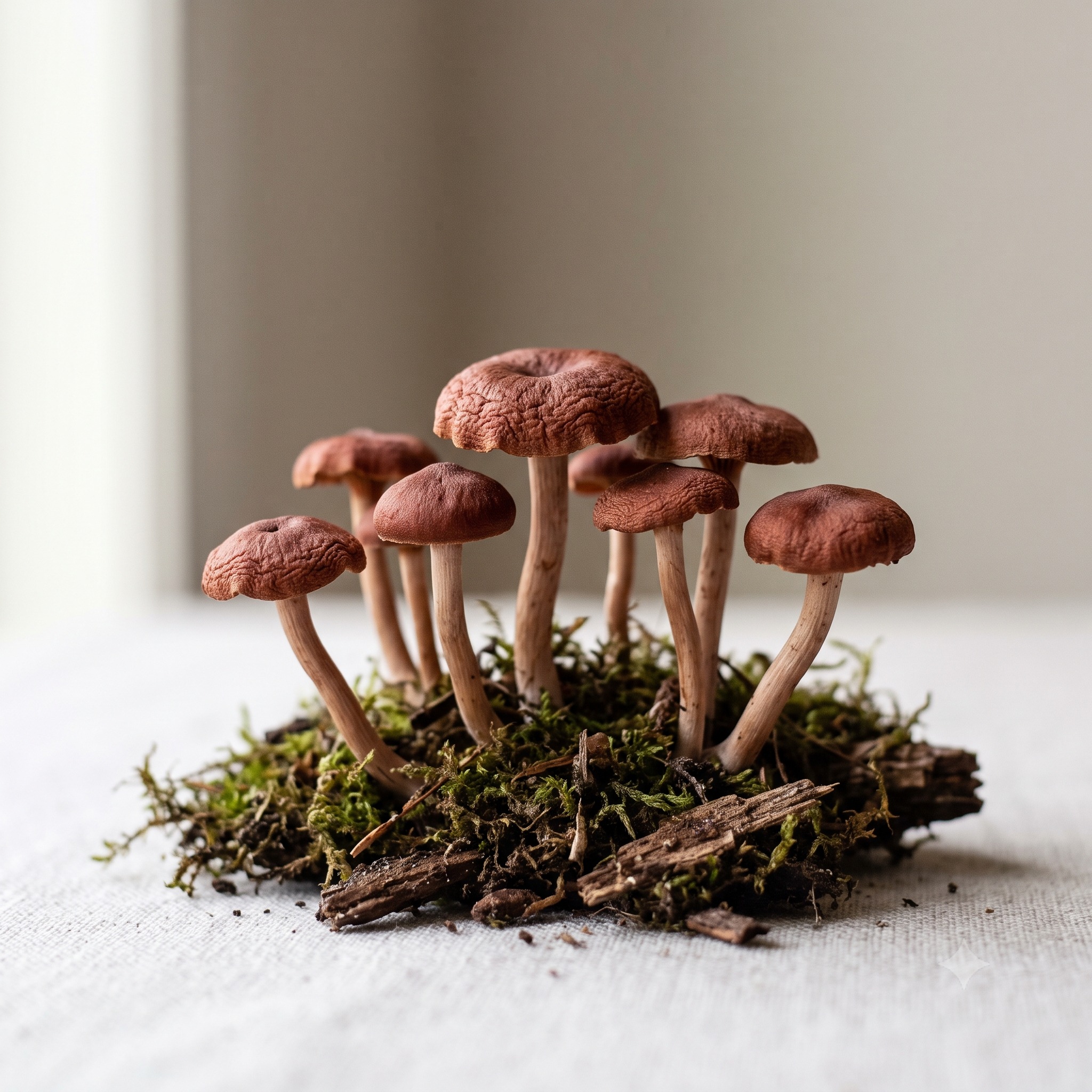
Candy caps are small to medium, with caps 2-6 cm across, orange-brown to reddish-brown or dull cinnamon, dry and often slightly wrinkled or velvety rather than shiny, becoming flat or slightly depressed with age. Gills are pale buff to pinkish-cinnamon, close, and running slightly down the stem. The stem is slender, the same colour as the cap or paler, and often hollow. The genus feature is the milk: cut or scratch the gills and a watery, thin, whey-like latex appears, which is a defining character of Lactarius and is white to clear in the candy caps rather than the thick creamy latex of many relatives. Flesh is brittle. Spore print is pale cream to buff. Fresh specimens have a faint sweet or slightly curry-like smell that becomes unmistakable maple syrup when dried. Several similar brown Lactarius species exist, some of which are not good to eat, so identification needs care.
Where It Grows
Candy caps are mycorrhizal. Lactarius rubidus grows with oak and conifers in California, Oregon, and Washington, fruiting through the winter rainy season from late autumn to early spring, which is when the west coast mushroom season peaks. Lactarius camphoratus grows in damp woodland with conifers and broadleaves across Europe, the Baltics, and parts of North America, fruiting in late summer and autumn, often in mossy acidic ground. Both are scattered rather than gregarious, appearing singly or in small groups, which makes gathering a decent quantity slow. Neither can be cultivated, and both depend on living tree roots, so productive spots recur annually as long as the habitat persists.
How to Grow at Home
Not possible. Lactarius species are ectomycorrhizal and depend on living trees, and no member of the genus is commercially cultivated. There is no spawn, no substrate, and no kit. Habitat is the only lever: mature oak and conifer with undisturbed litter and moss. For anyone who wants the flavour without the foraging, dried candy caps are sold commercially by specialist suppliers in North America, and buying dried is by far the most practical route, since the flavour lives in the dried mushroom anyway and a very small quantity goes a long way. It is also the safer route, given how many small brown Lactarius species exist and how similar several of them look in the field.
Growing Conditions
Light
Not relevant to the fungus, which fruits from woodland soil in shade. What matters is a healthy mycorrhizal host and undisturbed litter.
Watering
Fruiting is rain-driven. On the American west coast the season follows the winter rains, from late autumn into early spring; in Europe it follows late summer and autumn rain. In dry seasons the species is scarce.
Temperature & Substrate
Fruiting spans roughly 4-16°C in the cool damp parts of the year. The substrate is woodland soil and litter around living oak and conifer roots. There is no home equivalent.
Culinary Use
Dry them. That is the entire technique. Fresh candy caps have only a hint of the aroma, and the maple syrup character develops as the mushroom dries, because a precursor compound in the flesh converts into sotolon, the same molecule that gives fenugreek and maple syrup their smell. Dry them gently on a rack or in a low dehydrator, then store airtight; they will scent everything nearby, so a sealed jar matters. Use them in sweet applications: infused into cream for ice cream or panna cotta, ground to a powder for cookies and shortbread, steeped in milk for custard, or added to caramel. They also work in savoury dishes with pork or in a rich sauce, though the sweetness is startling if you are not expecting it. The quantity needed is small; a few grams of dried mushroom flavours a whole batch. Cook them; do not eat wild mushrooms raw.
Health & Nutrition
Nutritionally minor, since the quantities used are so small: a few grams of dried mushroom contributes negligible calories, some fibre, and trace minerals. The characteristic aroma comes from sotolon, formed as the dried mushroom's precursor compound breaks down, and it is the same compound responsible for the smell of fenugreek, aged sake, and maple syrup. There is a curious documented consequence: eating a substantial quantity can make sweat and urine smell of maple syrup for a day or so, which is harmless but surprising. As with all wild mushrooms, cook them, try a small amount first, and be certain of identification. Some brown Lactarius species are acrid and cause stomach upset, and a peppery or burning taste is a warning sign in this genus.
Common Problems
- No maple smell - either the mushrooms are still fresh, in which case dry them, or they are a different Lactarius species.
- Peppery or acrid taste - not a candy cap. Several brown Lactarius species are acrid and cause digestive upset.
- Scenting the whole cupboard - store dried candy caps in a genuinely airtight jar, away from other dried goods.
- Using too much - the flavour is powerful and easily overwhelming. Start with a fraction of what a recipe would use for ordinary dried mushrooms.
- Slow gathering - they fruit scattered rather than in troops, so filling a basket takes time.
Pros & Cons
Pros
- A genuinely unique dessert flavour available from no other mushroom.
- Tiny quantities go a very long way.
- Dries and stores beautifully for a year or more.
- Fruits in the cool season when little else is out.
Cons
- Cannot be cultivated at all.
- Several similar brown Lactarius species, some acrid.
- Fresh specimens give little hint of the flavour, so drying is mandatory.
- Scattered fruiting makes gathering slow.
Best Suited For
- Bakers and dessert cooks looking for an unusual natural flavour.
- Foragers in west coast North America during the winter rains.
- Anyone who prefers to buy dried specialist mushrooms rather than gather them.
Not ideal for foragers who cannot reliably separate brown Lactarius species, or cooks looking for a savoury workhorse mushroom.
FAQ
Why do they only smell like maple syrup when dried? A precursor compound in the fresh mushroom converts during drying into sotolon, the aroma molecule found in maple syrup and fenugreek. Fresh candy caps smell faint by comparison.
Are the European and Californian candy caps the same species? No. Genetic work separates the Californian Lactarius rubidus from the European and eastern North American Lactarius camphoratus. They are relatives that share the aroma, with the Californian species generally the stronger.
Do they really make your sweat smell of syrup? Eating a substantial quantity can produce that effect for a day or so. It is harmless, well documented, and one of the odder facts about wild food.
Never eat a candy cap without 100% expert identification. Brown Lactarius species are numerous and some are acrid. Confirm the watery whey-like latex, the cap and gill colours, the pale spore print, and above all the maple aroma on drying with an experienced identifier.
🪴 Foraging kit worth a look
Nothing here identifies a mushroom for you - identification stays with your field guides and local experts. These are simply the basics foragers carry.
Links go to Amazon or a partner store (such as Adagio Teas) and may earn us a commission at no extra cost to you. As an Amazon Associate we earn from qualifying purchases. We link gear types, not sponsors' picks: you choose the exact product.