Charcoal Burner
The charcoal burner (Russula cyanoxantha) is the best edible in a genus with a reputation for being impossible.
🗓️ Last reviewed: October 2026
Overview
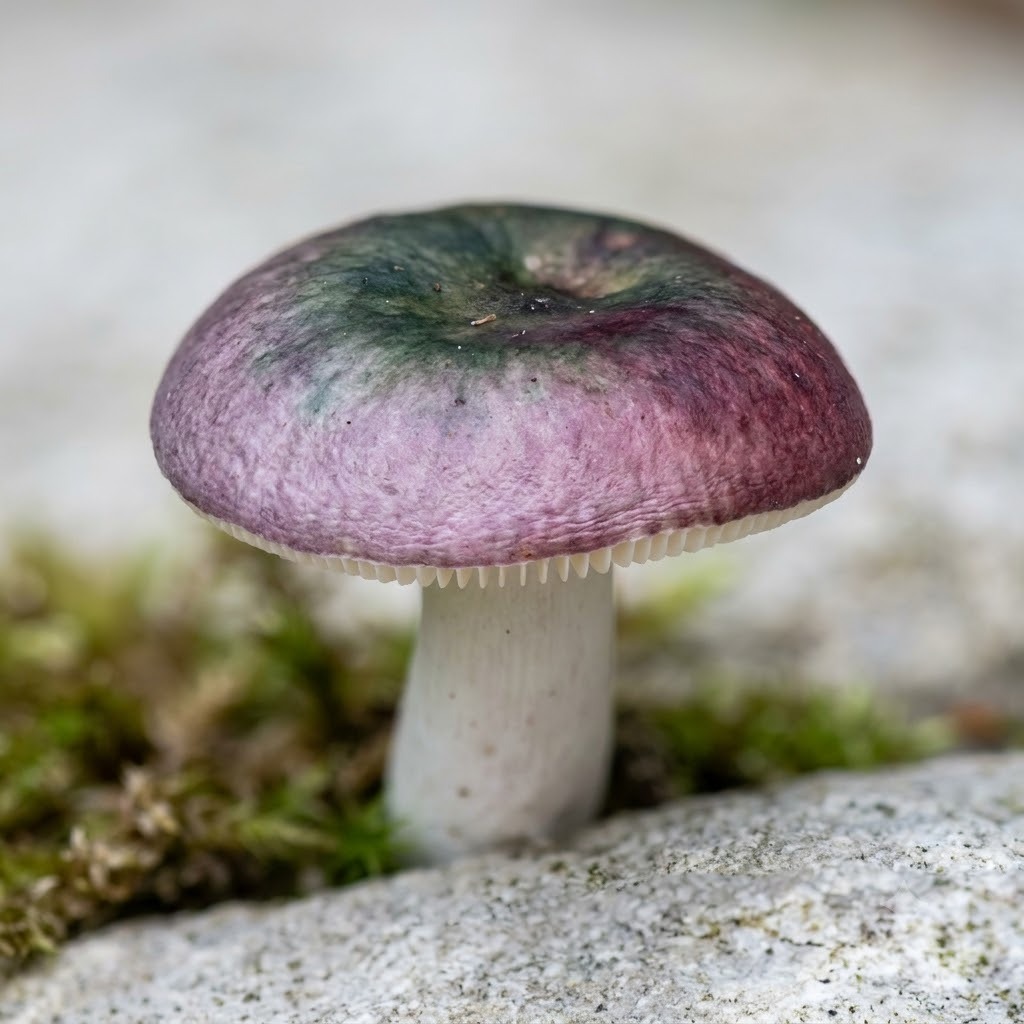
The charcoal burner (Russula cyanoxantha) is the best edible in a genus with a reputation for being impossible. Russula is a huge group of brittle-fleshed, brightly capped mushrooms that most foragers give up on, because separating the many species requires chemical tests, microscopy, and patience. The charcoal burner is the exception, because it has one feature no other Russula shares: its gills are flexible and greasy to the touch rather than brittle, so they bend under a thumb instead of shattering. Add a cap that mixes lilac, green, grey, and wine purple in the same specimen, and you have a species a careful beginner can learn. It is common, abundant, mild, and firm, and it is one of the few wild mushrooms that is genuinely good simply fried.
Identification & Appearance
The cap is 5-15 cm across, convex then flattening and finally slightly depressed, and the colour is famously variable: shades of lilac, violet, green, olive, grey, and wine-red often blend in the same cap, sometimes with a greenish centre and purple margin. The surface is slightly greasy when damp and the cuticle peels back a short way from the margin. Gills are white, crowded, and flexible and soft to the touch, sliding under a finger rather than snapping, which is the decisive feature. In every other Russula the gills are rigid and crumble. The stem is white, cylindrical, and brittle in the way of the genus, snapping cleanly like chalk. Flesh is white and unchanging. Spore print is white. The taste of a tiny piece of the flesh is mild, not peppery; in Russula identification a peppery or burning taste indicates species best avoided, though tasting anything requires expert-supervised technique and is not a substitute for identification.
Where It Grows
Charcoal burners are mycorrhizal with broadleaved trees, especially beech and oak, and also with birch and conifers in mixed woodland. They fruit from early summer through autumn in woodland on all but the most acidic soils, singly or scattered rather than in dense troops. They are among the most common woodland mushrooms in Europe and are found across much of Asia and North America too, and they appear in mature parks and large gardens with old trees as readily as in woodland. Because the fungus depends on living roots, the same trees produce year after year. In a good summer they are one of the first substantial edibles to appear, well before the autumn rush.
How to Grow at Home
Not possible. Russula species are ectomycorrhizal, dependent on living tree roots, and no member of the genus is commercially cultivated. There is no spawn and no substrate that will fruit them. The only meaningful contribution a gardener can make is habitat: keep mature beech and oak, leave leaf litter undisturbed, avoid compaction and fertiliser near the root zone. This is a foraging species, and the skill worth developing is the gill test, which takes two seconds and is the basis of separating this species from other Russula. Practising it on any Russula you find, without eating anything, is the fastest way to learn the difference between brittle gills that shatter and the flexible gills of the charcoal burner.
Growing Conditions
Light
Not relevant to the fungus itself, which lives in shaded woodland soil. What matters is the presence of a mature host tree and undisturbed litter above its roots.
Watering
Fruiting follows rain from early summer onwards. This species responds well to summer rain and often appears earlier in the year than most woodland edibles.
Temperature & Substrate
Fruiting spans roughly 10-24°C from early summer into autumn. The substrate is woodland soil and leaf litter threaded with living beech, oak, birch, or conifer roots, and no home substrate reproduces it.
Culinary Use
This is a genuinely good mushroom: firm, mild, and nutty, holding its texture in the pan far better than most Russula species, which tend to be soft. Slice thickly and fry hot in butter or oil; it browns nicely and does not weep. It works well in mixed dishes, on toast, in cream sauces, and as a component in a mushroom risotto. It does not dry particularly well, since the flavour is mild to start with, and it is best eaten fresh within a day or two of picking. Clean it with a brush; the greasy cap surface picks up leaf debris. Cook it thoroughly. In parts of eastern Europe Russula species including this one are salted, though the charcoal burner is good enough fresh that this feels like a waste.
Health & Nutrition
Nutritionally standard for a woodland mushroom: low calorie, some protein and dietary fibre, B vitamins, potassium, and trace minerals, with beta-glucans in the cell walls. As with all wild mushrooms, gather from clean woodland well away from roads and industry, since fungi take up heavy metals from soil. The specific caution for this genus is identification rather than toxicity: no Russula in Europe is deadly, but several are sharply peppery and cause vomiting and diarrhoea, and the genus is a common source of gastrointestinal poisonings simply because so many species look alike. Green-capped brittlegills can also be confused with the deadly death cap (Amanita phalloides), which unlike any Russula has a ring on the stem and a sac-like volva at its base. The flexible-gill feature is what makes this one identifiable, and without it you do not have a charcoal burner. Try a small cooked portion the first time.
Common Problems
- Brittle gills that shatter - then it is not a charcoal burner. Put it back; this is the whole test.
- Peppery or burning taste - indicates a different Russula, some of which cause serious stomach upset. Do not eat it.
- Maggot damage - common in warm weather; check the stem before picking.
- Confusion with other purple-capped Russula species - several exist and are hard to separate on colour, which is why the gill test rather than the cap colour is the identifying feature.
- Disappointing when dried - the mild flavour does not concentrate well. Eat it fresh.
Pros & Cons
Pros
- The one Russula a careful beginner can identify with a simple physical test.
- Firm texture that fries better than most of the genus.
- Common and widespread, often the first good edible of summer.
- No deadly look-alike in Europe within the genus, though green-capped specimens must be told apart from the deadly death cap.
Cons
- Cap colour is extremely variable and useless for identification.
- Poor keeping quality and mediocre dried.
- Cannot be cultivated.
- The genus as a whole is a minefield for beginners.
Best Suited For
- Foragers who want one reliable species from a difficult genus.
- Summer foraging, when few other good species are out.
- Cooks who want a firm mushroom for simple frying.
Not ideal for anyone who wants a mushroom that stores, or a forager unwilling to learn the gill test properly.
FAQ
What exactly is the flexible gill test? Run a thumb gently across the gills. In a charcoal burner they bend and feel slightly greasy; in every other Russula they crack and crumble. That single feature is what makes this species identifiable.
Does the cap colour matter? Very little. The same species can be lilac, green, grey, purple, or a mix. Identifying Russula by cap colour is how people get it wrong.
Are any Russula species deadly? No European species is considered deadly, but several cause severe vomiting and diarrhoea, and the genus is a frequent cause of gastrointestinal poisoning through misidentification.
Never eat a charcoal burner without 100% expert identification. Confirm the flexible non-brittle gills, white spore print, brittle chalk-snapping stem with no ring or volva, and mild taste with an experienced identifier before eating.
🪴 Foraging kit worth a look
Nothing here identifies a mushroom for you - identification stays with your field guides and local experts. These are simply the basics foragers carry.
Links go to Amazon or a partner store (such as Adagio Teas) and may earn us a commission at no extra cost to you. As an Amazon Associate we earn from qualifying purchases. We link gear types, not sponsors' picks: you choose the exact product.