Common Inkcap
The common inkcap (Coprinopsis atramentaria) is edible, harmless, and mild, right up until someone has a drink.
🗓️ Last reviewed: August 2026
Overview
The common inkcap (Coprinopsis atramentaria) is edible, harmless, and mild, right up until someone has a drink. It contains coprine, a compound that blocks the enzyme the body uses to clear acetaldehyde from alcohol, producing a reaction essentially identical to the one caused by the drug disulfiram, prescribed to deter drinking. Flushing, pounding heart, nausea, vomiting, and a splitting headache follow within minutes of a glass of wine, and the sensitivity lasts for days after the meal. It is sometimes called tippler's bane for exactly this reason. The mushroom itself is not poisonous; it is a mushroom with a condition attached, which is a rare and instructive category.
Identification & Appearance
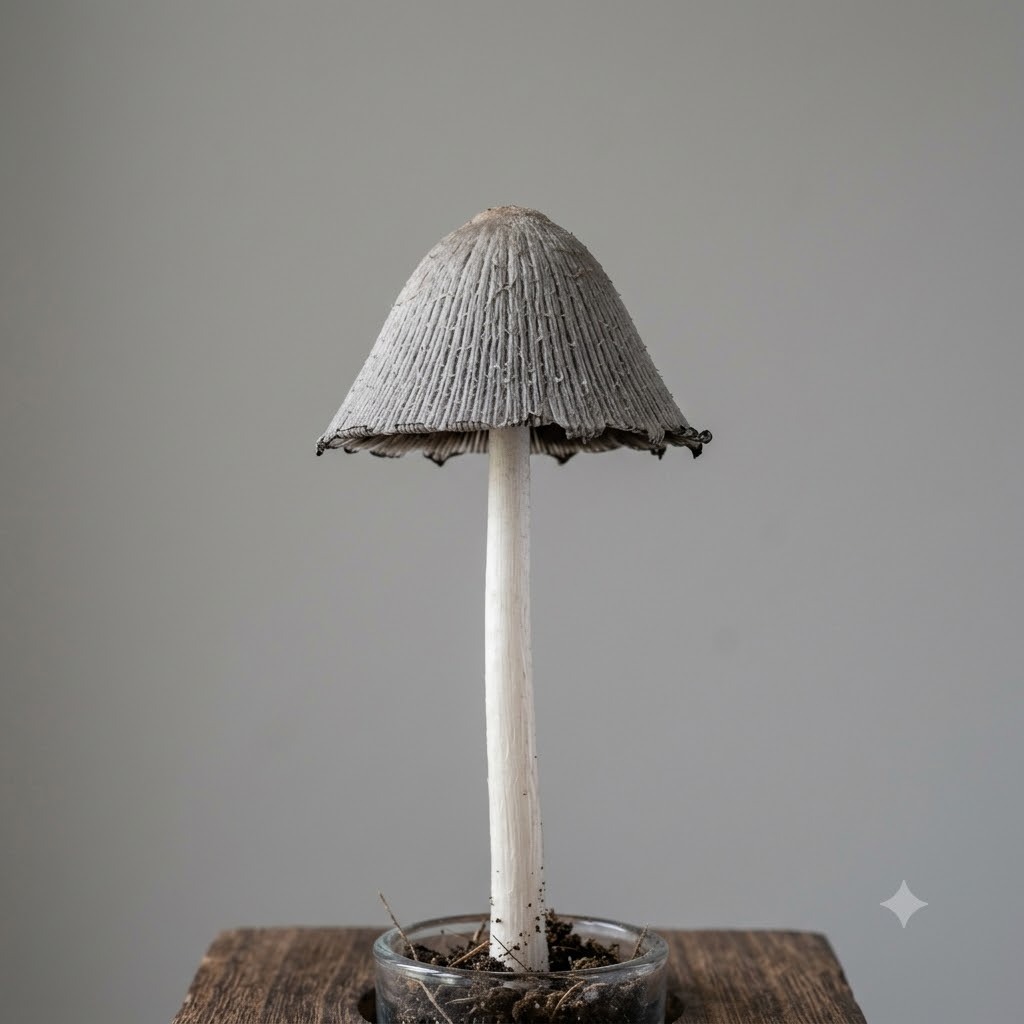
Caps are 3-8 cm across and 4-8 cm tall, pale grey to grey-brown, egg-shaped or bell-shaped, never opening flat, with fine radial grooves and often small scales near the centre. Gills start white, turn grey, then black, and finally the whole cap deliquesces, dissolving from the margin upwards into a black inky liquid that drips away, which is the family signature and gives the group its name. The stem is white, hollow, and slender, with a faint ring zone near the base rather than a proper ring. Spore print is black. The mushroom grows in clusters from buried wood, roots, and rich disturbed soil. Deliquescing to black ink is unmistakable, though it also means specimens must be used within hours of picking.
Where It Grows
Common inkcaps fruit in dense clusters from buried wood, tree stumps, roots, and rich disturbed ground, in gardens, parks, verges, waste ground, and woodland edges. They appear from spring through late autumn and can fruit repeatedly from the same spot through a season. They are very common across Europe, North America, and Asia, and they are especially frequent in gardens, on old stump sites, and around buried construction debris. Anyone who has had a tree removed and the stump ground out will often meet them the following year, appearing from the buried remains of the root system.
Can It Be Grown
Not commercially, though as a decomposer of buried wood and rich soil it is easy enough to encourage accidentally: bury woody debris in a garden bed and inkcaps often follow. There is no spawn on the market and no reason to seek any, given the alcohol interaction. Where they appear in a garden, they are harmless decomposers doing normal work, and there is no need to remove them unless small children have access. Their appearance is a useful indicator of buried wood, which can matter if you are planning to plant a tree or lay a path in the same spot.
Growing Conditions
Light
Not relevant to the fungus, which fruits from buried wood and rich soil in sun or shade alike, commonly on lawns, verges, and bare disturbed ground.
Watering
Fruiting follows rain across a long season from spring to late autumn. Clusters appear quickly, often overnight, and deliquesce within a day or two, so the window for picking is very short.
Temperature & Substrate
Fruiting spans roughly 5-22°C from spring into late autumn. The substrate is buried wood, tree roots, stump remains, and rich disturbed soil.
Why It Is Complicated Rather Than Poisonous
Eaten on its own, with no alcohol before or after, the common inkcap is a mild, edible mushroom. Eaten in combination with alcohol it produces a disulfiram-like reaction, because coprine inhibits aldehyde dehydrogenase, the enzyme that breaks down acetaldehyde produced when the body metabolises ethanol. Acetaldehyde accumulates, and the result is facial flushing, a hot prickling sensation, a racing heart, throbbing headache, nausea, and vomiting. Symptoms begin roughly ten to thirty minutes after drinking and typically resolve within three to six hours, occasionally lasting up to a day. The sensitivity window is long: alcohol consumed up to about 72 hours after the mushroom meal can trigger the reaction, and enzyme inhibition has been reported to persist for several days.
Health & Reaction Pattern
The reaction is unpleasant and frightening rather than usually dangerous, but it is not trivial: the cardiovascular effects, including tachycardia and a drop in blood pressure, can be significant in people with heart conditions, and cases requiring medical attention are documented. The practical implications go beyond a glass of wine at dinner, since alcohol appears in cough syrups, some medicines, and cooking. Anyone who eats this mushroom should avoid alcohol in any form for at least three days afterwards, and anyone who has eaten alcohol in the days before should not eat the mushroom. If someone experiences severe flushing, chest discomfort, or fainting after drinking, seek medical help and mention the mushroom meal.
Common Identification Traps
- Forgetting the timing window - it works in both directions and lasts up to about 72 hours after the meal. A drink three days later can still trigger it.
- Hidden alcohol - cough medicines, some sauces, and dishes finished with wine all count.
- Confusion with the shaggy inkcap - the edible shaggy inkcap is taller, white, and shaggy-scaled, and does not contain coprine, though it also deliquesces and must be used within hours.
- Confusion with small brown clustered mushrooms on wood - the deadly funeral bell grows in similar places; check for the black spore print and deliquescence.
- Leaving them too long - they dissolve into ink within a day, so a picked cluster left in a bag becomes a black mess.
The Rule That Prevents This
If you choose to eat common inkcaps, treat them as a three-day alcohol commitment in both directions, and simply do not bother if that is inconvenient. Given that they must be picked young, cooked within hours, and eaten in an alcohol-free window, most foragers conclude the shaggy inkcap is the better use of an evening. For identification, confirm the black spore print, the deliquescing gills, and the clustered growth from buried wood, and rule out small brown ringed mushrooms with rust-brown spores growing in the same habitat.
Best Suited For
- Learning the inkcap group and the phenomenon of deliquescence.
- Understanding drug-like interactions between food and medication.
- Foragers who do not drink and want an abundant garden species.
Edible only in the strict absence of alcohol for several days either side. Most people should simply leave it.
FAQ
How long do I have to avoid alcohol? At least three days after the meal, and it is sensible not to eat the mushroom if you have been drinking in the previous couple of days. Enzyme inhibition has been reported to persist for several days.
Is the reaction dangerous? Usually unpleasant rather than dangerous, but it involves a racing heart and a drop in blood pressure, which matters for people with cardiovascular conditions. Medical attention is warranted for severe symptoms.
Is the shaggy inkcap the same? No. The shaggy inkcap is a different species, taller and white with shaggy scales, and it does not contain coprine. It still needs cooking within hours of picking because it dissolves.
Never eat any inkcap without 100% expert identification. Confirm the black spore print, deliquescing gills, and clustered growth from buried wood, and remember that small brown mushrooms on wood in the same habitat include deadly species.
🪴 Foraging kit worth a look
Nothing here identifies a mushroom for you - identification stays with your field guides and local experts. These are simply the basics foragers carry.
Links go to Amazon or a partner store (such as Adagio Teas) and may earn us a commission at no extra cost to you. As an Amazon Associate we earn from qualifying purchases. We link gear types, not sponsors' picks: you choose the exact product.