Death Cap
The death cap (Amanita phalloides) is responsible for the large majority of fatal mushroom poisonings worldwide, and it is the single most important mushroom for any forager to be able to recognise and rule out.
🗓️ Last reviewed: August 2026
Overview
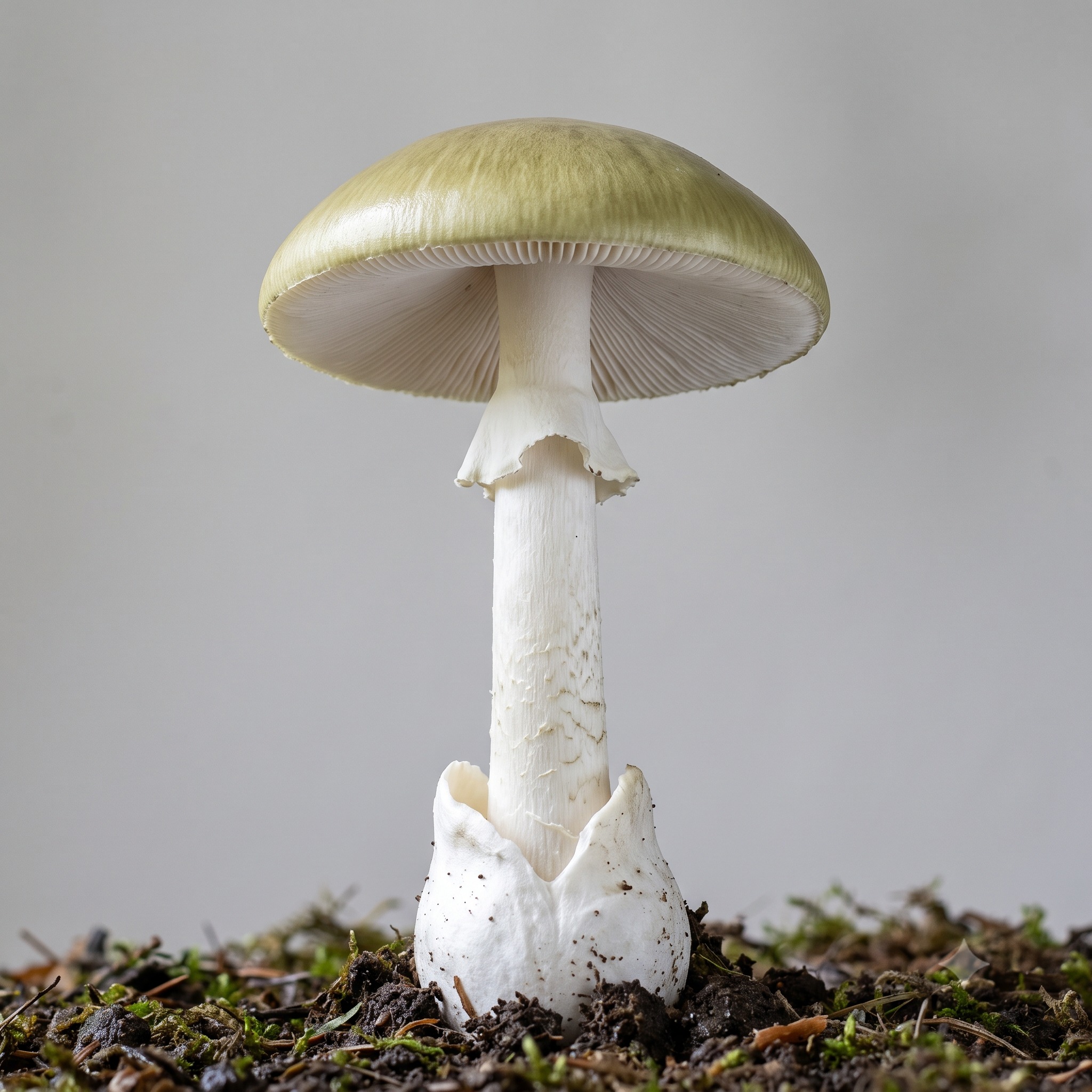
The death cap (Amanita phalloides) is responsible for the large majority of fatal mushroom poisonings worldwide, and it is the single most important mushroom for any forager to be able to recognise and rule out. It is not rare, it is not obscure, and it does not look sinister. It is a pleasant-looking, faintly greenish, white-gilled mushroom that grows under oak and other broadleaved trees in parks and gardens as readily as in woodland, and by several accounts it tastes good. This profile exists for one reason: so that readers can identify it in order to avoid it. Nothing here is a preparation guide. There is no safe way to eat this mushroom, and no cooking, drying, freezing, soaking, or peeling makes it safe.
Identification & Appearance
The cap is 5-15 cm across, smooth, and typically a pale olive-green to yellowish-green, sometimes brownish, bronze, or in some forms almost white, often with faint radial fibres and a slightly sticky surface when damp. Gills are white, free of the stem, and remain white at all ages, never turning pink or brown. The stem is white, sometimes faintly patterned, with a prominent skirt-like ring hanging near the top and, critically, a volva at the base: a white, sac-like cup enclosing the swollen stem base, which is often buried and must be excavated to see. The flesh is white and does not change colour. Spore print is white. The smell is faint and sweetish at first, becoming sickly in older specimens. The three features that together define the danger group are white gills, a ring, and a volva.
Where It Grows
The death cap is ectomycorrhizal, associating principally with oak and also with beech, chestnut, hornbeam, birch, and others. It fruits from summer through autumn in woodland, parkland, gardens, and along tree-lined streets, and it is entirely at home in urban and suburban settings, which is one of the reasons it kills people. It is native across Europe and has been spread widely by the international movement of nursery trees, becoming established in North America, especially California and the Pacific Northwest, and in Australia, New Zealand, southern Africa, and South America. Poisonings frequently involve people who moved from one continent to another and picked something that resembled an edible species from home; that pattern is well documented in medical case series.
Can It Be Grown
No, and nobody should try. It is mycorrhizal and cannot be cultivated in any case, but the more important point is that this species should never be deliberately propagated, moved, or kept. If it appears in a garden, particularly one used by children or dogs, the sensible response is to remove the fruit bodies carefully with gloves and dispose of them in sealed waste, while understanding that this does not remove the fungus itself, which lives in the tree roots and will fruit again. Where children or pets use the ground regularly, knowing the trees and checking after autumn rain is more useful than any removal effort. Do not compost them.
Growing Conditions
Light
Not relevant to the fungus, which lives on tree roots and fruits in shade or sun according to where the host tree stands. It appears in gardens and parks as readily as in woodland.
Watering
Fruiting follows summer and autumn rain, typically within one to two weeks. In practice this means the highest-risk period for accidental poisoning is a warm wet spell in late summer and autumn.
Temperature & Substrate
Fruiting spans roughly 12-24°C from summer into autumn. The substrate is soil around living roots of oak and other broadleaved trees, including planted specimens in gardens, parks, and streets.
Why It Is Not Food
This mushroom contains amatoxins, principally alpha-amanitin, which inhibit RNA polymerase II and shut down protein synthesis in cells, destroying liver tissue and often damaging the kidneys. The minimum lethal dose of amatoxin is around 0.1 mg per kilogram of body weight, and a single cap may contain 10-15 mg, which means roughly half a cap can be enough to kill an adult. Amatoxins are not destroyed by cooking, drying, freezing, or any traditional preparation method. There is no home test, no colour reaction, no animal that safely eats it, and no folk rule that works. Every year, experienced foragers among the victims demonstrate that confidence is not protection.
Health & Poisoning Pattern
Amatoxin poisoning follows a characteristic and treacherous three-phase course. First, a delay of six to twenty-four hours with no symptoms at all, which is unusually long and is itself a warning sign when it does begin. Second, severe gastrointestinal illness with violent vomiting, watery diarrhoea, and abdominal pain, causing dehydration. Third, an apparent recovery lasting a day or two during which the patient feels better, followed by liver failure, jaundice, bleeding disorders, and in serious cases kidney failure and coma. A substantial proportion of those who reach liver failure need transplant assessment. If you suspect anyone has eaten a death cap, go to an emergency department immediately, take any remaining mushroom material with you, and say clearly what was eaten and when. Do not wait for symptoms. Early treatment matters enormously.
Common Identification Traps
- Skipping the stem base - the volva is often buried. Any white-gilled mushroom must be dug up whole, not cut at ground level.
- Mistaking it for edible species from another country - the classic fatal error, particularly involving pale Volvariella and Amanita species eaten elsewhere.
- Mistaking young buttons for puffballs - always cut small white eggs in half; an Amanita button shows the outline of a cap and stem inside.
- Assuming green means dangerous and white means safe - death caps range from green to nearly white, and the destroying angel is pure white.
- Trusting taste or smell - by report it tastes pleasant. That is exactly the problem.
The Rule That Prevents This
White gills, a ring on the stem, and a sac-like volva at the base together define the deadliest group of mushrooms in the world. If a mushroom has all three, do not eat it, whatever else it resembles. Dig up every white-gilled mushroom completely so the base is visible, take a spore print, and have any collection checked by an experienced identifier before eating anything. Beginners should avoid the entire white-gilled, ringed, volva-bearing group permanently rather than trying to learn its edible members.
Best Suited For
- Learning to recognise, so it can be avoided permanently.
- Teaching foraging safety and the discipline of excavating the stem base.
Not food under any circumstances, for anyone, prepared in any way.
FAQ
Can cooking make it safe? No. Amatoxins survive cooking, drying, freezing, and every traditional preparation. There is no safe method.
How much is dangerous? Around half a cap can deliver a potentially fatal dose to an adult, since the minimum lethal amatoxin dose is roughly 0.1 mg per kilogram of body weight and a cap may hold 10-15 mg.
What if someone ate one an hour ago and feels fine? That is expected. Symptoms typically begin six to twenty-four hours later. Go to hospital immediately, take the mushroom material, and do not wait for symptoms.
Never eat any white-gilled mushroom with a ring and a volva. That combination defines the group responsible for almost all fatal mushroom poisonings. Learn it, avoid it, and have every wild collection checked by an experienced identifier.
🪴 Foraging kit worth a look
Nothing here identifies a mushroom for you - identification stays with your field guides and local experts. These are simply the basics foragers carry.
Links go to Amazon or a partner store (such as Adagio Teas) and may earn us a commission at no extra cost to you. As an Amazon Associate we earn from qualifying purchases. We link gear types, not sponsors' picks: you choose the exact product.