Dryad's Saddle
Dryad's saddle (Cerioporus squamosus, long known as Polyporus squamosus) is the big scaly bracket that appears on dead and dying hardwood in spring, often the first substantial fungus of the year and a familiar sight to morel hunters, who use it as a seasonal marker.
🗓️ Last reviewed: August 2026
Overview
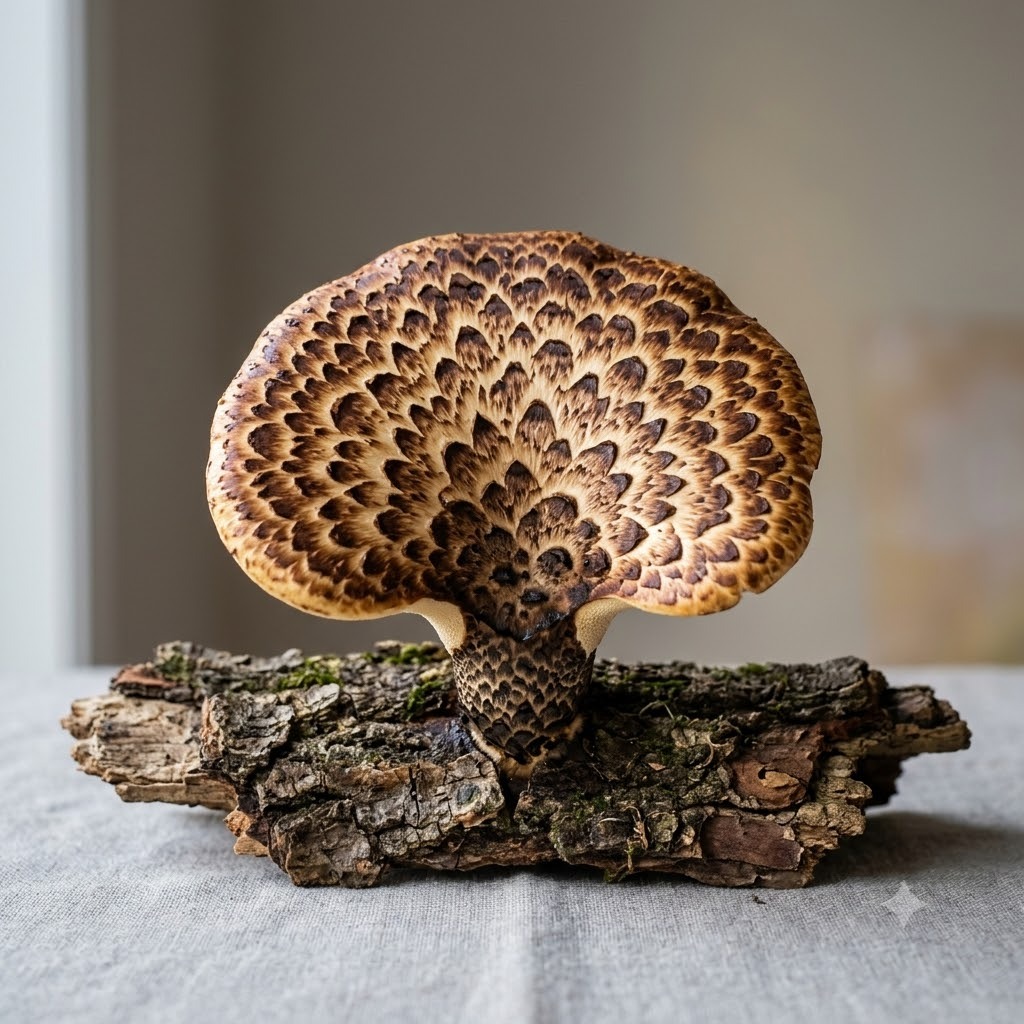
Dryad's saddle (Cerioporus squamosus, long known as Polyporus squamosus) is the big scaly bracket that appears on dead and dying hardwood in spring, often the first substantial fungus of the year and a familiar sight to morel hunters, who use it as a seasonal marker. It is also called pheasant back for the feather-like pattern of brown scales on its cap. It smells startlingly of fresh watermelon or cucumber, which is one of the most reliable and pleasant identification features in the whole of mycology. It is edible only when very young; within days the flesh turns to something with the texture of shoe leather, which is why so many people who try it once conclude it is inedible.
Identification & Appearance
The fruit body is a large bracket, 10-40 cm across and occasionally much larger, fan or kidney shaped, pale cream to ochre-yellow with a striking pattern of flattened dark brown scales arranged in concentric rows like feathers. It attaches to the wood by a short thick lateral stem that is black at the base. Underneath is a pore surface, white to cream, with large angular pores that are visible without a lens, often one to two millimetres across and elongated near the stem, which distinguishes it from most other brackets. The flesh is white, thick, and firm when young, becoming tough and corky within days. The smell is the giveaway: fresh specimens smell strongly of watermelon rind or cucumber. Spore print is white. Large scaly cap, huge angular pores, black stem base, and melon smell together make this hard to confuse with anything else.
Where It Grows
Dryad's saddle is a saprotroph and weak parasite on hardwoods, especially elm, beech, sycamore, maple, ash, and poplar. It fruits on dead trunks, stumps, fallen logs, and the wounds of living trees, most abundantly in spring and early summer with a smaller second flush in autumn. It causes a white rot in the heartwood. It is common and widespread across Europe, North America, and Asia, and it thrives in urban parks and along riversides where damaged hardwoods are plentiful. In much of its range it fruits at the same time as morels, and in classic morel country a pheasant back on a dead elm is a signal to start looking down at the ground.
How to Grow at Home
Not commercially cultivated, but as a hardwood saprotroph it is technically culturable, and it will grow on sterilised hardwood sawdust in laboratory conditions. No spawn is sold, and there is little incentive, since the edible window is so short that a cultivated crop would need harvesting almost at the pinning stage. The realistic version is opportunistic: hardwood logs and stumps left in a garden will sometimes produce it spontaneously, especially elm, sycamore, and maple. Leaving standing dead wood and stumps in place is good for woodland biodiversity generally and gives this species somewhere to live. Because it needs to be picked so young, having it close to home is actually a genuine advantage over finding it in the woods once a week.
Growing Conditions
Light
Not relevant to the fungus. It fruits from wood in shade or partial shade, and the relevant condition is the presence of dead or damaged hardwood.
Watering
Fruiting follows spring rain and is triggered by warming weather rather than by cold. Wet springs produce large flushes; dry springs produce few, and the brackets toughen faster in dry air.
Temperature & Substrate
Fruiting spans roughly 10-22°C, mostly in spring and early summer with a smaller autumn flush. The substrate is dead or damaged hardwood, especially elm, sycamore, maple, beech, and ash. It will not grow on conifer.
Culinary Use
Everything depends on age. Very young specimens, no more than a few days old and still soft enough that a fingernail sinks in easily, are genuinely good: firm, mild, and carrying that cucumber-melon note into the pan. Slice them thinly across the grain, discard anything tough, and fry hard or bread and fry them like schnitzel. Some cooks blanch them first. Older brackets are simply too tough to chew, and no amount of cooking fixes it, though they can be simmered for stock and then discarded, or dried and powdered as a seasoning. The rule of thumb is to press the edge of the bracket: if it does not yield easily, leave it. Cook thoroughly. Many people who report this species as inedible simply picked it a week too late.
Health & Nutrition
Low in calories with some fibre, protein, and trace minerals, like most brackets, plus the beta-glucans typical of polypores. There is no significant toxicity concern with correctly identified dryad's saddle, and it has no dangerous look-alikes in temperate woodland. The practical health note is the same as for any wood-growing fungus in urban settings: park and street trees are often treated, and riverside trees can sit in contaminated silt, so gather from clean sites. As always with a first-time wild mushroom, cook a small portion thoroughly and wait a day. Its tough older flesh is not toxic, merely indigestible in the mechanical sense, and eating a large quantity of leathery bracket is an unpleasant idea rather than a dangerous one.
Common Problems
- Tough as leather - the single most common complaint, and always an age problem. Press-test the edge before picking.
- Insect larvae - large brackets are frequently occupied, especially near the stem.
- Confusing spring bracket species - few look similar, but check the large angular pores and melon smell.
- Overharvesting a log - the same log fruits repeatedly; leave some brackets to mature and sporulate.
- Picking from treated park trees - know the site history.
Pros & Cons
Pros
- Fruits in spring when almost nothing else worthwhile is out.
- Large and conspicuous, easy to spot from a distance.
- Unmistakable identification features including a distinctive smell.
- A useful indicator species for morel season.
Cons
- Edible only when very young; the window is a few days.
- Frequently infested with insect larvae.
- Bland flavour compared with spring morels.
- Not commercially available or cultivated.
Best Suited For
- Spring foragers who check their local dead elms and sycamores regularly.
- Cooks who like breaded and fried mushroom cutlets.
- Anyone learning bracket fungi with an easy, safe species.
Not ideal for foragers who visit woodland rarely, since the edible window is too short to catch by chance.
FAQ
Why is mine impossible to chew? It was too old. Dryad's saddle toughens within days. Press the bracket edge, and if it does not dent easily under a fingernail, it is past eating.
Does it really smell of watermelon? Yes, and it is one of the most useful smells in fungus identification. Fresh specimens smell distinctly of watermelon rind or cucumber.
Is it a sign that morels are out? In much of its range the two overlap, and experienced hunters treat a fresh pheasant back on a dead elm as a signal to search the ground nearby.
Never eat a dryad's saddle without 100% expert identification. Confirm the scaly feather-patterned cap, large angular pores, black stem base, and melon smell with an experienced identifier before eating.
🪴 Foraging kit worth a look
Nothing here identifies a mushroom for you - identification stays with your field guides and local experts. These are simply the basics foragers carry.
Links go to Amazon or a partner store (such as Adagio Teas) and may earn us a commission at no extra cost to you. As an Amazon Associate we earn from qualifying purchases. We link gear types, not sponsors' picks: you choose the exact product.