False Morel
The false morel (Gyromitra esculenta) is the mushroom whose scientific name means edible and which is anything but.
🗓️ Last reviewed: August 2026
Overview
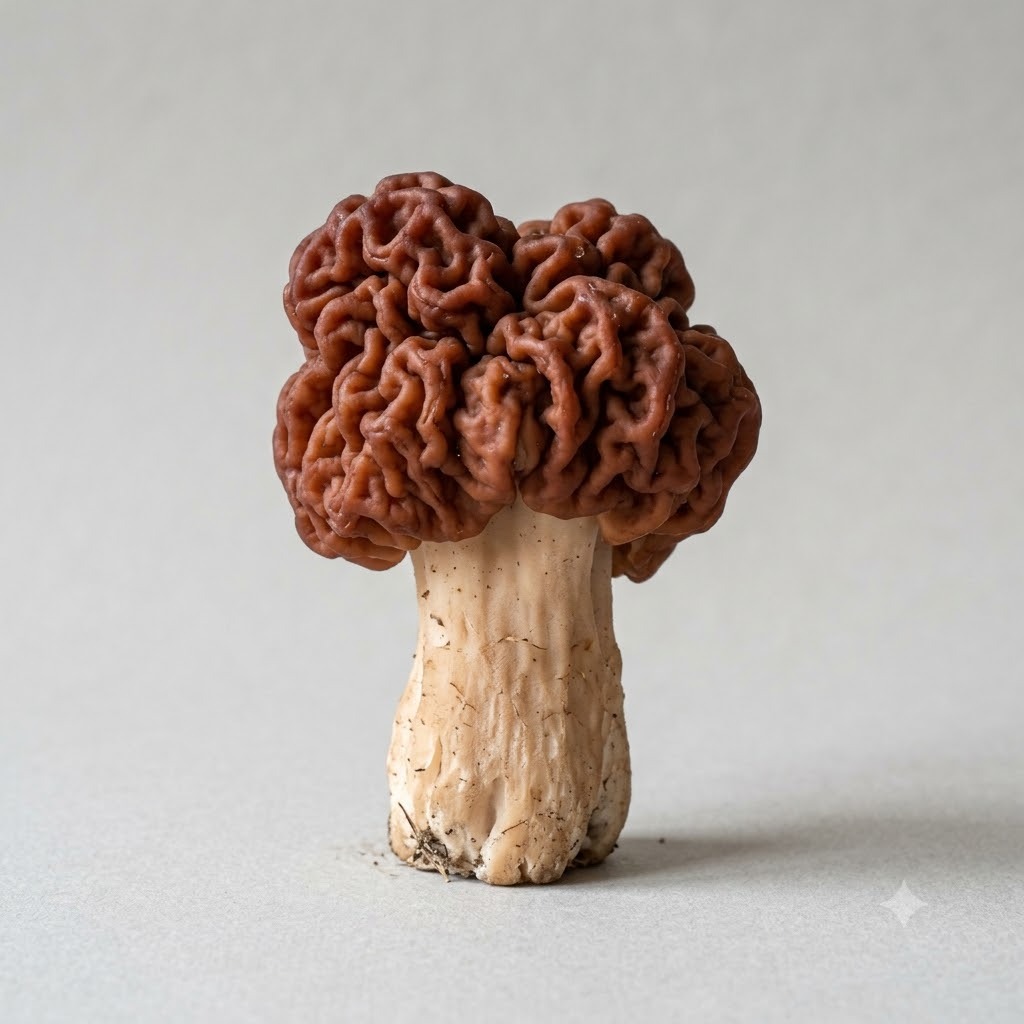
The false morel (Gyromitra esculenta) is the mushroom whose scientific name means edible and which is anything but. It is a brain-shaped, reddish-brown spring fungus that contains gyromitrin, a compound the body converts into monomethylhydrazine, a substance also used as rocket fuel. It has killed people. It is also eaten in quantity in Finland and parts of eastern Europe, where it is a traditional spring delicacy sold in shops under mandatory warning labels and preparation instructions. Those two facts sit awkwardly together, and the honest summary is this: it is genuinely toxic, the traditional parboiling regime reduces but does not reliably eliminate the toxin, and the Finnish Food Authority's 2025 risk assessment found that nearly one-fifth of the gyromitrin can remain even after the recommended preparation, with no safe intake level established.
Identification & Appearance
The fruit body is 4-15 cm across and 3-10 cm tall, an irregular, lobed, wrinkled brain-like or saddle-shaped mass in reddish-brown, chestnut, or dark purple-brown, sitting on a short, stout, pale, often furrowed stem. Cut it lengthways and the interior is chambered and irregularly hollow with internal folds and wads of tissue, not a single clean cavity. That is the decisive check against true morels, which are hollow from cap tip to stem base in one continuous chamber, and which have a distinctly pitted honeycomb surface rather than a wrinkled brain surface. True morels are also attached to the stem along the cap edge, while the false morel's lobed cap hangs free in places. Spore print is white to cream.
Where It Grows
False morels are saprotrophs of sandy, disturbed conifer ground, fruiting in spring, often on sandy soil under pine and spruce, along forest tracks, on old burn sites, and in clear-felled areas. The season runs from early spring to early summer, overlapping exactly with true morel season, which is the entire problem. It is widespread across northern and central Europe, Scandinavia, the Baltics, Russia, and North America. In Finland it is gathered commercially, and the species has genuine cultural weight there; it is also the reason Finland has one of the more developed regulatory frameworks for a toxic wild food anywhere in the world.
Can It Be Grown
It is not cultivated, and there is no reason to attempt it. Fruiting is associated with disturbed sandy conifer ground and is unpredictable even where the species is common. The important point for a gardener or forager is not cultivation but the calendar: this species fruits in spring alongside the true morels people actively hunt, so anyone gathering morels needs to be able to rule it out on sight. Learning that distinction is the practical work here. Anyone in Finland or the Baltics considering the traditional preparation should read their national food authority's current guidance rather than a recipe, because that guidance has changed.
Growing Conditions
Light
Not relevant to the fungus. It fruits on open sandy ground under conifers, along tracks, and in clearings, in both sun and partial shade.
Watering
Fruiting follows spring warming and moisture, typically as soil temperatures rise in early spring. It often appears on disturbed and burnt ground, and flushes are unpredictable from year to year.
Temperature & Substrate
Fruiting spans roughly 5-15°C in spring and early summer. The substrate is sandy, often disturbed soil under pine and spruce, including tracksides, clearings, and old burn sites.
Why It Is Not Food
Gyromitrin is metabolised in the body into monomethylhydrazine, which damages the liver, the nervous system, and red blood cells. Toxin concentration varies widely between collections, regions, and individual fruit bodies, so no fixed preparation rule can be reliable. The traditional Finnish approach involves repeated boiling in large volumes of water, with the water discarded each time and the work done outdoors or in a well-ventilated space, because the vapour itself is toxic. We do not reproduce the procedure here: it reduces gyromitrin substantially but does not remove it, residues remain, and anyone in a country where preparation is legal should follow the national food authority's official instructions rather than any summary. The Finnish Food Authority's 2025 risk assessment found that nearly one-fifth of the gyromitrin can remain even after the recommended double boiling, and that no safe intake level has been established. Cooking indoors without ventilation has poisoned people who never ate a bite.
Health & Poisoning Pattern
Symptoms typically begin six to twelve hours after eating, sometimes sooner: nausea, vomiting, watery diarrhoea, abdominal pain, headache, dizziness, and fatigue. In more serious cases this progresses to liver damage with jaundice, haemolysis, seizures, and in rare cases death. Sensitivity varies enormously between individuals, and there are documented cases of people eating the species for years before a severe reaction. Anyone with symptoms after eating false morel should go to hospital and say what was eaten. Cases of poisoning from inhaling cooking vapour are documented, which is why the traditional method insists on outdoor or well-ventilated preparation.
Common Identification Traps
- Confusing it with true morels - the central risk. True morels have a pitted honeycomb surface and are hollow in one continuous chamber; false morels are wrinkled and brain-like with chambered, cotton-wool-filled interiors.
- Assuming the name means safe - the species epithet esculenta literally means edible and is a historical artefact, not a recommendation.
- Trusting a family recipe - toxin levels vary by region and season, and sensitivity varies by person. Traditional use does not equal reliability.
- Cooking indoors - the vapour is toxic. This has caused poisonings in people who did not eat any.
- Building tolerance assumptions - eating it safely for years does not predict the next meal.
The Rule That Prevents This
Cut every spring mushroom that resembles a morel lengthways before it goes anywhere near a pan. A true morel is hollow from top to bottom in a single clean chamber with the cap attached to the stem along its edge, and the surface is pitted like a honeycomb. Anything wrinkled, lobed, brain-like, or internally chambered and stuffed with tissue goes in the bin. That one cut, done every single time, prevents essentially all confusion between the two.
Best Suited For
- Learning to rule out when hunting true morels in spring.
- Understanding why traditional use and safety are not the same thing.
Not recommended as food. Even in Finland, where sale is legal with a mandatory poison warning, the food authority's 2025 risk assessment found no safe intake level.
FAQ
People in Finland eat it. Why can I not? Finland permits sale with a mandatory poison warning and official preparation instructions, and its food authority still publishes boiling guidance rather than advising against the species outright. Traditional use and official tolerance do not make it safe, and this guide does not recommend eating it anywhere.
Does parboiling remove the toxin? It reduces gyromitrin substantially but does not remove it. Residues remain, concentrations vary unpredictably, and the vapour released during boiling is itself toxic.
How do I tell it from a true morel? Cut it lengthways. True morels are hollow in one continuous chamber with a pitted honeycomb surface. False morels are brain-like and wrinkled with chambered interiors full of tissue.
Never eat a false morel. The safest position remains not to eat it at all: even the Finnish Food Authority's 2025 risk assessment found that nearly one-fifth of the gyromitrin can survive the recommended preparation, with no safe intake level established. Learn it so you can rule it out during morel season.
🪴 Foraging kit worth a look
Nothing here identifies a mushroom for you - identification stays with your field guides and local experts. These are simply the basics foragers carry.
Links go to Amazon or a partner store (such as Adagio Teas) and may earn us a commission at no extra cost to you. As an Amazon Associate we earn from qualifying purchases. We link gear types, not sponsors' picks: you choose the exact product.