Funeral Bell
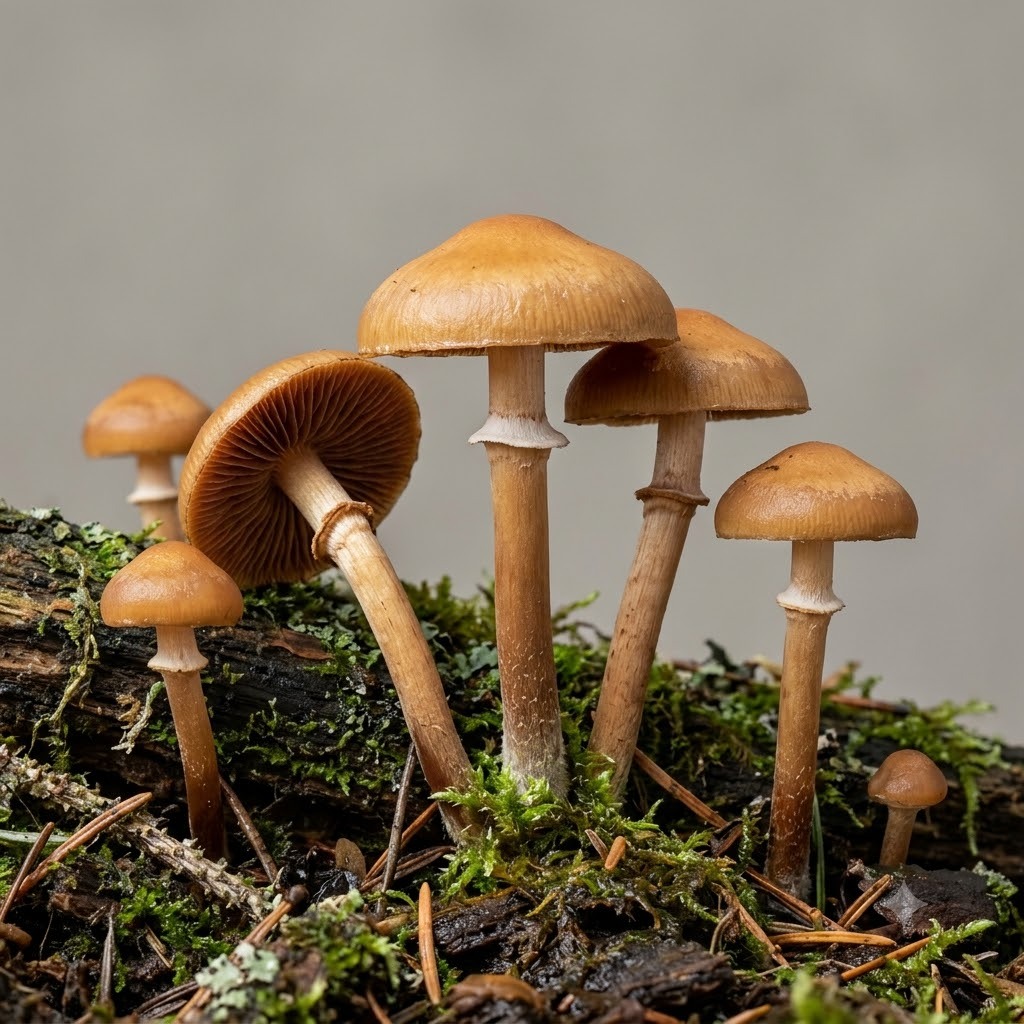
The funeral bell (Galerina marginata) is a small, plain, brown mushroom that grows in clusters on rotting wood and contains the same amatoxins as the death cap.
🗓️ Last reviewed: August 2026
Overview
The funeral bell (Galerina marginata) is a small, plain, brown mushroom that grows in clusters on rotting wood and contains the same amatoxins as the death cap. It is the reason experienced foragers refuse to gather small brown mushrooms from logs, and the reason beginner guides carry a blanket warning about the entire category. It has killed people who mistook it for the sheathed woodtuft, for honey fungus, for velvet shank, and for psilocybin-containing species, and every one of those confusions is documented. Nothing about it looks dangerous. It is small, dull, and utterly ordinary, and that is precisely the problem.
Identification & Appearance
Caps are 1.5-4 cm across, tawny to date-brown or ochre, smooth, and hygrophanous, fading dramatically as they dry so that a single cluster shows caps of several different shades. They are convex then flattening, often with a low central bump. Gills are pale then rusty brown, adnate to slightly decurrent. The stem is slender, brownish, darkening towards the base, smooth or silky below the ring with no scales, and carries a thin membranous ring that is often darkened by fallen spores and can disappear entirely in older specimens. Spore print is rust-brown. The smell is mealy or faintly farinaceous. The single most important comparison is with the edible sheathed woodtuft, which has distinct dark recurved scales on the stem below the ring; the funeral bell does not.
Where It Grows
Funeral bells are wood decayers, fruiting in clusters or scattered groups on rotting conifer and hardwood logs, stumps, buried wood, and wood chips, and they are common in gardens and parks as well as woodland, particularly on landscaping bark and wood-chip mulch. The season runs from spring through late autumn, peaking in autumn. The species complex is widespread across Europe, North America, and Asia. Their presence on garden wood chip is worth knowing about, because that puts a lethal mushroom in ordinary domestic settings where children play, and because it can fruit alongside other small brown mushrooms that hobbyists collect.
Can It Be Grown
No, and the question should not arise. It is a wood decayer and could in principle be cultured, and it must never be. If it appears on garden mulch or a stump where children or pets have access, remove the fruit bodies with gloves and dispose of them sealed, and be aware that the same mulch will produce more after rain. The genuinely useful protection is the household rule that nothing growing in the garden is picked or eaten by anyone, ever, and that any wild mushroom brought home is identified by someone competent before it goes near food.
Growing Conditions
Light
Not relevant to the fungus, which fruits from rotting wood in shade or open ground, including garden wood-chip beds in full sun.
Watering
Fruiting follows rain across a long season from spring to late autumn. Wood-chip mulch that stays damp produces repeated flushes, which is why garden beds can carry it year after year.
Temperature & Substrate
Fruiting spans roughly 5-20°C from spring to late autumn. The substrate is rotting wood of conifers and hardwoods, including logs, stumps, buried roots, and landscaping wood chip.
Why It Is Not Food
The funeral bell contains amatoxins, principally alpha-amanitin, the same toxins as the death cap. They inhibit RNA polymerase II, halting protein synthesis and destroying liver tissue, and they are not destroyed by cooking, drying, or freezing. A small number of these little mushrooms can contain a dangerous dose. There is no home test, no reliable colour reaction, and no safe rule of thumb. The species has been implicated in fatal poisonings across Europe and North America, in several cases involving people who believed they had gathered an edible clustered wood mushroom, which is exactly what it resembles.
Health & Poisoning Pattern
Amatoxin poisoning follows its characteristic pattern: no symptoms at all for six to twenty-four hours, then severe vomiting, watery diarrhoea, and abdominal pain, then an apparent recovery lasting a day or two, then liver failure with jaundice and bleeding problems, sometimes accompanied by kidney damage. That deceptive middle phase is why victims have been sent home from hospital and returned critically ill. If there is any possibility that someone has eaten a small brown mushroom from wood, go to an emergency department immediately, before symptoms start, and bring the remaining material. Say clearly what was eaten and when. Early treatment substantially improves outcomes.
Common Identification Traps
- Confusion with sheathed woodtuft - the deadliest confusion. Check the stem below the ring: scales mean woodtuft, smooth or silky means funeral bell.
- Confusion with honey fungus - honey fungus has a white spore print; the funeral bell's is rust-brown. Take the print.
- Confusion with velvet shank - velvet shank has a white spore print, no ring, and a dark velvety stem.
- Confusion with psilocybin species - well documented and repeatedly fatal. Small brown mushrooms on wood are the highest-risk category there is.
- Hygrophanous colour change - cap colour varies within a single cluster and cannot be used for identification.
The Rule That Prevents This
Do not gather small brown mushrooms from wood. That is the rule, and for the overwhelming majority of foragers it should be permanent. If you have a specific reason to work in this category, take a spore print of every collection, examine each individual fruit body for scales on the stem below the ring, never mix collections from different logs, and have an experienced identifier check the lot. The consequence of one error here is liver failure, and no meal justifies that risk.
Best Suited For
- Learning to recognise, so the whole category can be avoided.
- Teaching why blanket beginner rules about small brown mushrooms exist.
Not food under any circumstances. Cooking, drying, and freezing do not help.
FAQ
How do I tell it from the sheathed woodtuft? The stem below the ring. Sheathed woodtuft has distinct dark recurved scales; the funeral bell is smooth or silky. Both have rust-brown spore prints, so the print alone will not separate them.
Is it as dangerous as a death cap? It contains the same class of toxin. It is smaller, so more fruit bodies are needed for a lethal dose, but poisonings have been fatal.
Could it be growing in my garden? Quite possibly. It fruits readily on landscaping wood chip and bark mulch, which puts it in ordinary gardens and parks.
Never gather small brown mushrooms from wood. This is the category where beginner mistakes are fatal. Learn this species so you can recognise the risk, and leave the whole group alone.
🪴 Foraging kit worth a look
Nothing here identifies a mushroom for you - identification stays with your field guides and local experts. These are simply the basics foragers carry.
Links go to Amazon or a partner store (such as Adagio Teas) and may earn us a commission at no extra cost to you. As an Amazon Associate we earn from qualifying purchases. We link gear types, not sponsors' picks: you choose the exact product.