Honey Fungus
Honey fungus (Armillaria mellea and its close relatives) is two things at once: one of the most destructive tree pathogens in temperate gardens and forests, and an edible mushroom gathered in quantity across eastern Europe every autumn.
🗓️ Last reviewed: August 2026
Overview
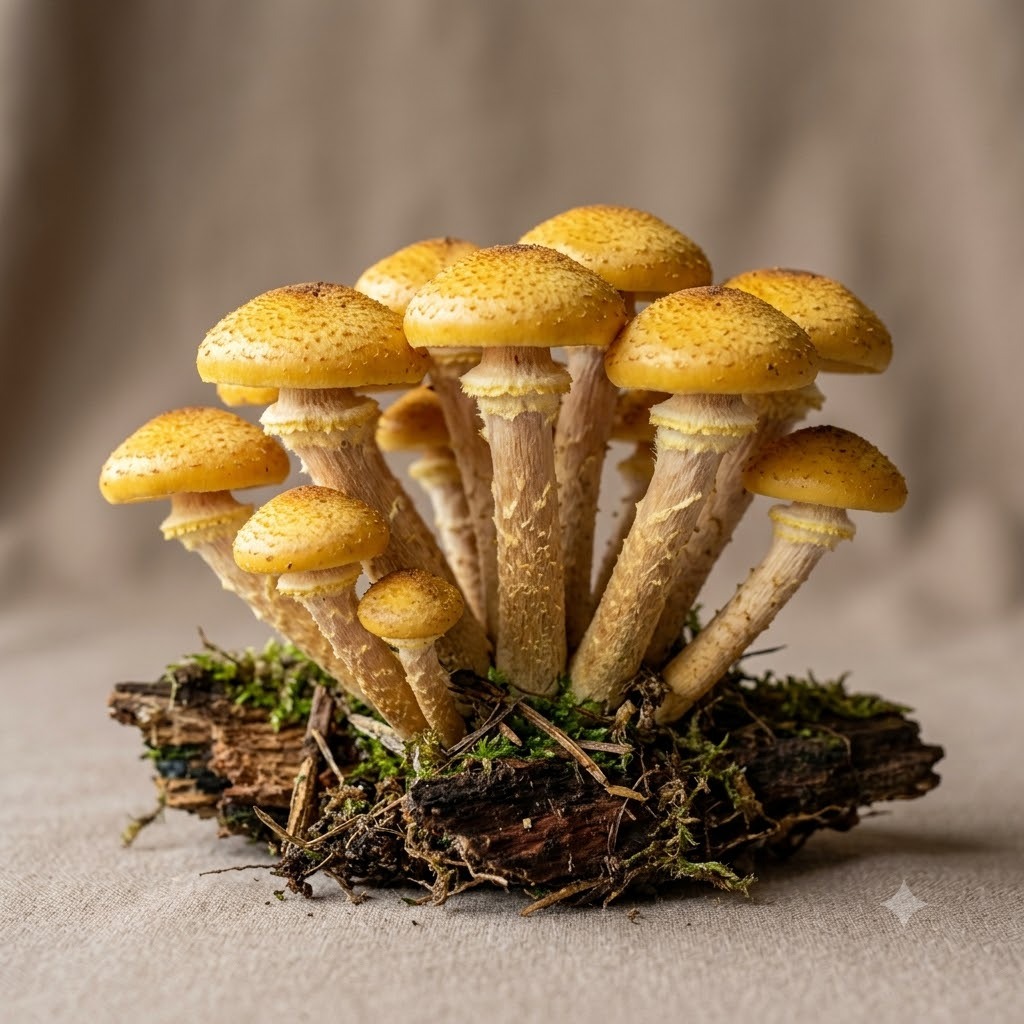
Honey fungus (Armillaria mellea and its close relatives) is two things at once: one of the most destructive tree pathogens in temperate gardens and forests, and an edible mushroom gathered in quantity across eastern Europe every autumn. It kills apple trees, hedges, ornamental shrubs, and mature forest trees by attacking living roots, spreading between them through black bootlace-like cords called rhizomorphs, and it is the reason many gardeners come to hate a mushroom for the first time. It is also delicious in a bland, meaty way when young and properly cooked, and it fruits in spectacular clusters that can fill a basket from one stump. The complication is that a meaningful proportion of people cannot digest it, and that its deadly look-alike grows on the same wood.
Identification & Appearance
Caps are 3-15 cm across, honey-yellow to tawny or olive-brown, often darker in the centre and covered in fine dark hairy scales, especially when young. Gills are white to cream, ageing pinkish then rust-spotted, and slightly decurrent, running a little way down the stem. The stem is tough and fibrous, paler above and darkening below, and it carries a prominent whitish woolly ring high up, which is one of the key features. Clusters are dense and often huge, growing from stumps, root plates, and the bases of living trees. The flesh is white. Spore print is white, and this is the critical check: the deadly funeral bell (Galerina marginata) grows on the same dead wood, has a ring, and superficially resembles a small honey fungus, but has a rust-brown spore print. Black bootlace rhizomorphs under nearby bark confirm Armillaria but are not always visible.
Where It Grows
Honey fungus attacks and then decays the roots and lower trunks of a very wide range of broadleaved and coniferous trees and shrubs. It fruits in dense clusters at the base of infected trees, on stumps, and from buried roots in lawns and borders, mainly in autumn after the first cool wet weather. Several species are involved and their aggressiveness differs, with some behaving mainly as decomposers of dead wood and others as active killers of living trees. The genus is distributed worldwide. One relative, Armillaria ostoyae, forms the famous enormous clonal colony in the Blue Mountains of Oregon, an individual fungus covering several square kilometres and regarded as one of the largest organisms on Earth, which gives some sense of how far a single mycelium can travel underground.
How to Grow at Home
Nobody should try, and this is the rare mushroom where the advice is the opposite of encouragement. Honey fungus is a serious pathogen; deliberately introducing it to a garden risks killing trees, hedges, and shrubs across the plot and, since it spreads through root contact and rhizomorphs, into neighbouring gardens. It is not commercially cultivated for exactly this reason. If it appears in your garden the appropriate response is management, not harvesting: remove infected stumps and root systems where practical, since the fungus lives on in them, avoid replanting susceptible species in the same ground, and consider a physical root barrier around valuable specimens. Enjoying the mushrooms from an infected stump is a small consolation prize, not a reason to keep the infection.
Growing Conditions
Light
Not relevant to the fungus. It lives in roots and wood, fruiting at the base of infected trees in shade or open ground alike.
Watering
Fruiting follows the first substantial autumn rain and a drop in temperature, often producing a sudden mass flush over a few days. Damp ground favours spread through rhizomorphs.
Temperature & Substrate
Fruiting spans roughly 5-16°C in autumn. The substrate is living and dead tree roots, stumps, and lower trunks of a very wide range of hosts, both hardwood and conifer.
Culinary Use
Honey fungus is widely eaten in eastern Europe, Russia, and the Baltics, where it is one of the great autumn harvests, usually pickled or salted in quantity. Take only young caps with the veil still intact or newly broken; discard all stems, which are tough and fibrous. The critical step is cooking. Honey fungus must be thoroughly cooked, and the standard practice is to parboil for at least five to ten minutes, discard the water, and then fry or pickle. Raw or undercooked honey fungus causes significant gastrointestinal upset, and even properly cooked it disagrees with a proportion of people, which appears to be individual sensitivity rather than a preparation failure. Anyone eating it for the first time should have a small portion and wait a day. The flavour is mild and slightly nutty, and it takes pickling brine and strong seasoning very well.
Health & Nutrition
Nutritionally it is a typical gilled mushroom: low calorie, some protein and fibre, B vitamins, and trace minerals. The health story is about preparation and tolerance. Undercooked honey fungus is a reliable cause of vomiting and diarrhoea, and this is not a rare quirk but a documented property of the species; alcohol is often reported to worsen reactions. Some people cannot tolerate it however it is cooked. That combination means it belongs to the group of mushrooms that are eaten widely in some cultures and treated cautiously in others, and there is no contradiction in that: the eastern European tradition includes the parboiling step as standard. The other consideration is the look-alike. Funeral bell contains amatoxins, the same class of toxin as the death cap, and grows on the same dead wood.
Common Problems
- Confusion with funeral bell - potentially fatal. Take a spore print: honey fungus is white, funeral bell is rust-brown. Never take small ringed brown mushrooms from wood casually.
- Stomach upset after eating - either undercooked or individual intolerance. Always parboil and discard the water; stop permanently if you react.
- Tough, fibrous stems - normal. Use caps only.
- Trees dying across the garden - the real problem with this species. Identify infected stumps and roots and remove them if practical.
- Old rust-spotted specimens - past their best and more likely to cause upset. Take young caps only.
Pros & Cons
Pros
- Fruits in enormous quantity from a single stump.
- Traditional pickling mushroom with a long culinary history.
- Distinctive clustered habit and ringed stem.
- Reliable autumn timing after the first cold rain.
Cons
- A destructive tree pathogen that no gardener should encourage.
- Must be parboiled; undercooked specimens cause serious upset.
- A proportion of people cannot tolerate it at all.
- Shares habitat with the deadly funeral bell.
Best Suited For
- Experienced foragers in regions with a pickling tradition.
- Cooks who preserve large autumn hauls in brine or vinegar.
- Anyone who already has an infected stump and wants to make use of it.
Not ideal for beginners, anyone with a sensitive digestion, or gardeners hoping to keep their trees.
FAQ
Why must it be parboiled? Because inadequately cooked honey fungus reliably causes vomiting and diarrhoea. Boil for five to ten minutes, discard the water, then cook properly.
How do I avoid the funeral bell? Spore print, every time. Honey fungus gives a white print; the deadly funeral bell gives a rust-brown one. Both can grow on the same log.
Can I get rid of it in my garden? Partly. Removing infected stumps and root systems removes its food base, and root barriers can slow spread, but established infections in mature soil are very difficult to eliminate.
Never eat a honey fungus without 100% expert identification. Confirm the white spore print, ringed stem, clustered growth on wood, and pale gills with an experienced identifier, then parboil before cooking.
🪴 Foraging kit worth a look
Nothing here identifies a mushroom for you - identification stays with your field guides and local experts. These are simply the basics foragers carry.
Links go to Amazon or a partner store (such as Adagio Teas) and may earn us a commission at no extra cost to you. As an Amazon Associate we earn from qualifying purchases. We link gear types, not sponsors' picks: you choose the exact product.