Common Puffball
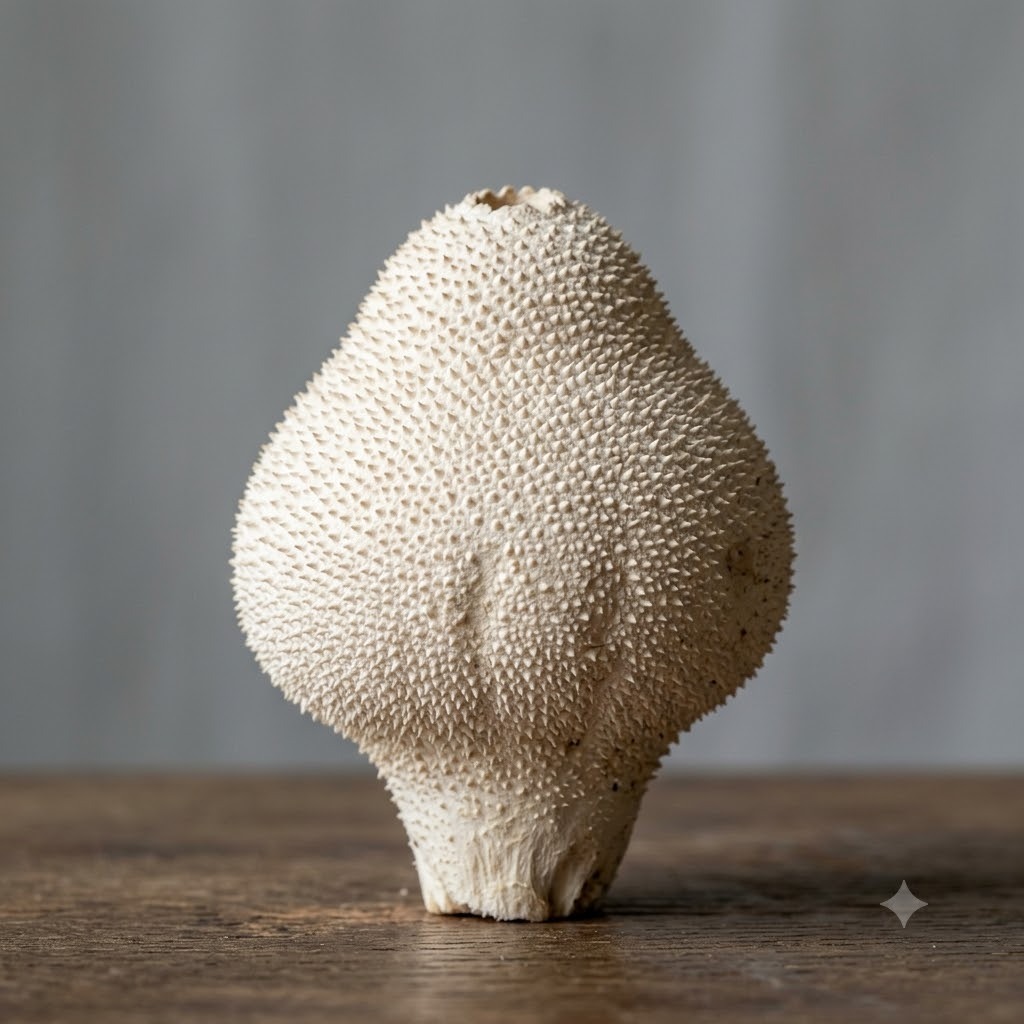
The common puffball (Lycoperdon perlatum) is the small, pear-shaped, spiny white fungus that stands in troops along woodland paths from late summer to late autumn, and puffs a cloud of brown spores when you press a mature one.
🗓️ Last reviewed: August 2026
Overview
The common puffball (Lycoperdon perlatum) is the small, pear-shaped, spiny white fungus that stands in troops along woodland paths from late summer to late autumn, and puffs a cloud of brown spores when you press a mature one. It is a good edible when young and pure white inside, mild and slightly nutty, with a texture between tofu and marshmallow that suits frying more than any other method. It is also one of the most important species for a beginner to learn properly, not because it is dangerous but because the safety rule that applies to it, cut every puffball in half before eating, is the same rule that prevents people eating the egg stage of a deadly Amanita by mistake.
Identification & Appearance
The fruit body is 2-7 cm across and 3-9 cm tall, pear or club shaped with a broad rounded top narrowing to a stalk-like base. The surface is white to pale grey-buff, covered in short conical spines and granules that rub off with handling, leaving a faint mesh pattern on the surface. As it matures it turns yellowish then brown and develops a pore at the top through which spores puff out when it is struck by rain, an animal, or a finger. The decisive test is internal: cut every specimen from top to bottom. Edible young puffballs are pure, uniform, marshmallow-white inside with no pattern whatsoever. Any yellow, olive, purple, or brown colouring inside means the spores have started to form and the mushroom is past eating. Any hint of a mushroom outline inside, a shadow of cap, gills, and stem, means it is not a puffball at all but the egg of an Amanita, potentially the deadly death cap or destroying angel.
Where It Grows
Common puffballs are saprotrophs of forest soil and litter, fruiting in conifer and broadleaved woodland, along paths and tracks, on mossy banks, in clearings, and sometimes on rotting wood. They favour disturbed ground and path edges and often appear in large troops or dense groups. The season is late summer to late autumn, and they persist long after they are edible, standing brown and papery through winter and puffing spores until they finally collapse. The species is widespread across Europe, Asia, North America, and beyond, and it is one of the most frequently encountered fungi in temperate woodland, which makes it a valuable teaching species for anyone starting out.
How to Grow at Home
Puffballs are not cultivated commercially and there is no home method. They are soil and litter saprotrophs whose nutritional requirements are not well understood in cultivation terms, and no spawn is sold. Scattering mature spore-filled puffballs on suitable woodland-edge ground is a common folk practice and occasionally coincides with fruiting a few years later, but there is no controlled evidence that it works. What does help is habitat: undisturbed woodland litter, path edges left unswept, and no fungicide. If you have woodland or a wooded garden edge, the species may well already be present and simply needs the ground left alone. Practically, this is a foraging species and the skills that matter are timing, since the edible window is short, and the discipline of cutting every single specimen open.
Growing Conditions
Light
Not relevant to the fungus itself. It fruits from litter and soil in shade, along woodland paths and in clearings, and the relevant condition is undisturbed leaf litter rather than any light regime.
Watering
Fruiting follows rain from late summer onwards. Puffballs respond quickly to a wet spell and can appear in large numbers within a week of good rain, then dry and mature fast in a following dry spell.
Temperature & Substrate
Fruiting spans roughly 5-20°C from late summer through autumn, continuing later into the year than many species. The substrate is forest litter and humus, sometimes rotting wood, and there is no home substitute.
Culinary Use
Puffballs must be picked young, when they are firm, pure white inside, and roughly the texture of a marshmallow. Peel or trim the outer skin if it is tough, slice into rounds or cubes, and fry in butter or oil; they brown well and take on the flavours around them. They soak up fat readily, so a light hand helps, and they are excellent breaded and fried, added to omelettes, or used as a soft component in a mixed mushroom dish. They do not dry well and do not keep more than a couple of days. The flavour is mild and slightly nutty rather than dramatic. Cook them thoroughly, and never eat one that shows any internal colour. It is also worth noting that puffball spores are an irritant if inhaled in quantity, so do not stand over a cloud of them, and there are recorded cases of respiratory illness from deliberately inhaling puffball spores.
Health & Nutrition
As food, puffballs are very low in calories, mostly water, with some protein, fibre, and trace minerals. They have a folk history as a wound dressing, and dried mature puffball tissue was used as a styptic in several traditions, though modern medicine has no place for that and the practice risks introducing spores into a wound. The genuine safety points are two. First, the identification rule: cut every one open, and discard any showing internal colour or the outline of a developing mushroom. Second, the spores: inhaling large quantities can cause a serious inflammatory lung reaction called lycoperdonosis, documented in cases where people deliberately breathed in spore clouds. Neither point makes the species dangerous to eat when picked young and checked properly.
Common Problems
- Yellow or olive inside - spores have begun to form. Past eating; discard.
- An outline of cap, gills, and stem inside - not a puffball but an Amanita egg, potentially deadly. Discard the whole collection and re-check everything else you have picked.
- Tough, leathery skin - older specimen or dry weather; peel it, or leave the mushroom.
- Soaking up too much oil in the pan - normal for the sponge-like texture; use a hot pan and less fat.
- Spore clouds when handling mature specimens - avoid inhaling; mature puffballs are not food anyway.
Pros & Cons
Pros
- Abundant, widespread, and easy to spot along woodland paths.
- The internal check is simple, decisive, and teaches good foraging discipline.
- Mild, pleasant flavour that takes seasoning well.
- Fruits late in the season when other species are finishing.
Cons
- Very short edible window; they yellow inside quickly.
- Poor keeping quality and does not dry.
- Spongy texture is not to everyone's taste.
- Can only be gathered, never grown.
Best Suited For
- Beginners learning safe foraging discipline with a forgiving species.
- Cooks who like breaded and fried mushrooms or mixed woodland fry-ups.
- Late-season foragers when the summer species have finished.
Not ideal for anyone wanting a mushroom that keeps, dries, or has a strong flavour.
FAQ
Why must I cut every single one open? Because the egg stage of a deadly Amanita looks like a small white puffball from the outside. Cutting it in half reveals the outline of a developing cap and stem inside, which no true puffball has.
Can I eat one that is yellow inside? No. Yellow, olive, or brown inside means spores are forming. The taste turns unpleasant and the texture goes powdery. Only pure white flesh is edible.
Are giant puffballs the same thing? They are relatives, much larger and treated the same way in the kitchen, and the same internal check applies: pure white flesh only.
Never eat a puffball without 100% expert identification. Cut every specimen from top to bottom, confirm uniform white flesh with no internal pattern, and have an experienced identifier confirm your first collections.
🪴 Foraging kit worth a look
Nothing here identifies a mushroom for you - identification stays with your field guides and local experts. These are simply the basics foragers carry.
Links go to Amazon or a partner store (such as Adagio Teas) and may earn us a commission at no extra cost to you. As an Amazon Associate we earn from qualifying purchases. We link gear types, not sponsors' picks: you choose the exact product.