Deadly Webcap
The deadly webcap (Cortinarius rubellus, and its close relative the fool's webcap Cortinarius orellanus) is the mushroom that poisons you slowly.
🗓️ Last reviewed: August 2026
Overview
The deadly webcap (Cortinarius rubellus, and its close relative the fool's webcap Cortinarius orellanus) is the mushroom that poisons you slowly. It contains orellanine, a toxin that attacks the kidneys, and its defining and most dangerous feature is the delay: symptoms may not appear for two to three weeks after the meal, by which time nobody connects the illness to a mushroom eaten a fortnight ago and irreversible kidney damage is already under way. Its most publicised case involved the novelist Nicholas Evans, author of The Horse Whisperer, who in 2008 ate webcaps gathered in Scotland along with three relatives; all four suffered kidney failure, and he later received a kidney transplant.
Identification & Appearance
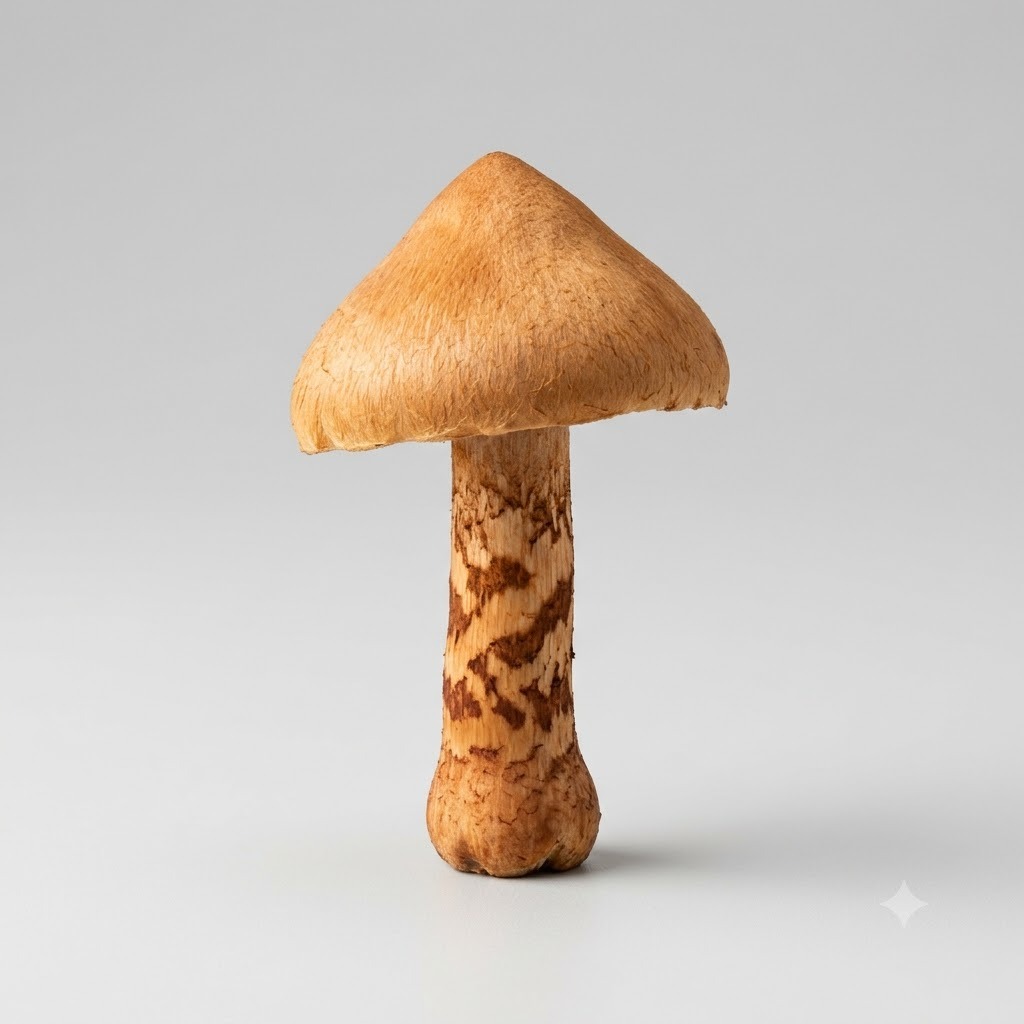
Caps are 3-8 cm across, tawny orange-brown to foxy red-brown, dry, finely fibrous or slightly scaly, conical then flattening with a persistent pointed central bump. Gills are widely spaced, thick, and the same rusty orange-brown as the cap, darkening with age. The stem is slender, yellowish to tawny, usually with faint pale yellowish bands or fibrous girdles left by the veil. The genus feature is the cortina, a cobweb-like veil of fine fibres stretching from cap edge to stem in young specimens, which collapses onto the stem and is often marked by a rusty band of trapped spores. Spore print is rust-brown. The smell is faintly radish-like. Nothing about the mushroom warns of danger, and species-level identification within Cortinarius is notoriously difficult even for specialists.
Where It Grows
Deadly webcaps are mycorrhizal, associating with conifers, especially spruce and pine, and with birch, and they favour damp mossy woodland on acidic soils. Cortinarius rubellus is a species of northern and montane conifer forest, common in Scandinavia, Scotland, the Baltics, and mountain forests further south, while Cortinarius orellanus is more associated with broadleaved woodland in central and southern Europe. Both fruit from late summer through autumn. The genus Cortinarius is enormous, with hundreds of species in Europe alone, most of them brown, most of them impossible to separate without expert knowledge, and a number of them containing orellanine.
Can It Be Grown
No. It is mycorrhizal and cannot be cultivated, and there would be no conceivable reason to try. The relevant knowledge here is not cultivation but avoidance: the entire genus Cortinarius should be treated as off-limits by anyone who is not a specialist, and that is standard advice in every serious foraging guide. It is one of the few genera where blanket avoidance is genuinely the professional recommendation rather than beginner caution, because the toxic species cannot be reliably separated from the harmless ones by field characters alone.
Growing Conditions
Light
Not relevant to the fungus, which lives on tree roots and fruits in damp mossy woodland shade.
Watering
Fruiting follows late summer and autumn rain in damp acidic woodland. In wet years webcaps can be abundant in exactly the mossy conifer woodland where people hunt chanterelles and boletes.
Temperature & Substrate
Fruiting spans roughly 5-18°C from late summer into autumn. The substrate is damp acidic woodland soil and moss around living spruce, pine, and birch roots.
Why It Is Not Food
Deadly webcaps contain orellanine, a bipyridine toxin that specifically damages the kidneys, causing tubular necrosis and often irreversible renal failure. It is not destroyed by cooking, drying, or freezing. The most dangerous feature is pharmacological rather than chemical: the latency period runs from about two days to three weeks, most often around one to two weeks, so there is no immediate warning and no association in the victim's mind between the meal and the illness. By the time thirst, nausea, back pain, and reduced urine output appear, substantial kidney damage has occurred. Many victims require dialysis, and some require transplantation.
Health & Poisoning Pattern
The pattern is: eat, feel entirely normal for days or weeks, then develop intense thirst, frequent urination followed by reduced output, nausea, vomiting, loss of appetite, headache, fatigue, and pain in the flanks or lower back. Blood tests show rising creatinine and failing kidney function. Treatment is supportive; there is no antidote, dialysis may be needed, and recovery of kidney function is uncertain, with permanent damage and transplantation both documented outcomes. Anyone who realises they may have eaten a webcap, even weeks earlier, should seek medical assessment immediately and say exactly what was eaten and when. Do not wait for symptoms.
Common Identification Traps
- Confusion with edible species - the Nicholas Evans party took webcaps for ceps (a mistake a gill check would have caught - ceps have pores, not gills), while in Scandinavia and a 1979 Scottish case webcaps were mistaken for chanterelles. Chanterelles have blunt forking ridges, pale flesh, and a pale spore print; webcaps have true gills and rust-brown spores.
- Confusion with edible brown mushrooms generally - webcaps look like a great many ordinary brown woodland mushrooms.
- The genus problem - Cortinarius contains hundreds of species that cannot be separated reliably in the field. Even a correct genus identification does not make a species safe.
- No immediate illness - eating some and feeling fine the next day means nothing at all with this toxin.
- Missing the cortina - the cobweb veil is present only in young specimens and collapses early, leaving only a rusty band.
The Rule That Prevents This
Take a spore print of anything you plan to eat, and treat every rust-brown spore print from a gilled woodland mushroom as a reason to stop. Then go further: avoid the genus Cortinarius entirely. Look for the cobweb veil in young specimens and the rusty band on the stem in older ones, and if either is present, put the mushroom back. This is one of the rare cases where the correct advice to essentially everyone, including many experienced foragers, is to leave an entire genus alone permanently.
Best Suited For
- Learning to recognise the cortina and the rust-brown spore print so the genus can be avoided.
- Understanding why delayed-onset poisonings are the most dangerous kind.
Not food under any circumstances. No preparation makes it safe.
FAQ
How long before symptoms appear? Usually one to two weeks, sometimes as little as two days or as long as three weeks. That delay is what makes this toxin so dangerous.
Is the damage permanent? Often. Many victims require dialysis, and kidney transplantation has been necessary in documented cases, including a well-publicised one in the UK.
Can an expert tell webcap species apart? Specialists can separate some, using microscopy and chemistry. In the field, with hundreds of similar brown species, the honest answer for almost everyone is no.
Never eat any mushroom with a cobweb veil and rust-brown spores. Avoid the entire genus Cortinarius. Take spore prints, look for the cortina, and if in any doubt, do not eat it.
🪴 Foraging kit worth a look
Nothing here identifies a mushroom for you - identification stays with your field guides and local experts. These are simply the basics foragers carry.
Links go to Amazon or a partner store (such as Adagio Teas) and may earn us a commission at no extra cost to you. As an Amazon Associate we earn from qualifying purchases. We link gear types, not sponsors' picks: you choose the exact product.