Brown Roll-Rim
The brown roll-rim (Paxillus involutus) is the mushroom that punishes loyalty.
🗓️ Last reviewed: August 2026
Overview
The brown roll-rim (Paxillus involutus) is the mushroom that punishes loyalty. For most of the twentieth century it was gathered and eaten across central and eastern Europe, sold in markets, and printed in guides as edible after cooking. Then the mechanism of its toxicity became clear, and it turned out to be one of the strangest in mycology: the fungus sensitises the immune system over repeated meals, and at some unpredictable point the body begins destroying its own red blood cells. People who had eaten it safely dozens of times died. It is now classed as poisonous everywhere, and it stands as the clearest possible argument against the idea that eating a mushroom safely once proves anything at all.
Identification & Appearance
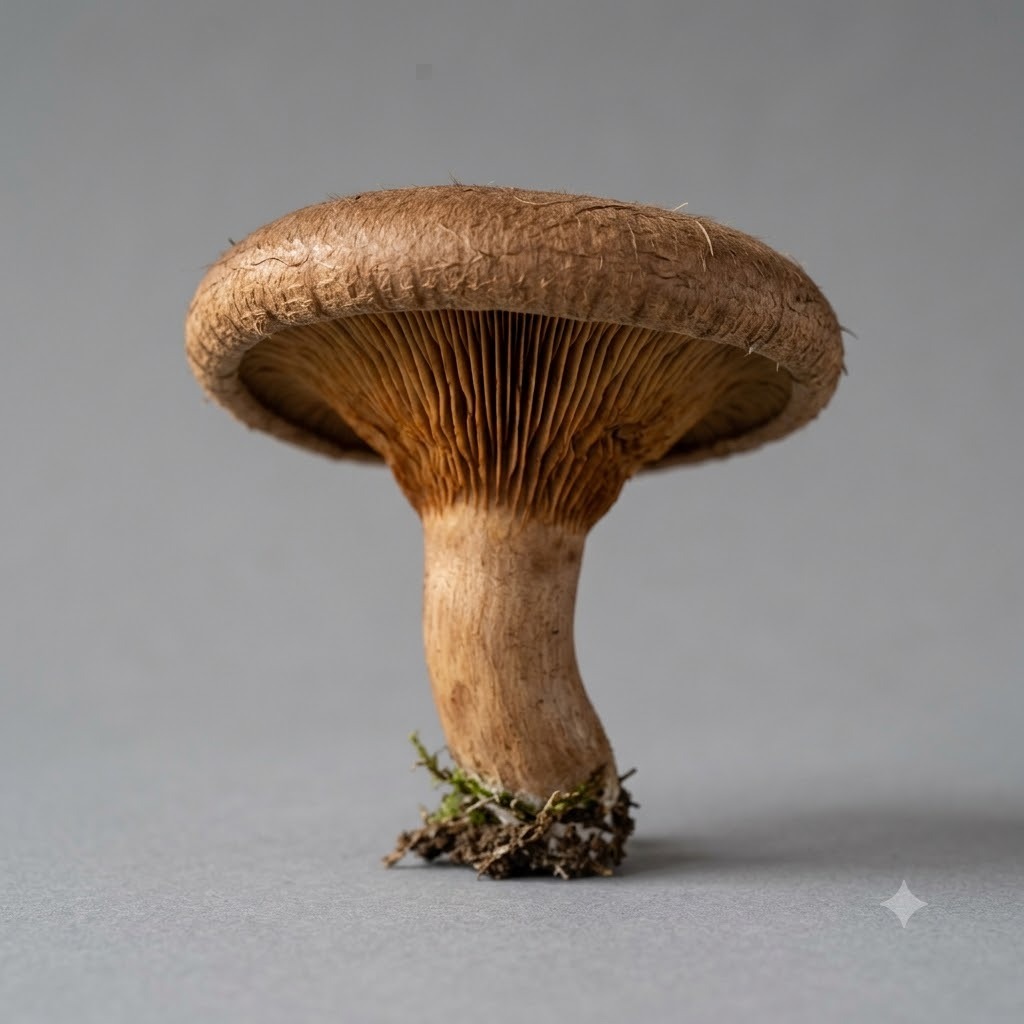
The cap is 5-15 cm across, ochre to olive-brown or rusty brown, slightly downy when young and becoming smooth and sticky when damp, and it is funnel-shaped in maturity. The defining feature is the margin: strongly inrolled, rolled under like a scroll, and it stays that way well into maturity, which is where the common name comes from. Gills are pale ochre to yellowish-brown, crowded, decurrent, running well down the stem, and they can be rubbed or peeled away from the cap flesh with a thumb, which is unusual. Critically, the gills and flesh bruise dark reddish-brown wherever they are touched or damaged, and the marks appear within minutes. The stem is short, stout, and the same colour as the cap or paler. Spore print is ochre to snuff brown.
Where It Grows
Brown roll-rims are ectomycorrhizal, associating with birch above all, and also with pine, spruce, willow, and other trees. They fruit from summer through late autumn in woodland, on heaths, in parks and gardens with birch, and on damp acidic ground, often in large numbers. They are extremely common across Europe, and have been introduced to other continents with planted trees, notably in Australia and New Zealand. The habitat overlaps heavily with the birch boletes and other species that foragers gather, and the mushroom is abundant enough that anyone walking in birch woodland in autumn will meet it repeatedly.
Can It Be Grown
No, and no one should want to. It is mycorrhizal and not cultivable. Where it appears in a garden with birch it is doing normal ecological work with the tree roots and can be left alone, with the fruit bodies removed if small children have access. The important knowledge is historical and behavioural rather than horticultural: this species is the standard example used to explain why traditional edibility claims need re-examining, and why individual experience of eating a wild mushroom safely says nothing whatsoever about whether it is safe.
Growing Conditions
Light
Not relevant to the fungus, which lives on tree roots and fruits in woodland, heath, park, and garden shade or open ground according to its host.
Watering
Fruiting follows summer and autumn rain, sometimes producing very large flushes under birch. In wet autumns it can be one of the most abundant mushrooms present.
Temperature & Substrate
Fruiting spans roughly 8-20°C from summer into late autumn. The substrate is acidic soil around living birch, pine, spruce, and willow roots, often on damp mossy ground.
Why It Is Not Food
Two separate problems. First, the mushroom is directly irritating to the gut when raw or undercooked, causing vomiting and diarrhoea, which is why traditional practice always insisted on thorough cooking. Second, and far more serious, is Paxillus syndrome: repeated exposure sensitises the immune system, which produces IgG antibodies that bind to an antigen from the mushroom. On a later meal, immune complexes form on the surface of red blood cells and trigger complement-mediated destruction of those cells. The result is acute haemolytic anaemia, which can progress to kidney failure, shock, and death. The trigger antigen has never been fully characterised despite decades of research, and there is no way to predict who will be affected or when. Cooking does not prevent it.
Health & Poisoning Pattern
An acute Paxillus reaction begins within one to two hours of a meal: vomiting, diarrhoea, and abdominal pain, followed by signs of haemolysis, including dark or red-brown urine, jaundice, pallor, breathlessness, and collapse. Blood tests show falling haemoglobin and evidence of red cell destruction, and acute kidney injury can follow. Treatment is supportive and may include transfusion and dialysis; there is no antidote, and fatalities have been documented, the best-known being the German mycologist Julius Schäffer, who died in 1944 after a meal of this species; the immune mechanism was only worked out decades later, and the mushroom was formally reclassified as poisonous in the 1980s. Anyone who becomes ill after eating this mushroom, especially with dark urine, must go to hospital immediately and say what was eaten. Anyone who has eaten it regularly should stop permanently.
Common Identification Traps
- Old guidebooks - many older European field guides list it as edible after cooking. Those books are out of date and should not be trusted on this species.
- Family tradition - the most dangerous trap here. People have died from a dish they had eaten safely for years, because sensitisation builds silently.
- Confusion with edible brown funnel-shaped mushrooms - check for the inrolled margin, the decurrent gills that rub away from the cap, and the dark reddish-brown bruising.
- Assuming cooking makes it safe - cooking addresses the gut irritation, not the immune mechanism.
- Assuming a single safe meal proves safety - it proves the opposite of nothing. Sensitisation requires exposure.
The Rule That Prevents This
Do not eat brown roll-rims, and be sceptical of any wild food advice that rests on the phrase we have always eaten these. Check the field guides you rely on for their publication date, since edibility ratings genuinely change as evidence accumulates. For identification, learn the three features together: strongly inrolled cap margin, decurrent gills that separate from the cap flesh, and dark reddish-brown bruising on gills and flesh. Then leave it where it grows.
Best Suited For
- Learning to recognise, so it can be avoided permanently.
- Teaching why traditional edibility is not evidence of safety.
- Understanding delayed and immune-mediated mushroom toxicity.
Not food. Cooking does not prevent Paxillus syndrome, and previous safe meals do not predict the next one.
FAQ
My grandparents ate these for years. Were they lucky? Effectively yes. Sensitisation builds silently over repeated meals and the reaction, when it comes, is sudden and severe. Documented fatalities have occurred in exactly that pattern.
Does thorough cooking make it safe? No. Cooking reduces the direct gut irritation, but the immune-mediated haemolysis is a separate mechanism that cooking does not address at all.
How would I know a reaction was happening? Vomiting and diarrhoea within a couple of hours, followed by dark or red-brown urine, pallor, jaundice, and breathlessness. That combination is a medical emergency.
Never eat a brown roll-rim. It is classed as poisonous throughout Europe today, regardless of what older guides or family tradition say. Learn it, and leave it.
🪴 Foraging kit worth a look
Nothing here identifies a mushroom for you - identification stays with your field guides and local experts. These are simply the basics foragers carry.
Links go to Amazon or a partner store (such as Adagio Teas) and may earn us a commission at no extra cost to you. As an Amazon Associate we earn from qualifying purchases. We link gear types, not sponsors' picks: you choose the exact product.