Birch Polypore
The birch polypore (Fomitopsis betulina, long known as Piptoporus betulinus) is the smooth white to pale brown bracket that grows on dead and dying birch and almost nowhere else.
🗓️ Last reviewed: August 2026
Overview
The birch polypore (Fomitopsis betulina, long known as Piptoporus betulinus) is the smooth white to pale brown bracket that grows on dead and dying birch and almost nowhere else. It is one of the most common fungi in northern woodland and one of the most useful to people who are not looking for dinner: it is far too corky and bitter to be a food mushroom, but it has a long documented history as a wound dressing, a razor strop, a firelighting material, and a folk remedy. It is also part of one of archaeology's better stories. Ötzi, the 5,300-year-old man found frozen in the Alps in 1991, carried pieces of birch polypore threaded on a leather strap, and researchers have argued about what he used them for ever since.
Identification & Appearance
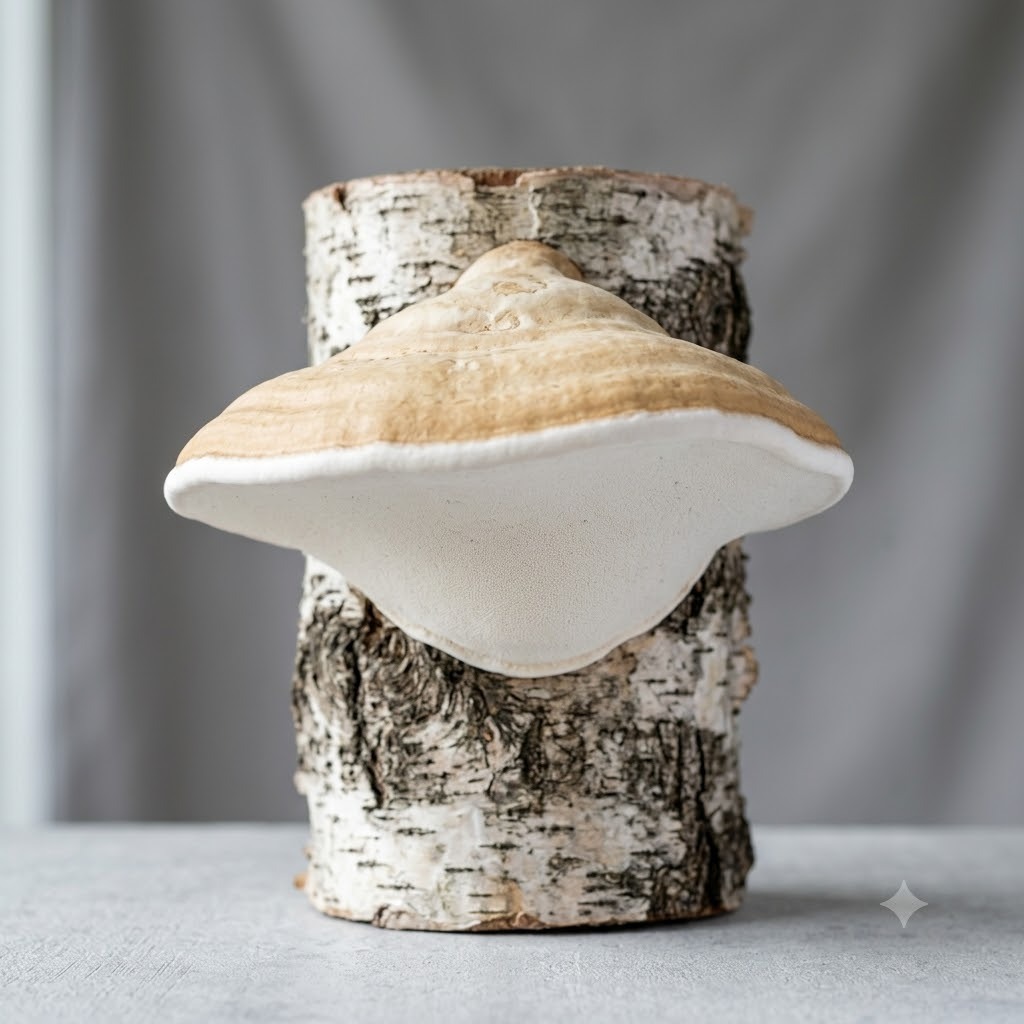
The fruit body is a smooth, hoof-shaped or kidney-shaped bracket 5-25 cm across, attached to the trunk by a short thick lateral stub or directly by its side. The upper surface is smooth, thin-skinned, and pale grey-brown to buff, often cracking in older specimens, with a distinctly rounded inrolled margin. The underside is a white pore surface with very fine pores, roughly three to five per millimetre, that darken slightly with age and bruise faintly. The flesh is white, thick, corky, and rubbery when fresh, drying hard and light. It smells faintly mushroomy and tastes bitter. Spore print is white. Growth on birch is effectively diagnostic; this species is essentially restricted to birch, so host tree plus smooth pale bracket plus fine white pores identifies it reliably.
Where It Grows
Birch polypore is a saprotroph and weak parasite of birch, causing a brown rot in the heartwood, and it fruits on dead standing birches, fallen trunks, and stressed living trees. It is extremely common wherever birch grows, across Europe, northern Asia, and North America. New brackets form annually from late summer through autumn, and old ones persist on trunks for a year or more, going hard and grey. A dead birch will often carry a whole ladder of brackets up its trunk. Because birch is a short-lived pioneer tree that dies in large numbers as woodland matures, this fungus is one of the main agents recycling it, and finding it is usually a matter of walking through any birch stand with dead trees in it.
How to Grow at Home
There is no commercial cultivation and no reason for one, since the fruit body is not a food. As a birch-wood saprotroph it can in principle be cultured, and material for tea and tincture making is generally wild-harvested. If you have birch on your land, dead standing birches and fallen trunks will produce it on their own within a few years, and leaving them in place is the whole method. This has real ecological value beyond the fungus, since standing dead birch supports woodpeckers, insects, and a long list of other species. If you want to harvest for craft or tea use, take young soft brackets in late summer and autumn, cut cleanly, and leave plenty on the trunk.
Growing Conditions
Light
Not relevant to the fungus, which lives inside birch wood and fruits from the trunk in shade or open woodland alike. The only requirement is dead or dying birch.
Watering
New brackets form after late summer and autumn rain. Once formed they are tough and persist through dry weather, hardening over the winter into the pale corky discs that stay on the trunk for a year or more.
Temperature & Substrate
Brackets form mainly in late summer and autumn, roughly 8-20°C, and persist year-round. The substrate is birch heartwood, dead or dying, standing or fallen. It will not grow on other tree species in practice.
Traditional & Practical Uses
This is not a culinary mushroom. It is corky, bitter, and unpleasant to chew, and nobody eats it as food. What it has instead is a long list of practical uses, several of them well documented. Thin strips of the dried flesh were used as a razor strop, giving the alternative name razor strop fungus, because the fine-textured surface polishes a blade. Dried, it takes a spark and smoulders, so it was used in firelighting kits. Cut into strips, the fresh flesh has been used as an improvised plaster or wound dressing, and it does have antibacterial compounds in laboratory tests, which is presumably why the practice persisted. Modern use is mostly as a tea or tincture, made by simmering dried slices, which produces a bitter, mild, mushroom-flavoured drink.
Health & Nutrition
Birch polypore has been studied for compounds including polyporenic acids, betulinic acid derived from its birch host, and various polysaccharides, and laboratory work has reported antibacterial, anti-inflammatory, and antiparasitic activity. Two things are true at once here. The research is real and interesting, and it is overwhelmingly laboratory and animal work rather than clinical evidence in people, so nothing about it supports treating this fungus as a medicine. The Ötzi connection is often cited as proof that it was used medicinally 5,300 years ago, and it may have been, but researchers have also proposed firelighting and other practical uses for what he carried; the honest answer is that we do not know. Anyone with a health condition should talk to a doctor rather than a mushroom. Do not put fungal tissue on an open wound.
Common Problems
- Expecting it to be edible - it is not. Corky, bitter, and inedible as food.
- Harvesting old hard brackets - year-old brackets are woody and of little use. Take young soft ones in late summer and autumn.
- Confusion with other brackets - check the host. Birch polypore is essentially restricted to birch, with a smooth pale skin and very fine white pores.
- Treating it as medicine - laboratory findings are not clinical evidence, and self-treating a real condition with a woodland fungus is a bad idea.
- Using it on wounds - a historical practice, not a modern one. It risks infection.
Pros & Cons
Pros
- Extremely common and easy to identify by host tree alone.
- Genuinely useful for craft: strops, tinder, and cordage-adjacent uses.
- Interesting subject of laboratory research with a documented archaeological history.
- Harvesting has minimal ecological impact when done lightly.
Cons
- Not edible in any meaningful sense.
- Bitter and unpleasant as a tea for many people.
- Health claims far outrun the evidence.
- Old brackets are woody and useless.
Best Suited For
- Bushcraft and traditional craft enthusiasts.
- Naturalists learning bracket fungi and deadwood ecology.
- Anyone curious about the archaeology of fungal use.
Not ideal for cooks, or anyone seeking a mushroom with proven medical benefit.
FAQ
Can I eat it? No, not as food. It is corky and bitter. Some people simmer dried slices as a bitter tea, which is a different proposition from eating it.
What did Ötzi use it for? Nobody knows for certain. Medicinal use has been proposed, as has firelighting and other practical use. The pieces were found threaded on a leather strap, which is suggestive but not conclusive.
Is it a threat to my birch trees? It mainly colonises dead and dying wood and stressed trees. Its presence on a living birch usually indicates the tree is already in decline rather than that the fungus caused it.
Never eat any bracket fungus without 100% expert identification. Confirm the birch host, smooth pale upper surface, and very fine white pores with an experienced identifier before using it for anything.
🪴 Foraging kit worth a look
Nothing here identifies a mushroom for you - identification stays with your field guides and local experts. These are simply the basics foragers carry.
Links go to Amazon or a partner store (such as Adagio Teas) and may earn us a commission at no extra cost to you. As an Amazon Associate we earn from qualifying purchases. We link gear types, not sponsors' picks: you choose the exact product.