Artist's Conk
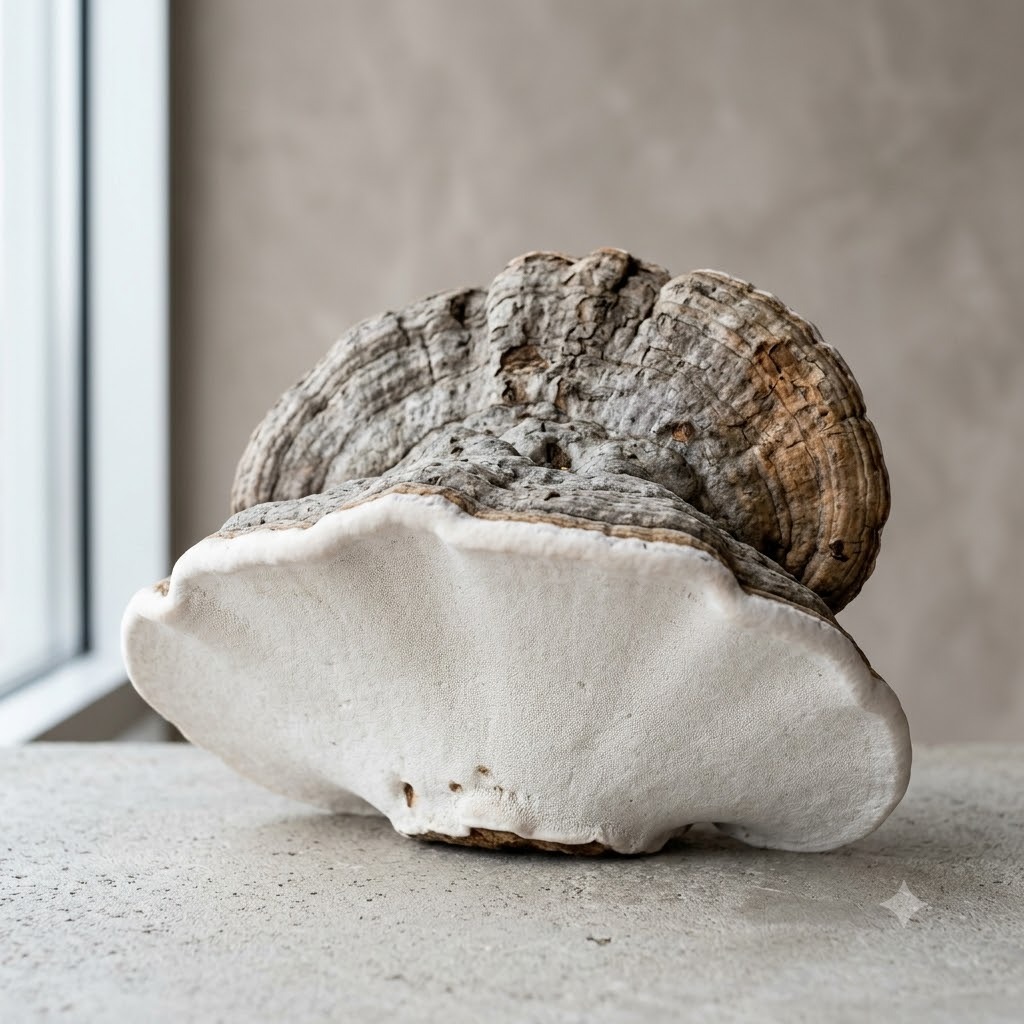
The artist's conk (Ganoderma applanatum) is the large, flat, woody bracket that grows on dead and dying hardwood trees and lives for years, adding a new layer of pores each season.
🗓️ Last reviewed: August 2026
Overview
The artist's conk (Ganoderma applanatum) is the large, flat, woody bracket that grows on dead and dying hardwood trees and lives for years, adding a new layer of pores each season. It gets its name from its most charming property: the white pore surface underneath bruises instantly and permanently brown wherever it is touched, so a sharp point draws on it like a pencil on paper, and the drawing stays for as long as the dried conk survives. Naturalists have used them as sketching surfaces for well over a century. It is far too woody to eat, but it is a good species to know, both as a common decayer of veteran trees and as a relative of the medicinal reishi, with which it shares a genus and a good deal of laboratory attention.
Identification & Appearance
The fruit body is a hard, woody, flat bracket, 10-60 cm across and occasionally larger, semicircular or fan-shaped, growing shelf-like from a trunk. The upper surface is dull grey-brown to greyish, often concentrically ridged and furrowed, hard and crusty, and frequently dusted with a thick layer of rusty brown spores shed from its own pore surface or that of a bracket above. The underside is a fine white to cream pore surface with tiny pores, and this is the key feature: press it and it bruises brown instantly and permanently. The flesh is brown, woody, and layered, and cutting a conk in half reveals annual tube layers, which can be counted like tree rings. Spore print is brown. It is perennial, unlike most brackets, and individual conks can persist and grow for many years.
Where It Grows
Artist's conk is a white-rot decayer of hardwoods, especially beech, oak, maple, poplar, and many others, and it also occurs on conifers. It grows on standing dead trees, on the trunks of living but declining trees, on stumps, and on fallen logs, and it is one of the most widespread and abundant bracket fungi across Europe, North America, and Asia. Because it is perennial, it does not have a season in the way a mushroom does; conks are present year-round and add a fresh layer of tubes and a fresh white growing margin each year, usually in summer. On a veteran tree it is often a sign of substantial internal decay, which matters if that tree is somewhere people walk or park.
How to Grow at Home
Not cultivated, and there is no reason to. It is a wood-decay fungus that will find suitable trees on its own, and encouraging it near valuable or hazardous trees would be a poor idea, since it decays structural wood in living trunks. If you manage woodland and want the species, leaving standing dead hardwood in place is the entire method. From a tree safety perspective, a large artist's conk on the trunk of a mature tree near a path, road, or building is worth having assessed by an arborist, since it indicates internal white rot even when the crown still looks healthy. That is the practical relationship most people have with this species: not growing it, but reading what it tells you about a tree.
Growing Conditions
Light
Not relevant to the fungus, which lives inside the wood and produces perennial brackets on trunks in shade or full light alike.
Watering
Growth of the new margin happens in the growing season and is favoured by damp conditions, but conks persist through drought and frost regardless. They are among the most weather-resistant fungal structures in the woods.
Temperature & Substrate
Brackets are perennial and present all year, adding tube layers annually in the warm season. The substrate is the heartwood of dead and living hardwoods, principally beech, oak, maple, and poplar.
Traditional & Practical Uses
Not a food. The flesh is woody and inedible, and no amount of cooking changes that. The main use is artistic: cut a fresh conk with the white pore surface intact, draw on it with any sharp point before the surface dries, and the bruised lines darken permanently. Dried carefully out of direct sun, the drawing lasts for decades, and conk art has a genuine following. It has also been used as a natural tinder, and the layered flesh takes dye. Beyond that, the species is used in traditional Asian medicine, where it is known as a relative of the reishi group, and it is sold as a dried tea or extract; that use is traditional rather than clinically established, and the woody material must be simmered for a long time to extract anything at all.
Health & Nutrition
There is no nutritional content of practical relevance, since nobody consumes it as food. Ganoderma applanatum has been studied for polysaccharides, triterpenoids, and other compounds, with laboratory reports of antioxidant, anti-inflammatory, and immunomodulatory activity, in line with the broader Ganoderma literature that centres on reishi. As with every entry in that literature, the honest position is that this is cell and animal work and preliminary human data, and it does not support treating any condition with a woodland bracket. If someone chooses to drink a long-simmered decoction, the main practical cautions are ordinary ones: identify the species correctly, harvest from clean woodland away from roads and treated timber, and talk to a doctor about anything that matters medically, particularly if taking blood-thinning medication, since Ganoderma species have been reported to affect clotting.
Common Problems
- Trying to eat it - it is woody and inedible. This is a drawing surface, not a dinner.
- Drawing on a dried conk - the bruising reaction only works on a fresh white pore surface. Once it dries, it will not mark.
- Confusing it with reishi - reishi has a shiny, varnished, reddish upper surface; artist's conk is dull, grey-brown, and crusty.
- Ignoring it on a garden tree - a large conk on a living trunk indicates internal decay, and near a path or building that is a safety question for an arborist.
- Brown dust everywhere - the rusty spore deposit is normal and can be prodigious.
Pros & Cons
Pros
- Unmistakable, abundant, and present year-round.
- A genuinely unique natural drawing surface.
- Long-lived perennial brackets whose layers can be counted.
- A useful indicator of internal tree decay for woodland managers.
Cons
- Completely inedible.
- Indicates structural decay in trees people may care about.
- Health claims are unsupported by clinical evidence.
- Sheds enormous quantities of brown spore dust.
Best Suited For
- Artists and crafters looking for an unusual natural medium.
- Woodland managers and tree owners learning to read decay indicators.
- Naturalists interested in perennial fungi.
Not ideal for foragers looking for food, or anyone hoping for a documented medicinal effect.
FAQ
How does the drawing actually work? The living white pore surface bruises brown where it is damaged. A sharp point makes a permanent brown line. It works only while the conk is fresh, so draw the same day you cut it.
Is it the same as reishi? Same genus, different species. Reishi has a glossy varnished red-brown surface; artist's conk is dull, grey, and crusty, and much woodier.
Should I remove it from my tree? Removing the bracket does nothing, since the fungus lives inside the wood. If the tree is near a path or building, have an arborist assess it rather than pulling the conk off.
Never eat any bracket fungus without 100% expert identification. Artist's conk is not a food species at all. Confirm identification before using it for craft or tea, and do not treat any fungus as medicine.
🪴 Foraging kit worth a look
Nothing here identifies a mushroom for you - identification stays with your field guides and local experts. These are simply the basics foragers carry.
Links go to Amazon or a partner store (such as Adagio Teas) and may earn us a commission at no extra cost to you. As an Amazon Associate we earn from qualifying purchases. We link gear types, not sponsors' picks: you choose the exact product.